
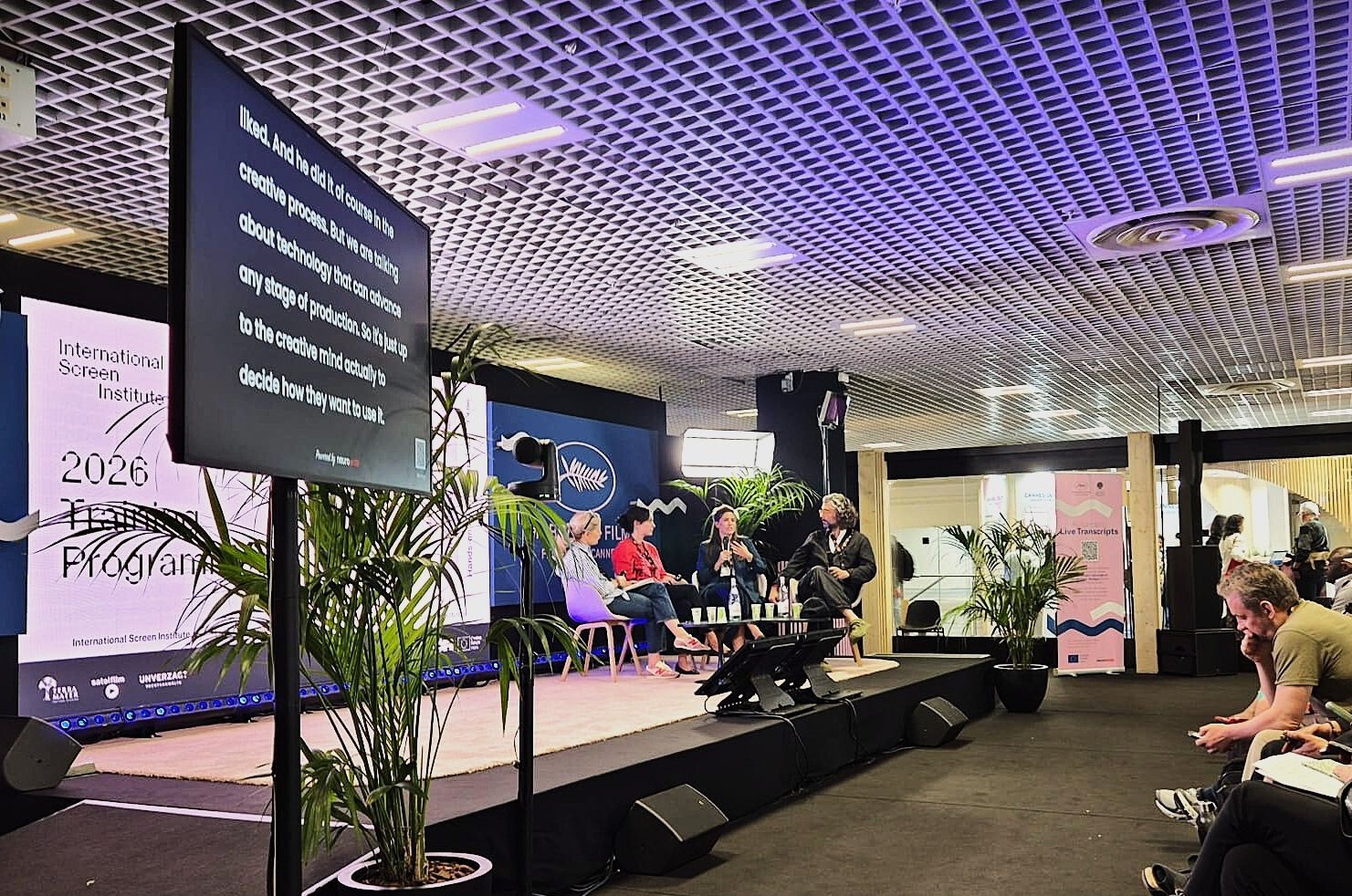
– CANNES 2026: Industry experts at the Marché du Film have discussed the legal, ethical and creative implications of integrating AI tools into filmmaking workflows
l-r: Charlotte Lund Thomsen, Margarita Grubina, Andrea Elisa Pisu and Carlo Rizzo during the panel
The rapid expansion of AI tools across the audiovisual sector is forcing producers, creatives and legal experts to rethink questions of authorship, consent and transparency, according to speakers at the Cannes Next panel “AI Meets IP: Voice, Rights and Creative Control”, presented by the International Screen Institute on 13 May at the Marché du Film (12-20 May).

Moderated by CinemaO cofounder Carlo Rizzo, the discussion brought together Andrea Elisa Pisu, legal and policy advisor Charlotte Lund Thomsen and Respeecher‘s VP of business growth Margarita Grubina to explore how AI-driven workflows are already reshaping production practices while raising new ethical and contractual concerns.
Pisu outlined the institute’s growing focus on technological transition across its training initiatives, arguing that media professionals increasingly need practical knowledge of AI systems and their implications. She explained that the organisation had expanded existing programmes – including business and legal training, audience design and market-orientated initiatives – by incorporating technology-focused components. In her view, this means combining traditional approaches with automated and data-driven tools, particularly in areas such as audience engagement and production workflows.
She also introduced “Future Ready”, a new programme launching in November and designed to help professionals navigate the technological transition affecting the audiovisual sector. Pisu stressed that the aim was neither to demonise nor blindly celebrate AI, but rather to equip creators with the knowledge required to make informed choices. “AI is just the next technology advancement,” she said, adding that creators should decide independently whether and how to integrate such tools into their practice.
The session also highlighted Austrian producer Georg Tiller’s experimental, AI-driven work and his “Prometheus Manifesto”, which “explores critically the world of AI”. Pisu described Tiller as an example of a producer who moved from “traditional filmmaking” towards experimentation with AI tools in order to expand creative possibilities and rethink the role of the producer within the value chain.
The panel then shifted towards practical industry applications through the work of Ukrainian company Respeecher, which specialises in AI-generated voice technologies for film, television and gaming. Grubina explained that the company had been developing its technology for roughly eight years, long before AI became a mainstream topic in the entertainment industry.
Presenting clips from productions involving the company’s technology, Grubina stressed that Respeecher’s approach had always prioritised ethical safeguards, and collaboration with performers and rights holders. “We never clone voices without permission from the voice owner,” she stated, noting that the company also avoids using clients’ copyrighted data to train its models and limits access to generated voice models exclusively to the client involved in the project.
She added that transparency with audiences and collaborators remained essential, particularly in an environment where AI-related backlash often emerged when productions attempted to conceal their use of such tools. Grubina cited Emilia Pérez as one example where voice-enhancement technologies had been used transparently to support a performer’s singing capabilities while preserving the intended creative performance.
Legal uncertainty and differing international regulations formed another central topic of discussion. Thomsen explained that producers were currently facing multiple concerns, ranging from the use of copyrighted material in AI training systems to disclosure obligations surrounding AI-generated content. She noted that new EU rules concerning AI transparency and deepfake labelling are expected to come into force in August, although many aspects remain legally unresolved.
While describing herself as “technology-agnostic”, Thomsen repeatedly emphasised the importance of consent, documentation and contractual clarity. “Transparency, consultation and consent” should form the basis of any AI-related workflow, she argued, particularly when dealing with performers’ voices, likenesses or personal data.
The lawyer also stressed that producers working across borders must account for differing funding regulations, broadcaster policies and legal frameworks depending on where projects are financed and distributed. Maintaining a “clean chain of title”, including detailed records of AI-generated elements and permissions obtained, would become increasingly important for financing, festival circulation and international sales, she explained.
Both Thomsen and Pisu underscored that AI tools should not be viewed as replacements for creative talent, but rather as complementary instruments requiring strong pre-existing craft skills. Referring again to Tiller’s work, Thomsen argued that successful experimentation with AI still depended on a filmmaker’s underlying artistic and technical expertise.
The panel was wrapped up by a short Q&A session.
