
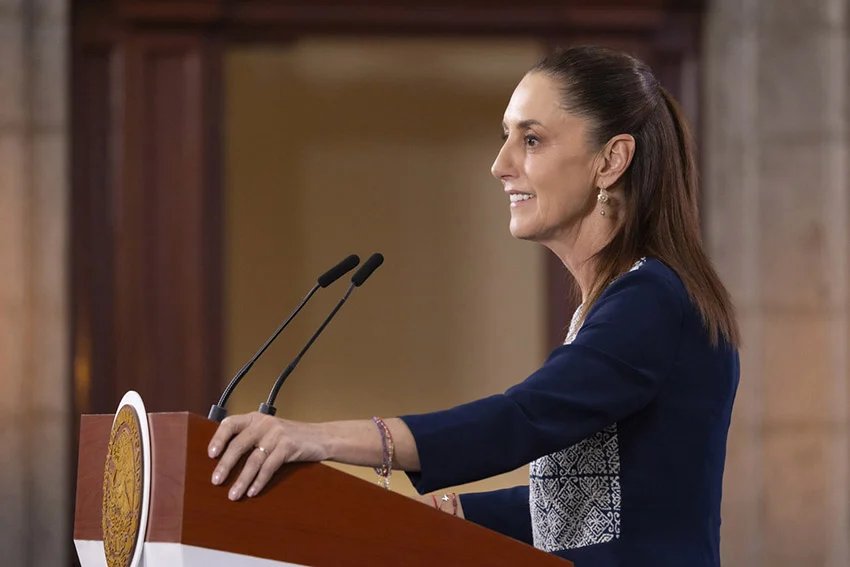
Sheinbaum’s mañanera in 60 seconds
- 🎓 Delgado stays put: Sheinbaum dismissed rumors that Education Minister Mario Delgado will resign or be fired, saying he’s doing a “great job” and pointing to plans to create 330,000 new university places. She downplayed the school calendar fiasco, saying, “There was a proposal, people didn’t agree with it, and we returned to the original proposal.” In addition, Sheinbaum accused The Economist and other outlets of blowing the affair out of proportion.
- 🇨🇳 Plan China: Tourism Minister Josefina Rodríguez unveiled a strategy to grow Chinese tourism to Mexico. The government wants China to become Mexico’s 10th-largest source of tourists by 2029, up from 14th today. Key moves include debut participation at the ITB China fair in Shanghai and a presence on Chinese social media platforms like Weibo.
- 🏙️ “Ajolotización” defended: Sheinbaum backed Mexico City Mayor Clara Brugada’s decision to plaster the capital with axolotl imagery and purple-painted pedestrian bridges ahead of the World Cup, saying the color and murals “give happiness to the city.” Not everyone agrees: One Mexico City motorcyclist told Televisa there’s still “a shitload of potholes” whose repair should take priority.
Why today’s mañanera matters
At her Friday morning press conference, President Sheinbaum responded to “rumors” that Education Minister Mario Delgado would leave his job — either by resigning or being fired.
There have been calls for Delgado to go after his announcement last week of an ill-conceived plan to end the school year 40 days early due to Mexico’s World Cup hosting duties and hot weather. The plan was abandoned, but just hours before that announcement was made, the education minister put his foot in it again by essentially saying that the last month of classes is a waste of time.
Sheinbaum has stuck by Delgado, a Morena party powerbroker, and continued to do so at today’s mañanera.
Also of note at the president’s final press conference of the week was Tourism Minister Josefina Rodríguez’s announcement of a plan aimed at attracting more Chinese tourists to Mexico, and Sheinbaum’s defense of Mexico City Mayor Clara Brugada’s decision to make extensive use of the image of the ajolote (axolotl) and purple paint to beautify the national capital ahead of the FIFA men’s World Cup.
‘Plan China’: Government aims to attract more Chinese tourists
Tourism Minister Rodríguez told reporters that tourism to Mexico from China is “very important” and the government wants to “consolidate the market.”
She said that 107,000 Chinese tourists came to Mexico in 2025, representing an annual increase of 8.2%. Rodríguez highlighted that the top ten states visited by Chinese tourists are Mexico City, México state (where the Teotihuacán archaeological site is located), Nuevo León, Jalisco, Baja California, Chiapas, Querétaro, Guanajuato, Quintana Roo and Chihuahua. She also said that Chinese tourists, in the main, are not seeking “sun and beach” (sol y playa) when they travel to Mexico, but rather “culture, gastronomy and experiences,” including ones related to Day of the Dead.
After noting that Mexico held its first-ever tourism fair in China last year, the tourism minister said her ministry’s “goal” is for China to become the 10th-largest source country of tourists to Mexico by 2029. She said that China is currently the 14th-largest source of tourists to Mexico.

As part of a tourism promotion strategy dubbed “Plan China,” Rodríguez said that Mexico, for the first time, will be represented at ITB China, a leading tourism trade fair that will take place in Shanghai later this month.
Among the other aspects of Mexico’s “Plan China” strategy are attendance at other tourism fairs in China and the presence of the official “Visit Mexico” brand on Chinese social media sites such as Weibo.
Sheinbaum rejects ‘rumors’ that Delgado will leave education minister role
A reporter asked the president about “rumors” that Education Minister Mario Delgado will leave his position.
Sheinbaum said that was not the case, before noting that she would attend a meeting with Delgado later in the day.
She said that Delgado — a former lawmaker and ex-chief of the ruling Morena party — is doing a “great job” as education minister, highlighting that he is working on a number of projects, including one aimed at creating 330,000 new places for students at campuses of the Rosario Castellano University and “other universities.”
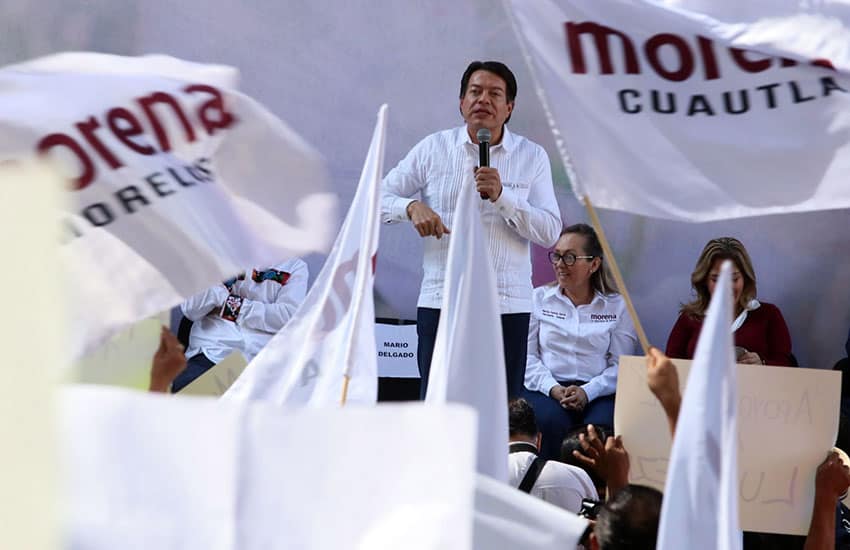
Sheinbaum played down the controversy surrounding the announcement and subsequent cancellation of the plan to end the school year almost six weeks early on June 5.
“There was a proposal, [people] didn’t agree with it, and we returned to the original proposal [to end the school year on July 15],” she said.
Sheinbaum noted that The Economist published an article on the “school calendar issue.”
“… The eyes of the world are on Mexico,” she said before suggesting the issue was blown out of proportion by The Economist and other media organizations.
“They made it big news — I mean, it’s remarkable,” said Sheinbaum, who has accused Mexican and international media outlets of deliberately seeking to damage her government.
Published under the headline “Mexico’s daft plan to cut the school year for the World Cup,” The Economist article said that the retreat on the plan to end the school year early “made it look as though the [Education] ministry was freestyling one of the most basic parts of its job.”
“The affair is a blot on Mexico’s education system, which has several serious problems,” The Economist wrote.
Sheinbaum defends the ‘ajolotización‘ of CDMX
A reporter asked Sheinbaum about the “ajolotización” of Mexico City — the extensive use of the image of ajolotes (axolotls), in murals, on light rail carriages, etc. — as well as the beautification of public infrastructure in the capital, such as pedestrian bridges, by painting it purple.
Mayor Clara Brugada has defended the ajolotización of the capital amid criticism that the city government is failing to adequately respond to real — and serious — infrastructure and transport problems.
Now dubbed ‘El Ajolote,’ Mexico City’s light rail to Xochimilco debuts its US $139M makeover
Sheinbaum told reporters that “all governments paint pedestrian bridges … and Clara decided that in order to beautify the city she was going to use the color lilac” — which matches the flowers of Mexico City’s ubiquitous jacaranda trees, and is not too dissimilar to the political color of Morena.
“Now there is great criticism, I don’t see why,” she said. “In addition, the truth is the bridges look very beautiful.”
Sheinbaum also said that the use of color and the painting of murals on streets and in other public spaces “gives happiness to the city.”
“It makes it beautiful and that greatly changes the mood of those who live in the city,” she said.
Sheinbaum also noted that “Brugada chose the ajolote, an animal endemic to the Valley of Mexico, as a symbol of the city.”
“I don’t know why there is so much criticism,” she said.
One Mexico City resident who spoke to the broadcaster Televisa said that the government should first focus on fixing streets in the capital, rather than painting pedestrian bridges purple.
“There is still a shitload of potholes,” said Gerardo Franco, a motorcyclist.
“They should focus on what society really needs,” he said.
By Mexico News Daily chief staff writer Peter Davies (peter.davies@mexiconewsdaily.com)
