
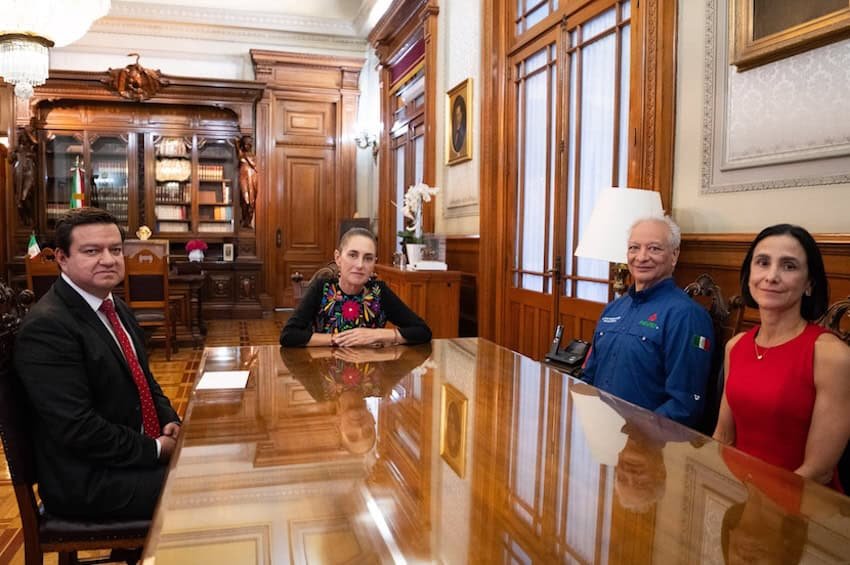
President Claudia Sheinbaum appointed Juan Carlos Carpio to be the new director of Mexico’s state-owned oil company after the embattled former CEO stepped aside on Thursday.
Víctor Rodríguez resigned to return to his academic pursuits and will continue to support the government from the Institute of Electricity and Clean Energy, Sheinbaum said.
El nuevo director de Pemex no es petrolero, es un hombre de números.
Juan Carlos Carpio Fragoso es economista por la UNAM, tiene una maestría en Gerencia Pública por el CIDE y prácticamente toda su carrera estuvo ligada al manejo de dinero público, deuda y finanzas… pic.twitter.com/cs7HesrfFH— Aristegui Noticias (@AristeguiOnline) May 15, 2026
Characterized as a resignation, Rodríguez’s departure was considered a foregone conclusion even before credit ratings agency S&P on Tuesday revised Mexico’s outlook to “negative,” citing the government’s continued fiscal support of the debt-ridden oil company.
S&P reaffirmed Pemex’s credit rating (“BBB” with a negative outlook), but acknowledged that its “capital structure is unsustainable, given its low liquidity and high leverage.”
Rodríguez faced considerable criticism in April over a massive oil spill that affected almost the entire southern half of the Gulf of Mexico.
After initial denials that Pemex was responsible, Rodríguez confirmed on April 16 that a pipeline belonging to the state-owned oil company was the primary source of the disaster, but insisted he was unaware of the problem and was misled by his subordinates.
Despite this, Sheinbaum said the oil spill had nothing to do with the change of leadership at Mexico’s flagship company.
In a video released Thursday night on social media entitled “Relevant news,” (shown here in Spanish), Sheinbaum explained that Rodríguez’s departure was premeditated.
“When I won the election I asked Víctor to come help me at Pemex and he said, ‘I’m busy at the [national university], it’s going to be very difficult,’ but … after thinking about it, he told me, ‘Yes, I’ll help you, but on one condition, only a year and a half’,” she said.
Sheinbaum and Rodríguez have known each other for decades, studying physics at the National Autonomous University (UNAM), collaborating on academic projects and publishing papers together on energy matters while working at the Faculty of Sciences.
Sheinbaum tapped Rodríguez to head Pemex “to boost Pemex’s profitability and rescue the company from ballooning debt and recurring accidents,” calling him “an expert in energy economics and policy.”
For his part, Rodríguez said it was an honor to have served in Sheinbaum’s administration, saying “I retire with the satisfaction of having served with honesty and commitment.”
The newspaper El País reported that Rodríguez had twice submitted his resignation last year only to have Sheinbaum refuse to accept it.
In addition to the environmental disaster in the Gulf, Rodríguez’s tenure at Pemex was marred by a fatal accident at the Olmeca refinery in Tabasco, the failure to manage the company’s persistent debt while unable to attract foreign capital, significant financial issues including losses of US $2.6 billion in 1Q 2026 and declining oil production.
In January, Pemex reported a debt of approximately US $84.5 billion, a 13.4% decrease compared to 2024. The reduction was achieved due to the support of nearly US $22.65 billion granted last year by the Finance Ministry for debt repurchases and the issuance of pre-capitalized notes.
The appointment of Carpio, formerly Pemex’s finance director, must be approved by the Pemex Board of Directors.
An economist trained at UNAM, Carpio is close to Energy Minister Luz Elena Gonzalez, for whom he worked when she was head of Mexico City’s finances during Sheinbaum’s tenure as mayor of the capital.
With reports from Reuters, The Associated Press, La Jornada, Infobae and N+
