
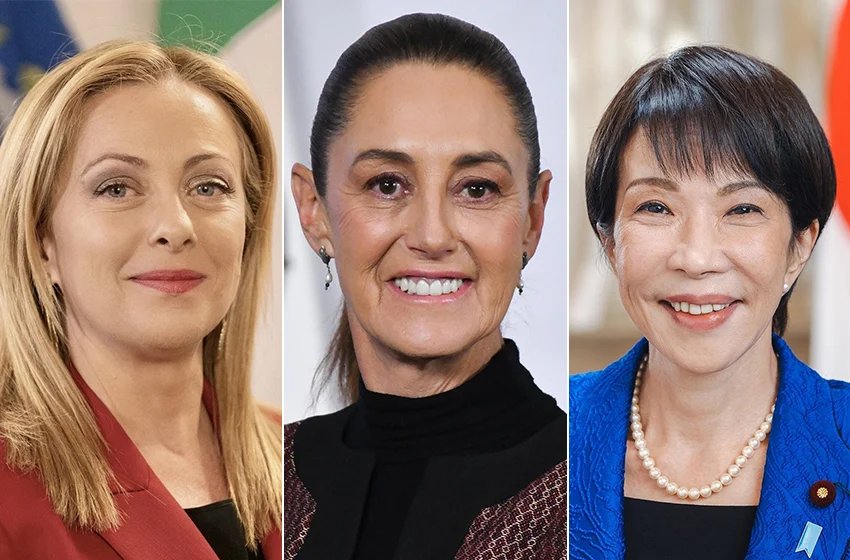
Let me start with a confession. When I was first asked to compare Claudia Sheinbaum, Giorgia Meloni and Sanae Takaichi, my instinct was to push back. The piece felt like the kind of thing you write about women that you would never even think to write about men. Nobody, as far as I know, has published a piece comparing Macron, Xi Jinping and Trump on the grounds of them being males in positions of power. Beyond the fact that they are all women leading their countries, what is the basis for putting them in the same sentence? They disagree on almost everything: migration, climate, gender, China, the role of the state. Treating them as a category because they share a chromosome felt reductive.
Female heads of government are not news in themselves, either. Thatcher, Merkel, Bachelet, Indira Gandhi, Jacinda Ardern. The list is long, the ideological span runs from hard-right to socialist, and that already tells us something useful: Being a woman predicts almost nothing about how someone will govern.
So why bother?
Because the more I sat with the assignment, the more the discomfort was the point. In a world where machismo is not the exception but the operating system — in Mexico, in Italy, in Japan — the fact that three of the world’s largest economies are simultaneously led by women, each the first ever in her country’s top job, is genuinely remarkable. Thatcher, Merkel and Bachelet broke their ceilings one at a time, decades apart.
What is new in 2026 is that all three breakings happened almost at once. That is rare. And when history clusters its exceptions like this, I think it is usually trying to say something about the rules they’re breaking.
Three women, three doorways
Giorgia Meloni grew up in working-class Garbatella, raised by a single mother after her father walked out when she was a baby. She joined the youth wing of Italy’s post-fascist movement at fifteen, never went to university, and in 2022 became the first far-right head of government in Western Europe since 1945. Hers is now the third-longest-serving government in Italian republican history.
Sanae Takaichi was a heavy-metal drummer in college and remains a vocal Iron Maiden fan. Her three declared political heroes are Margaret Thatcher, Shinzo Abe and Ronald Reagan. Protégée of the assassinated Abe, she won the leadership of Japan’s ruling LDP in October 2025; in February 2026 she gambled on a snap election and won a two-thirds supermajority, the largest ever for a single party in the lower house. The Economist promptly called her “the most powerful woman in the world.”

Claudia Sheinbaum is the daughter of two scientists who were also activists in Mexico’s 1968 student movement. She was a student activist in the 1980s and spent time at Berkeley while working on a Ph.D. on energy use in Mexico’s transportation and building sectors. In June 2024 she won 35.9 million votes — close to 60%, the largest absolute count in Mexican history — and used her constitutional supermajority to pass six amendments in her first three months in office.
What they share — and it isn’t what you’d think
Despite ideological distance, three patterns repeat. None came from a political dynasty. All three built their careers outside the inner circles of their establishments — and may govern with that outsider impatience because they did not inherit the system, so they owe it less. Each succeeded a charismatic male predecessor whose shadow still defines the landscape: AMLO for Sheinbaum, Abe for Takaichi, Berlusconi for Meloni. Managing a male predecessor’s ghost — invoking him when useful, distancing oneself when necessary — is one of the most consistent challenges of female leadership in major economies. And none campaigned on gender, yet all three are judged through it: Meloni’s voice is “shrill,” Takaichi’s marriage history is dissected, Sheinbaum is “cold” and “robotic.” Descriptors that almost never travel to male leaders.
How each is actually governing
Eighteen months into Sheinbaum’s term, three-and-a-half years into Meloni’s, and six months into Takaichi’s, we have enough material to evaluate not just their arrivals but their actual records. The scorecard below tracks six dimensions; four are worth pulling out in prose.
On the economy, all three have so far avoided crises. Italy under Meloni has grown slowly — projected GDP growth of 0.6%-0.8% — but kept its deficit near 3% and absorbed €194 billion (US $226 billion) in EU recovery funds. Mexico under Sheinbaum has held macroeconomic stability through a turbulent year: Foreign direct investment hit a record $36 billion in the first half of 2025, the major credit rating agencies have all kept Mexico’s rating intact, and growth has been sluggish at around 0.7%. Japan under Takaichi has rolled out a roughly $134 billion stimulus, heavy on semiconductors, AI and strategic technology — too early to judge results, but large enough that markets are paying attention.
On security and sovereignty, the three look most different. In Mexico, perceived insecurity remains the country’s top concern: 48% of Mexicans named it the country’s main problem in March, even as government data has reported falling homicides since October 2024. In Italy, Meloni’s government issued more than 450,000 migrant work permits between 2023 and 2025 — a quietly pragmatic policy that contradicts her hardline rhetoric. In Japan, Takaichi has redefined the country’s posture more dramatically than her domestic predecessors: She accelerated the timeline to reach 2% of GDP in defense spending, lifted decades-old restrictions on lethal weapons exports, and broke long-standing strategic ambiguity by stating that a Chinese attack on Taiwan could trigger a Japanese military response. Beijing retaliated with flight cancellations, seafood import bans and increased military patrols.
And then there is the Trump factor.
Trump’s relationship with Meloni was, until early this year, the warmest of any European leader’s; she was the only one to attend his second inauguration. That changed in April, when Trump publicly attacked her over her support for Pope Leo XIV and her position on the Iran war, calling her “much different than I thought.” The relationship has cooled. Takaichi has been more careful. She has kept the relationship warm but said little, and six months in, I think Washington still cannot quite tell what kind of partner she is going to be. That ambiguity is probably her foreign policy at the moment.
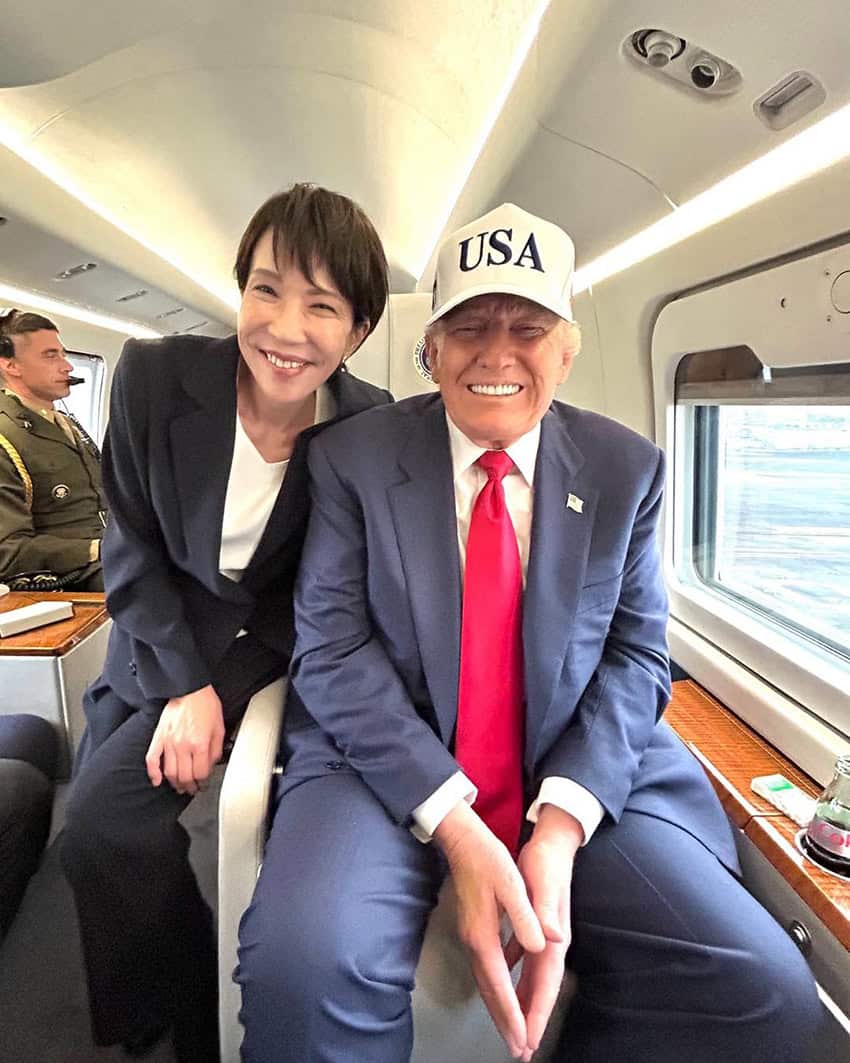
Sheinbaum, by contrast, has executed what most analysts now consider a textbook performance under impossible pressure. She has avoided retaliatory tariffs; secured at least three separate extensions on Trump’s tariff deadlines; kept USMCA largely intact through repeated 25%, 30% and 35% threats; and, according to multiple reports, earned the personal respect of Trump and his inner circle, including Stephen Miller. Her formula has been to keep a cool head and maintain mutual respect. She publicly emphasizes that “dialogue and respect have prevailed” while quietly tightening cooperation on fentanyl interdiction, migration and — controversially — imposing tariffs of up to 50% on roughly 1,400 goods from China and other Asian countries without trade agreements with Mexico, a move that aligns Mexico with U.S. concerns about Chinese transshipment. So far, only Sheinbaum has so far managed to turn the experience of being cornered into something that looks like a strategy.
Finally, on the question this article is really asking — what each has actually delivered for the women coming after — the contrast is sharp. Meloni and Takaichi run conservative governments that have actively rolled back, or refused to advance, gender-related rights: Meloni has tightened reproductive politics and restricted LGBTQ+ family rights; Takaichi opposes same-sex marriage, separate marital surnames, and female imperial succession. Sheinbaum is the only one who openly identifies as a feminist; she elevated the women’s affairs body to a full Ministry and has pushed substantive-equality reforms — though Mexican feminist movements remain critical of how much of that agenda has been substantive versus rhetorical.
The harder question
So we have three women, three exceptions, three different politics. The interesting question is no longer whether their gender matters — it clearly does, in the obstacles they have faced and the scrutiny they receive — but whether their gender is producing different outcomes. And the honest answer, eighteen months in, is: I cannot really see it. Not yet, anyway. Not in the ways we were promised.
There are two competing theories. The optimistic one says women in power govern differently: more cautious, more consensus-driven, less prone to the testosterone-fueled brinkmanship that produces wars, market crashes and constitutional crises. The skeptical one says the opposite: women who reach the top in male-dominated systems do so precisely by out-hawking the men. They have to be tougher, more disciplined, more willing to break things, because the margin for error is smaller. Thatcher, the original Iron Lady, is the patron saint of this theory.
So look at our three. Each one shows us, in her own way, what governing actually costs. And what they show is not as neat as we might like.
Meloni has been smarter than her rhetoric. She governs to Berlusconi’s right on migration but to his left on Europe — this is calculated moderation, not a softening. The 450,000 migrant work permits she quietly issued between 2023 and 2025 are the gap between the speech and the governing. Isn’t this the most interesting thing about her premiership? Then in April 2026, when Trump pressured her over Pope Leo XIV, she stood with the Pope. You can disagree with everything else she has done and still recognize that for what it was: a leader choosing conviction over advantage, which is rarer than it should be.
Takaichi has done in six months what three decades of Japanese prime ministers would not attempt. She has accelerated rearmament, broken strategic ambiguity on Taiwan, and visited the Yasukuni shrine in a way her male predecessors only dared in private. Whether that is courage or recklessness, we will only know later. What is harder to argue is that she did not know what she was doing. She knew and did it anyway. In a moment that confuses noise with strength, a leader who acts quietly but forcefully is worth watching.
Sheinbaum’s record under pressure is the most instructive of the three, because the pressure on her has been the most relentless. She has never raised her voice or lowered her standards — a rare trait in Mexican politics. She held the line against Trump’s tariff threats by acting as if the line did not need to be defended — which, as it turned out, was the right way to defend it. Judicial reform is where admiration gets complicated, but in the first days of April we learned that Morena congressmen are proposing an update, which could address some key concerns of judicial reform critics. Anyhow, history grades on what gets left standing, and we will not really know that for years.
This is going to sound like a joke except it isn’t. Three women walked into the hardest rooms in the world. One chose conviction over favor. Another chose action over approval, even when the action was the kind that closes doors permanently. The third chose “cabeza fría” over confrontation, and turned it into the most underrated form of leverage of the year. None of them looks particularly cautious. None looks consensus-driven. All three look, in their own ways, like leaders who reached the top by being harder than the men around them — and who are governing accordingly. That is not a failure of female leadership. It may be the most honest demonstration we have ever had of what the top of politics actually requires of anyone, regardless of gender. None of them chose easy, because none were offered easy.
I think this is the real finding. The table doesn’t change because of who sits at it. The people who sit at it may not share an ideology, or a background, or even an ambition the rest of us would recognize. What they share is the loneliness of those who got to the top and found out power is nothing like they had been told. In a few decades, we will discuss their legacies and get to a fair scorecard. Hopefully by then we will be talking about the office itself — what it selects for, what it rewards, what it slowly asks you to give up in exchange for keeping it. They didn’t invent those terms. They, like us, inherited them.
Let us know what you think in the comments.
Maria Meléndez writes for Mexico News Daily in Mexico City.
