
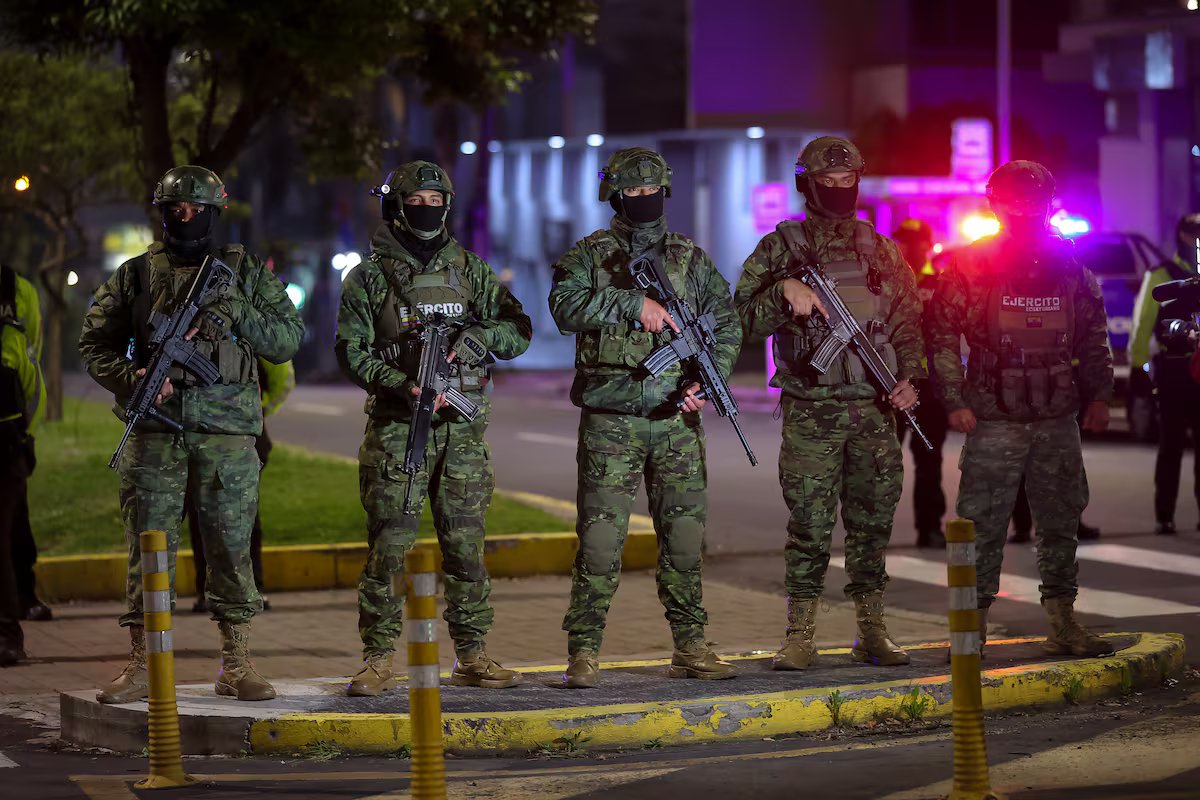
In two and a half years, Ecuador has spent 846 days under a state of emergency, almost the same amount of time that Daniel Noboa has been in power. During this period, the president has restricted people’s free movement for 272 days, decreeing seven curfews, which the government has maintained as its main strategy for combating violence. For the authorities, the supposed success of the initiative is measured by the number of people arrested: during the 15 days of the curfew last March, 1,283 people were apprehended for violating the measure, and homicides were reduced by almost 30% during the early morning hours.
Even so, the country is experiencing its seventh curfew since this government took office, and although government spokespeople announce the measures in advance, some people are only now finding out that their daily routine will be disrupted once again. Like Vanesa Cervantes.
Cervantes lives in one of Guayaquil’s most dangerous neighborhoods, on the banks of the Salado Estuary. There, some times of the year it feels more like a war zone. Gunfire erupts at any hour, robberies are constant, and the tension seems endless, never allowing anyone to let their guard down. For her, life in the neighborhood boils down to a single rule: see no one, hear no one, speak to no one. It’s a constant state of anxiety. Curfews, she says, haven’t brought any more security. She watches her neighbors — those who leave for work early in the morning — lock themselves inside before nightfall, but she never sees military or police patrols on the streets.
For Cervantes, the curfew is already the new normal, even though it disrupts her daily routine. “Buses are running almost an hour late, and you have to fight for a seat to get on because everyone is late for work,” she explains. She also has to incur unexpected taxi expenses to get to work on time.
In the nine provinces and four cities where the latest curfew is in effect, life has changed dramatically. Public transportation starts running later, and that change alone has altered people’s daily routines. In Quito, for example, schools have had to adjust their start times. Businesses that used to stay open late now have to pack everything up well in advance, because they must factor in the time it takes employees to get home. The same is true for cinemas, theaters, restaurants, and entertainment venues. Some events have even had to be canceled for fear of low attendance.
Nighttime commerce, logistics services, and freight transport have also been directly impacted by the curfew between 11:00 p.m. and 5:00 a.m. This coincides precisely with their operating hours. During the day, trucks are prohibited from circulating in urban areas in most cities. Since the measure was implemented, many truckers traveling to Pichincha — the only Andean province under curfew — are stranded at the border and forced to sleep in their trailers, exposed to the dangers of the road. Everything comes to a standstill and then speeds up within the 18 hours during which movement is permitted in Ecuador.
Cervantes has learned to adjust her routine to this new normal: leaving work and returning to confinement. She has already accepted that in Guayaquil — one of the most dangerous cities in the world — one must live with violence. Sociologist Natalia Sierra believes that this “normalization” is a product of the population’s exhaustion, not only due to the violence of criminal groups, but also due to state violence. “It has to do with an unconscious strategy of resistance; if we don’t resist, if we consciously live with this pressure of violence, it can lead to a psychiatric crisis,” the expert believes.
This self-protection routine is evident in small, automatic gestures like walking with a purse or backpack pressed against the chest, avoiding talking on the phone in the street, and being wary of anyone next to you, anyone staring too much, or anyone riding a motorcycle. Cervantes says that, over time, she has even learned to identify patterns in criminal behavior. For example, on the 15th and 30th of each month, when companies pay salaries, no one carries valuables. “Thieves know that those are the days when those of us who work receive our paychecks, so they are the worst days to be on the street or to get on a bus with money or your phone,” she explains. She leaves everything at home, carrying only a light backpack with a t-shirt or an empty wallet, just to give the impression that she has something, because even having nothing to hand over can cause criminals to become agitated and violent.
“We’ve normalized a constant state of vigilance,” Sierra says. “The anxiety of walking while looking behind us, constantly checking if someone is following us, touching our bags to make sure they’re still there. We live attentive to every movement. And when that becomes commonplace, what really becomes normalized is violence.”
In the last five years, violence in Ecuador has increased sharply. The country went from having one of the lowest homicide rates in Latin America to exceeding 50 murders per 100,000 inhabitants in 2025, the most violent year in its history.
This surge coincides with a regional context in which insecurity and violence are pressuring Latin American governments to implement harsher measures to combat organized crime. At the same time, Washington’s anti-drug policy has found a strategic ally in the Noboa administration. Among the most controversial joint operations are the air and maritime attacks in Ecuadorian waters.
So far in 2026, fishermen from three boats have reported being bombed by drones and captured by “gringos.” Thirty-eight fishermen survived the attacks, while eight remain missing. The Ecuadorian government has not denied that the United States is conducting operations in Ecuadorian waters, but neither has it confirmed the bombings.
According to Sierra, Ecuador lacks a national plan outlining the type of security it seeks. She sometimes even believes the government doesn’t want to combat the violence or the fear it instills in the population — a fear that keeps people “still,” she asserts. “Fear is a tool of control. It mobilizes people to where those in power want them to go, to carry out projects that serve their interests. Because fear paralyzes, and part of that is the normalization of violence.”
Cervantes, on the other hand, is no longer interested in the results of the seventh curfew imposed in recent years. Nor does she believe that this time it will bring back the peace she once had. Especially since, in the first week since the measure began, not a single day has passed without the silence of confinement being abruptly broken in several Guayaquil neighborhoods by gunfire after 5:00 a.m., just when the curfew is lifted. The routine of fear and vigilance never rests.
Sign up for our weekly newsletter to get more English-language news coverage from EL PAÍS USA Edition
