
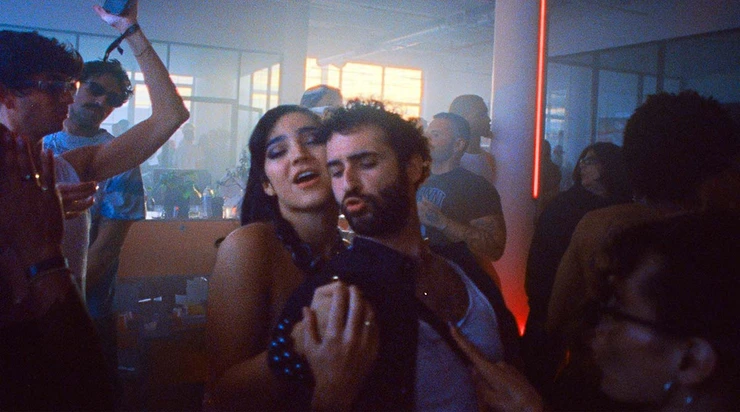
Films written, directed by and starring the same person tend to fall into two camps: horribly mediocre, or worse. Then sometimes, the three roles manage to complement each other, and you get something genuinely memorable, and fortunately, Club Kid, premiering at the Cannes Film Festival 2026, cements Jordan Firstman, star of HBO’s I Love LA and various Instagram lives during COVID, as a major triple threat.
Firstman plays Peter, a down-on-his-luck queer man and washed-up party promoter in contemporary Brooklyn. In a 2016 flashback, he’s in his element as the life and soul of the nightclub scene, parading about with an equally chaotic entourage (Cara Delevingne amongst them). When two British girls – nicknamed “Innit Babes” by Peter’s crew for their repeated use of the phrase – make an advance whilst off his face on MDMA, Peter treats one of them to a quick fumble in the dark room.
Ten years later, we find Peter entering his mid-thirties, just as chaotic and starting to feel like he should know better, when one of the Brits (scene-stealer Kirby Howell-Baptiste) reappears on his doorstep with Arlo (Reggie Absalom), his biological child from the tryst. She’s not the mother, but the mother’s friend, come to drop Arlo off into his reluctant dad’s hands following the mother’s death a week ago. “You get a kid, good to go! You’re good, babes! Bye!”
It’s a fairly cookie-cutter premise – a person who doesn’t have their life together gets lumbered looking after a child. Maybe they’ll learn a lesson on the way? But Club Kid offers a new dynamic to that time-old tale and is commendably void of cliché. Peter’s reaction to this new development feels wholly real – initially, trying every avenue to get out of it, then gradually acclimatising and reaching a point where life without Arlo is unimaginable, and his presence in the LGBTQ+ club scene really shifts this idea into another direction than it could have gone. Yes, we’ve seen this story happen before – Kramer vs Kramer, Raising Helen, Goodnight Mister Tom – but never to a man like this, in this environment, at this time. It suggests that sometimes the thing that might be best for us might be the one thing we couldn’t possibly assume, and that’s a message worth hearing.
It’s also pleasing to see this crowd of Peter’s LGBTQIA+ friends all take Arlo under their wing. “I love the dolls!” Arlo remarks, already well aware of the lingo. Peter’s chosen family, who might just be sidelined to silly side-characters in a lesser film, all have clout and substance. Even the downstairs neighbour, Evelyn (Coleen Camp), and Peter’s trademark bonkers roommate (Eldar Isgandarov channelling a queer Azerbaijani Rhys Ifans in Notting Hill) get a proper plotline rather than jokey one-liners, making them more than just lazily-written oddballs inserted here for the lols. It’s also good to see a film with a gay lead and supporting characters that isn’t purely about that. Peter’s queerness is part of his life, but not the only facet of it, folded deeply into it as it usually is. It isn’t the story; it simply informs the story.
The film also admirably manages to avoid depicting the club scene as demonic – in fact, it presents it as a place of community. It’s not the sole source of Peter’s problems if he could only just escape it – it’s just that it doesn’t quite serve him in the same way anymore. As he continues playing that same role of Party Animal in his mid-thirties, he seems steadfastly aware that it lacks the same value it once held. One scene showing him still dancing on his own after the club lights have all turned on and the cleaners are busy sorting the venue out, hits hard, if a little on-the-nose. Given that the club scene is often how queer people find their tribes in big cities, the constant depiction of it as a drug-fused, debauched nightmare always feels like a tough – yes, pill to swallow.
The film loses some points for not probing further into the reality of its premise. The concept of calling child services (especially with the blatant VISA issues) is referenced briefly but never again. Arlo’s mum is said to have committed suicide a week earlier, but little time is spent on how this might have impacted him. He feels absurdly adaptable for a 10-year-old whose mother has recently died, shipped to New York a day later and forced to live with a man he’s never met.
In Kramer vs Kramer, which took a similar line, there are scenes of real turmoil between Dustin Hoffman’s character and his son, the famous “I want my mommy!” “Well, I’m all you’ve got!” scene does this effectively, as they try to navigate this new way of existing around each other. There is a noticeable absence of any friction whatsoever between Peter and Arlo, save for one short scene in a park, though it’s swiftly glossed over. Arlo seems more of a symbol for Peter’s growth than anything else, and it’s the film’s loss.
When it works, though, it really works. There are moments of deep poignancy as they get to know each other, never quite blossoming into a standard father-and-son dynamic, though it becomes warmly fraternal. When Arlo eventually calls Peter “Dad,” it doesn’t feel trite. In taking such a well-trodden idea and transforming it into something distinctly unique, Firstman has done a brilliant job. The film will mark his shift from Internet comedian and Rachel Sennott’s co-star to a true standalone talent.
★★★★
In UK cinemas soon / Jordan Firstman, Cara Delevingne, Diego Calva, Reggie Absalom / Dir: Jordan Firstman / Stay Gold, Topic Studios
Discover more from
Subscribe to get the latest posts sent to your email.
