
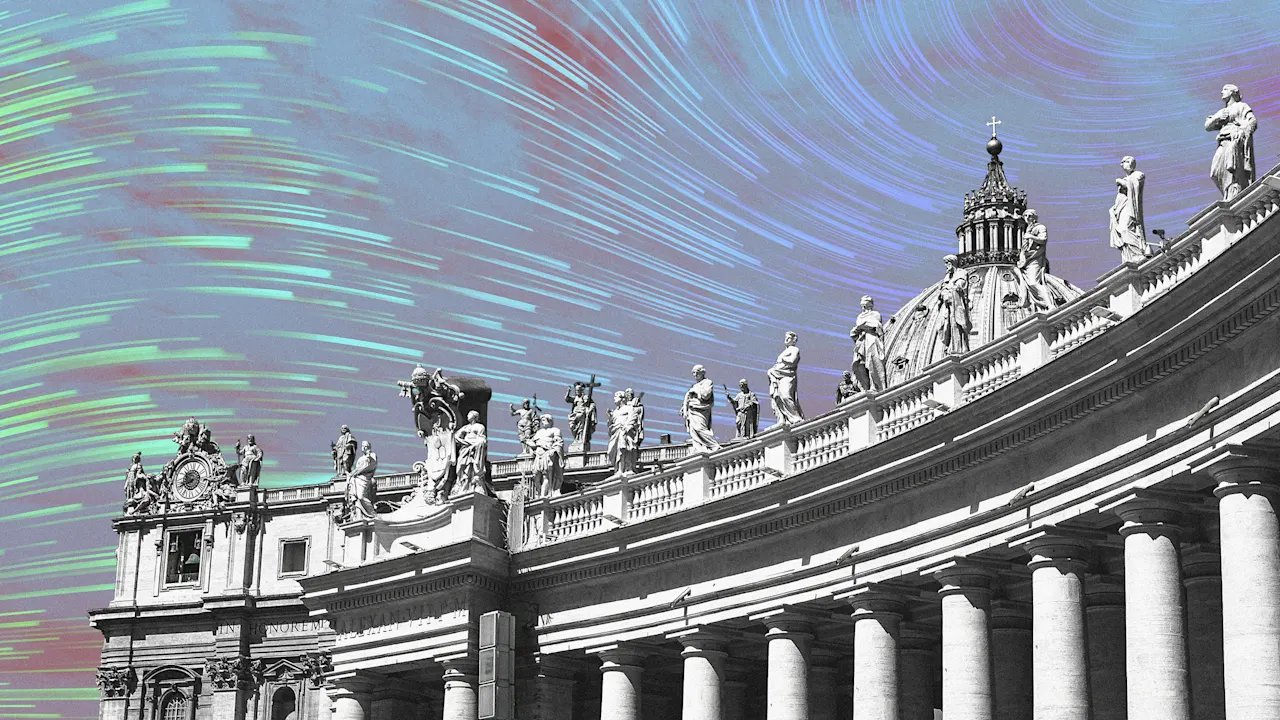
In a recent speech at Rome’s La Sapienza University, Pope Leo XIV warned that investments in artificial intelligence and high-tech weapons could push the world into what he called a “spiral of annihilation.”
Leo has identified AI as a critical issue for humanity and is expected to soon release a papal encyclical (a kind of open letter on Catholic doctrine) addressing the subject. His concerns reflect a broader debate taking shape across religious communities: Though artificial intelligence in its current form has only been in the marketplace for a few years, religious leaders and scholars from traditions stretching back centuries or more have already weighed in on the technology.
While perspectives naturally vary across faiths and, in some traditions, between sects and congregations, many discussions have focused on the roles AI can and can’t play in religious teaching and study. Additionally, scholars are examining its implications for human labor, society, and the environment.
AI and religious teaching and practice
Some clerical leaders have experimented with using AI to draft sermons and other religious materials, while some faith communities have built chatbots designed to answer doctrinal and ethical questions. A team that included researchers from Kyoto University has even deployed a robotic Buddhist monk, dubbed the “Buddharoid,” at a temple in Kyoto, where it can assume postures associated with prayer. The project comes as Japanese Buddhism, like some other religious traditions around the world, faces declining numbers of adherents. Other developers have created AI versions of spiritual figures, including emulations of Jesus, the Virgin Mary, and even Satan.
But other leaders have been more cautious about how AI should be used in religious practice, often emphasizing the unique relationship between humans and the divine. R. Albert Mohler Jr., president of the Southern Baptist Theological Seminary, recently told Decision magazine that a pastor who uses AI to write a sermon (versus using it for research) is essentially committing plagiarism.
“Let’s just state the theological obvious: A pastor is a human being who is called to study God’s Word, to hear God’s Word, to preach God’s Word, and to obey God’s Word,” Mohler said. “A machine is called to none of those things and capable of none of those things.”
The Church of Jesus Christ of Latter-day Saints noted late last year that AI “cannot replace the gift of divine inspiration or the individual work required to receive it,” indicating that AI can be used for tasks like research, editing, and translating but not to “replace the individual work and spiritual guidance required to prepare divinely inspired talks, lessons, prayers, or blessings.”
Pope Leo recently called on priests to avoid “the temptation to prepare homilies with artificial intelligence,” arguing that AI “will never be able to share faith.”
Still, other Christian organizations have developed AI for purposes like training for missionary work and even answering questions about scripture. More than 600,000 people have used FaithBot, an AI tool launched by the Southern Baptist Convention’s International Mission Board last year, for instance.
Overall, according to a survey from evangelical research organization Lifeway Research, only about 10% of U.S. Protestant pastors say they’re regular users of AI, with another 32% experimenting with it. Another 18% are actively avoiding it, while 20% are ignoring it, according to the survey. Pastors expressed concern about errors in AI content, while 55% agreed with a statement that “God has always shared His Word through people, and AI isn’t a person.”
Protestant churchgoers surveyed are divided over the technology’s use in sermon preparation: About 44% say they don’t see anything wrong with pastors using it to prepare sermons, but 43% disagree. They’re also divided on the merits of hearing a sermon about “applying biblical principles to AI,” with younger churchgoers more likely to say such a presentation would be valuable. About 61%, though, say they’re concerned about AI’s influence on Christianity.
Similar questions apply in other religions, with AI tools readily available for studying a variety of religious texts from essentially all major traditions, even amid concern that their responses may lack nuance, human wisdom, and divine inspiration.
Rabbi Yehuda Shurpin, author of a question-and-answer column for Chabad.org, recently weighed in, saying that AI can’t “replicate the depth of human connection required for spiritual counseling and support” or substitute for a rabbi on questions of Jewish law. And Egyptian religious authorities have warned against the use of AI in interpreting the Quran, while writers for the Yaqeen Institute for Islamic Research recently cautioned allowing AI to devalue religious scholarship.
“In the Islamic tradition, knowledge has never been an exercise in processing information; it is a moral and spiritual pursuit rooted in sincerity and realized through meaningful application,” wrote Mohamed AbuTaleb, Ibtihal Aboussad, and Kenan Alkiek. “Knowledge should draw us closer to Allah.”
AI and labor
Multiple religious leaders have expressed concerns about AI’s potential role in replacing human labor from both a theological perspective and a humanitarian one, with the pope recently advising that AI should be a tool to serve flesh-and-blood humans, not replace them.
Mohler, of the Southern Baptist Theological Seminary, discussed “the possibility that AI could take away meaningful work and jobs from human beings who, as we see in the earliest chapters of Genesis, were made in God’s image and were made to work.”
Conflating humans and AI can also risk devaluing human labor in general, some religious leaders say. Daniel Daly, executive director of the Center for Theology and Ethics in Catholic Health, recently warned that a human may come to be viewed as a “machine to be used.”
And the technology’s occasional tendency to regurgitate existing material without properly citing or compensating the people behind it can disrespect those authors and go against religious precepts, warned Rabbi Geoffrey A. Mitelman in a recent article. Other religious leaders have expressed concern about AI and copyright, too: “Islamic ethics place a high value on fairness and the protection of property,” the Yaqeen Institute authors noted.
AI accuracy remains a concern as well, with hallucinations far from a solved problem. The Church of Jesus Christ of Latter-day Saints counseled last year that church leaders shouldn’t turn to AI to give church members advice on “medical, financial, legal, or other sensitive matters,” suggesting they turn to trained human professionals instead.
Nor, say some religious leaders, can AI replace human creativity. “Artificial intelligence has certainly opened up new horizons for creativity, but it also raises serious concerns about its possible repercussions on humanity’s openness to truth and beauty, and capacity for wonder and contemplation,” Pope Leo said in December, warning about the displacement of human labor and the abandonment of God-given talents.
While AI, in theory, can provide more time for rest and leisure, allegedly labor-saving devices certainly haven’t always done so, writes pastor and technology scholar A. Trevor Sutton in Christianity Today. True rest, he suggests, comes from following religious commandments to seek it—not simply from putting machines to work for us.
Additionally, Jewish scholars have begun to weigh in on how and when AI may be used during the Sabbath, when work is generally forbidden, citing precedent from prior technologies.
Social and environmental justice
In a 2021 essay, Soraj Hongladarom, a philosophy professor at Chulalongkorn University in Bangkok, argued that ethical AI development can follow the Buddhist principle of seeking to eliminate world suffering.
Some religious leaders hope for AI’s help in addressing humanitarian issues—from developing new health treatments to boosting food and industrial production. In 2023, Southern Baptist officials sought to “acknowledge the powerful nature of AI and other emerging technologies, desiring to engage them from a place of eschatological hope rather than uncritical embrace or fearful rejection.”
But many faith communities have expressed concern about the negative aspects of AI, including labor issues, AI’s use in combat, the potential for generating misinformation, and the environmental costs of deploying sprawling new data centers.
The pope recently warned that military AI should be monitored “so that it does not absolve humans of responsibility for their choices and does not exacerbate the tragedy of conflicts.” The World Council of Churches has similarly warned about the risk of “killer robots,” or autonomous weapons systems, to human life.
Jewish scholars frequently compare modern technology and AI to the centuries-old legend of the golem, a clay creature who is brought to life to act as an obedient servant or protector but (in most stories) eventually becomes independent of its masters, spiraling out of control and wreaking havoc.
Furthermore, religious leaders and scholars have warned about AI’s potential for misinformation—including false claims about religion and religious communities. “Because most of that data is Western and secular in origin, AI often carries blind spots about Islam and Muslims,” wrote the Yaqeen Institute authors. “Some models, for instance, have even failed to acknowledge real-world injustices, such as the persecution of Uyghur Muslims.”
The American Jewish Committee has noted that many Jewish Americans are concerned about AI’s potential for spreading misinformation about Jews. And Pope Leo himself has been the target of AI misinformation.
The potential environmental costs associated with data center use of water and power also haven’t gone unnoticed by faith communities—from the Presbyterian Church (USA) to the Methodist Church in the United Kingdom—even as some express optimism that AI could help develop new technologies to aid the environment and humankind. Different communities are likely to reach different conclusions about those trade-offs. In some parts of the United States, Capital B News recently reported, reactions to data center projects have divided churches along racial lines.
