
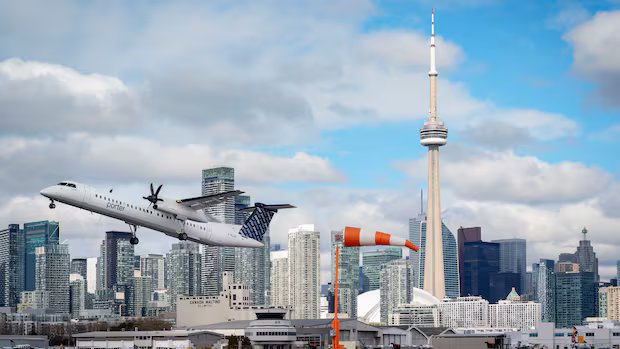
It’s a figure the Ontario government has highlighted several times: $8.5 billion.
That’s the projected annual economic boost an expanded Billy Bishop airport could provide by 2050, at least according to Premier Doug Ford’s government.
But weeks after first touting that claim, neither the province nor the Toronto Port Authority — which owns Billy Bishop — has provided any evidence to support it. The province won’t say if it’s done its own economic analysis, and a spokesperson for the port authority says its study of the economic impact is still underway.
Several experts say they’re skeptical of the $8.5 billion figure and argue the potential economic benefits of expanding the airport are likely overblown. Yet these supposed benefits form a key part of the province’s rationale for moving to override planning and environmental regulations, expropriate land from the city and take over the municipality’s role in the tripartite agreement governing the land — in a push to expand the airport and allow jets to take off.
“The Ford government has an unfortunate tendency … to announce big plans and big visions without having done any analysis,” said Sandford Borins, a retired professor of public management at the University of Toronto, who has studied airport planning.
The provincial government maintains the expansion would benefit the economy, and is needed as traffic at Toronto Pearson airport increases.
No complete study from port authority
In March, the premier announced he would make Billy Bishop airport a “special economic zone,” which, under Bill 5, would allow the province to override certain laws in order to push ahead with development.
In April, Ontario Transportation Minister Prabmeet Sarkaria introduced legislation that would see the province take over the City of Toronto’s spot in a tripartite agreement that governs the land. The agreement is currently between the city, the federal government and the Toronto Port Authority, which is a federal agency.
A government news release in March announcing the planned legislation said the Toronto Port Authority “estimates the airport’s activities will contribute up to $8.5 billion to Canada’s economy every year by 2050.” That figure was again cited in an April news release, and has been cited by the premier when speaking with the media.
CBC News contacted the Toronto Port Authority to ask about the source of the $8.5 billion estimate. In an emailed statement, communications and public affairs vice president Deborah Wilson said “work is underway to quantify the economic impact of modernizing the airport.”
The port authority said “preliminary work” was done last year, but that an economic impact study is ongoing, and work will continue into the fall.
CBC News asked the transportation minister’s office why it is trusting a figure from the port authority when its study is not complete, and if the province has done its own analysis.
In an emailed response, spokesperson Dakota Brasier said the economic benefit “is too important to not move forward,” but her statement did not address those questions.
“The reality is Pearson is at capacity and we need to ensure we have options for the growing population,” the statement said.

A decade-long multi-billion dollar expansion of Toronto’s Pearson airport is now underway. Upgrades include revitalizing the terminals and renovating airfield controls and baggage carousels.
According to Toronto Pearson’s website, 47.3 million passengers travelled through the airport in 2025. That’s still lower than the pre-pandemic number of 50.5 million in 2019. Last week, the airport held a groundbreaking event for the first phase of an expansion and modernization project, which is intended to accommodate 65 million total passengers annually.
“Toronto Pearson is a busy global hub airport especially at peak travel times; however, we are not at capacity,” said airport spokesperson Sean Davidson in an email to CBC News, in response to Brasier’s statement.
According to the Toronto Port Authority’s website, more than 1.7 million passengers travelled through Billy Bishop in 2025 — down from two million in 2024, and from a peak of 2.7 million in 2019. The province has said the number of passengers is expected to increase to 10 million annually with the expansion.

Critiques of the economic argument
Borins, the retired professor, said he’s unconvinced by arguments that expanding Billy Bishop will be an economic boon for the city, in part because he believes much of the traffic would simply be displaced from Pearson.
Whether travellers pass through Pearson or Billy Bishop, “it would contribute the same billions of dollars to the economy,” Borins said.
Frédéric Dimanche, a professor of hospitality and tourism management at Toronto Metropolitan University, says it’s difficult to directly measure the economic value a passenger brings to the city. While the island airport may be convenient for business travellers coming to the city for meetings, Dimanche argues those travellers could be less valuable when it comes to dollars spent, particularly if they don’t stay overnight.
“We should get away from that perspective of tourism where we say, ‘the more people we bring, the better it is,'” Dimanche said.
“A day trip really is not going to have much of an impact.”
Divided views on airport’s future
The province’s March and April news releases both featured quotes from the Ontario Chamber of Commerce and the Toronto Region Board of Trade. Giles Gherson, CEO of the board of trade said the Billy Bishop expansion would “unlock economic growth.”
CBC News requested interviews last week with both organizations, as well as the Toronto Association of Business Improvement Areas. All three declined.
Advocates against the expansion, meanwhile, point to environmental costs, and say the addition of jets would negatively affect people’s enjoyment of the waterfront.
Borins and Dimanche both argue those costs should be considered as part of any economic analysis.
Cost of expansion unclear
Along with the social costs, the price tag of expanding the airport to accommodate jets is unclear.
Deborah Wilson, with the Toronto Port Authority, said in an emailed statement the “cost of the modernization will depend entirely on the final plan,” which is not yet complete.
Earlier this month, Ford said the province is considering helping to pay for the expansion.
“We’re going to look at that, along with hopefully the federal government, because they’re going to benefit as well,” Ford told reporters.

At this point, it’s not clear if the federal government will greenlight the plan, which will require federal sign-off under the tripartite agreement.
CBC News asked federal Transport Minister Steven MacKinnon’s office if he supports the proposal to allow jets, and if the federal government is considering paying for the expansion.
A statement from his press secretary Marie-Justine Torres did not address the question about covering the cost, but said “the federal government will continue working with all parties to ensure that strong standards for safety, environmental protection, noise and community impact are upheld for any future proposals.”
Calls for independent analysis
While the Toronto Port Authority says its studies are still underway, NDP MPP Chris Glover says he’s wary of any economic analysis the port authority will eventually publicize.
“I don’t trust the objectivity of a report that’s commissioned by the Toronto Port Authority. There should be one commissioned by an independent body,” Glover said.
Dimanche agrees that economic impact numbers from interested parties are often “grandiose,” and said in order to make an informed decision, the government should compare more than one analysis.
“I wouldn’t feel comfortable voting for this at the moment without seeing a very strong argument for very significant economic impact,” said Dimanche.
At this point, he says, no one is providing it.
