
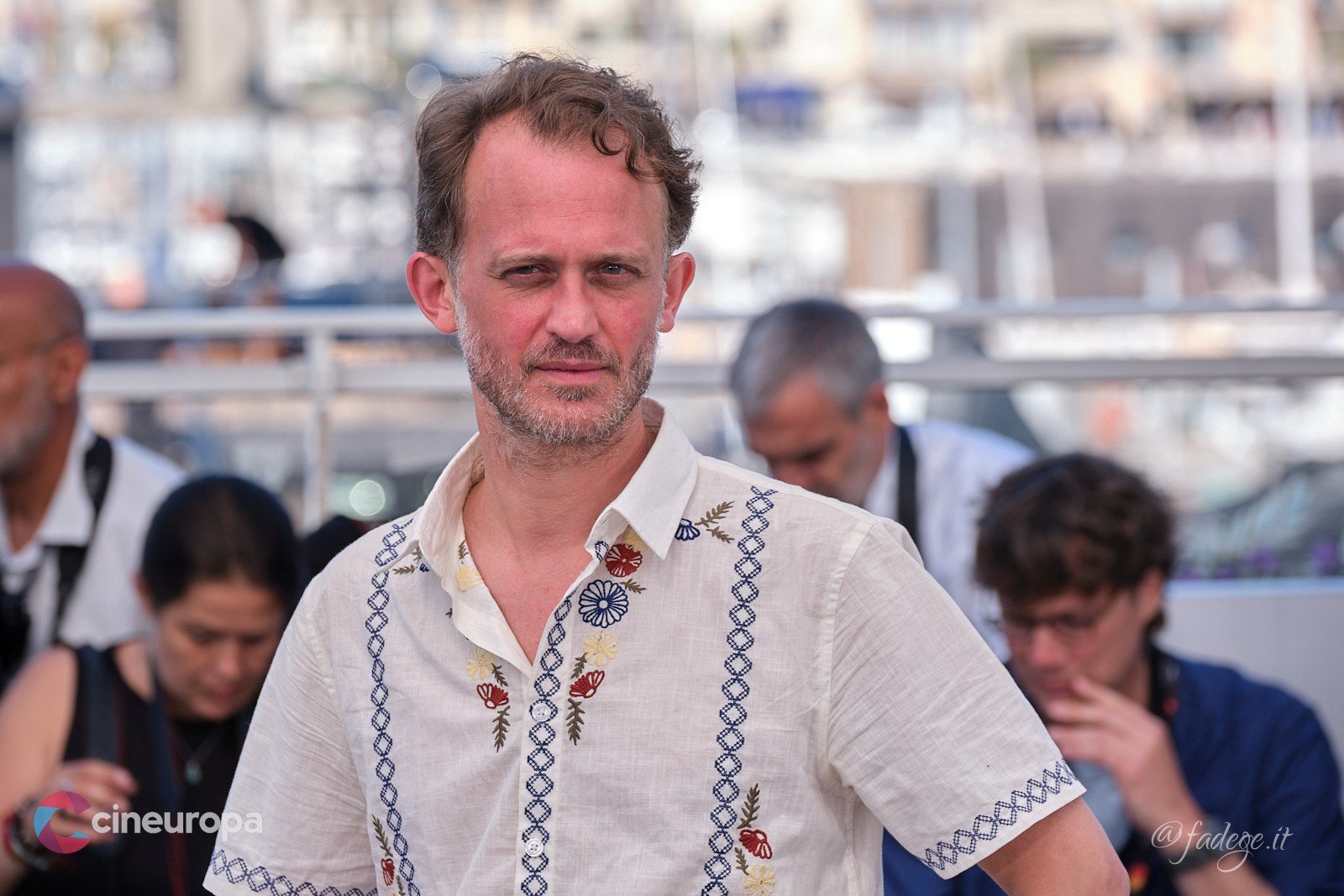
“I wanted to capture the faces behind the major historical figures, the people in the background”
– CANNES 2026: The filmmaker talks to us about his second feature film, a story on the French Collaboration, directly inspired by his great-grandfather’s own experiences
(© 2026 Fabrizio de Gennaro for Cineuropa – fadege.it, @fadege.it)
Having made a name for himself with his debut feature film, Zero Fucks Given, co-directed with Julie Lecoustre and which premiered in Critics’ Week, Emmanuel Marre presented his second feature film, A Man of His Time, in competition at the 79th Cannes Film Festival.
Cineuropa: How do you turn material drawn from family archives – in particular your great-grandparents’ correspondence – into fiction?
Emmanuel Marre: When I discovered it, I felt it touched on something very intimate, and at the same time I quickly realised there was something broader there, a memory shared by many French families, one facet among many of the Collaboration Era. I wanted to capture the faces behind the major historical figures, the people in the background.

Indeed, Henri enters the film in the background, gradually coming into the foreground.
In terms of cinematic language, my director of photography and I felt it would be interesting to place the use of zooming and zooming out at the heart of the narrative. This serves both to focus on the character and to invite the viewer to look at the context. We start with a character to reflect the trajectory of an entire country. The question I ask myself about Henri is: how did he end up doing this? We have a particular narrative structure: a character who declares he wants to get somewhere, but who is constantly on the run. And so: what is he running from? Surely his inability to give love and attention; he is obsessed with himself, thinking only of reaching the position he believes he deserves, to the point of forgetting the people he loves. What I still don’t understand is that he is both opportunistic and convinced of his own righteousness. He is also someone who claims to want to protect a country, at the cost of endangering his own people. At heart, he is above all someone who wants to be listened to and looked at. He eventually finds that place, but it is too late. It destroys everything.
The film also places his love story with his wife at the heart of the narrative, reminding us that even in times of war, people fell in and out of love.
In the screenplay, one might have had doubts about whether Henri loved his wife, which is not the case in the film. And I think it’s more powerful, in terms of questioning the figure of the monster, to present someone who has real, sincere feelings for his wife. Those who behave like scoundrels politically or ideologically, within society, aren’t necessarily scoundrels in their private lives. I’ve just rewatched the film and I thought to myself: if the condition for participating in a fascist regime were to be a bad person in one’s daily life as well, the world would surely be a more peaceful place. We could spot the problems right from the private sphere. Henri and Paulette are ordinary characters, in both senses of the word. Mundane, and at the same time, they have something we all share.
The direction makes the viewer an active participant, with an almost subjective camera that follows the characters.
We discussed this at length with the producers; the camera must never be forgotten, the audience had to feel that we were filming. That’s why there are flashes and zooms; you can sense that someone is filming. There is no attempt to fade into the background in order to achieve a neutral perspective or to feign authenticity.
What was your approach when it came to deciding how to portray the period aesthetically?
We started with amateur colour archive photos, without trying to recreate the chemical process. What interested us was that every era overlaps with many others. In the 1940s, you can also see elements of the 1920s and 1930s; at times, you might have thought it was set in 1970. The important thing was to create a sense of liveliness, just like in real life. And then we had to be realistic about our resources; we couldn’t afford big scenes with vehicles and extras. So we tried to film in the actual locations where events had taken place, such as the Maison du Peuple in Limoges. At the same time, we weren’t looking for the kind of effect that trainers might have in Sofia Coppola’s Marie Antoinette; that wasn’t the idea. To give a sense of the present, we sometimes had to resort to historical inaccuracies, for the sake of better understanding, and not with the intention of creating a disconnect or a surprise.
(Translated from French)
