
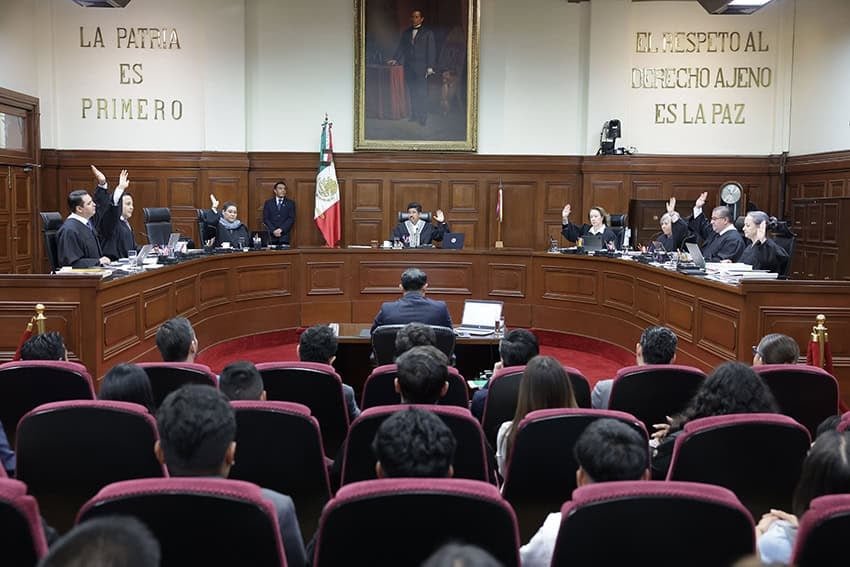
President Claudia Sheinbaum on Wednesday submitted a proposal to Congress that seeks to postpone Mexico’s next judicial elections to 2028 and make other changes to the judicial reform that took effect in 2024.
The president’s reform bill effectively recognizes that there were a range of deficiencies in the 2025 judicial elections and seeks to address them.
Mexico held its first ever judicial elections in 2025 and citizens were scheduled to go to the polls to elect more judges in 2027.
However, Sheinbaum said on Monday that she would submit a proposal to Congress to postpone Mexico’s second judicial elections to 2028 in order to avoid a clash with municipal, state and federal elections that will take place in June 2027. The president cited logistical difficulties related to holding judicial elections and other elections on the same day as the main reason why she was proposing the postponement of the former. She is now proposing that the second judicial elections be held on June 4, 2028, a date on which a presidential recall election could also be held.
The constitutional reform bill Sheinbaum sent to Congress on Wednesday proposes a number of other changes to the judicial reform that former President Andrés Manuel López Obrador signed into law just two weeks before his six-year term ended on Oct. 1, 2024.
The proposal to amend the 2024 reform comes after just 13% of eligible voters participated in the 2025 judicial elections. Those who participated faced the gargantuan task of electing almost 2,700 judges, including nearly 900 federal ones. Complicated ballots with large numbers of candidates led many voters to make use of cheat sheets, some of which were handed out by people affiliated with the ruling Morena party.
Despite the low turnout, Sheinbaum declared the elections a success, although she conceded that the process could be “perfected.”

Still, Sheinbaum has maintained that judicial elections were — and are — necessary to rid Mexico’s judiciary of corruption, nepotism and other ills. She has rejected claims that the motivation for holding judicial elections was to seize control of the judiciary. That said, many judges who were elected last year, including Supreme Court justices, have links to the government and/or Morena.
What does Sheinbaum want to change?
The federal government is now proposing that each individual judgeship race be limited to two candidates. Selection committees would choose the four best-qualified would-be candidates from a list of aspirants and that number would be reduced to two via sortition. The number of candidates allowed to vie for positions in courts that need to find people to occupy numerous judgeships would also be reduced, although they would still number in the dozens in various cases.
The El País newspaper reported that “the government’s bet is to transform a saturated and unreadable ballot into a more manageable” one. Sheinbaum is also seeking to ensure an equal number of male and female candidates on ballots.
Among the government’s other proposed changes to the 2024 judicial reform is one aimed at ensuring that judicial election campaigns and the voting process itself take place “without the intervention of political party representatives.” The National Electoral Institute would be tasked with ensuring that interference by political parties is avoided.
Drawn up by officials including presidential legal adviser Luisa María Alcalde, Sheinbaum’s reform bill also seeks to ensure that judicial election candidates are well-qualified to become judges. In 2025, requirements for candidates included having a “good reputation,” holding a law degree and presenting five letters of recommendation from neighbors and colleagues. If Sheinbaum’s proposal passes Congress — as is expected given Morena’s congressional strength — candidates would be required to have the “necessary technical knowledge” to serve as a judge and possess qualities such as “honesty,” which isn’t currently specified as an essential trait.
With judicial elections approaching, Mexico struggles to vet candidates with criminal ties
Sitting judges who want to contest judicial elections with the aim of winning a different judgeship would be required to resign from their current position. In accordance with the proposed changes to the judicial reform, which could be approved as soon as next week, appraisal and oversight of judges would be more stringent than is currently the case, with judges to be subject to performance reviews from their first year in the job.
In addition, Sheinbaum’s reform bill proposes that the Supreme Court return to what would essentially be a dual-chamber system of the kind that existed prior to the 2024 judicial reform.
El País reported that the proposed modification “represents a significant change to the redesign promoted by López Obrador, whose bet had been to centralize all [Supreme Court] decisions in a single plenary as part of his narrative of austerity and institutional simplification.”
Judges’ association: Postponement of judicial elections is a sign of the ‘inviability of the original design’
In a statement issued on Monday, the National Association of Federal Circuit Magistrates and District Judges (JUFED) said that postponing the next judicial elections to 2028 is “the clearest confession” from the federal government “about the inviability of the original design” of the elections.
Released two days before Sheinbaum submitted her reform proposal to Congress, the statement also said that delaying the elections by one year is equivalent to “postponing a systemic mistake without addressing the underlying causes.”
The reduction of candidates and the “simplification” of ballots are “insufficient measures,” JUFED argued.
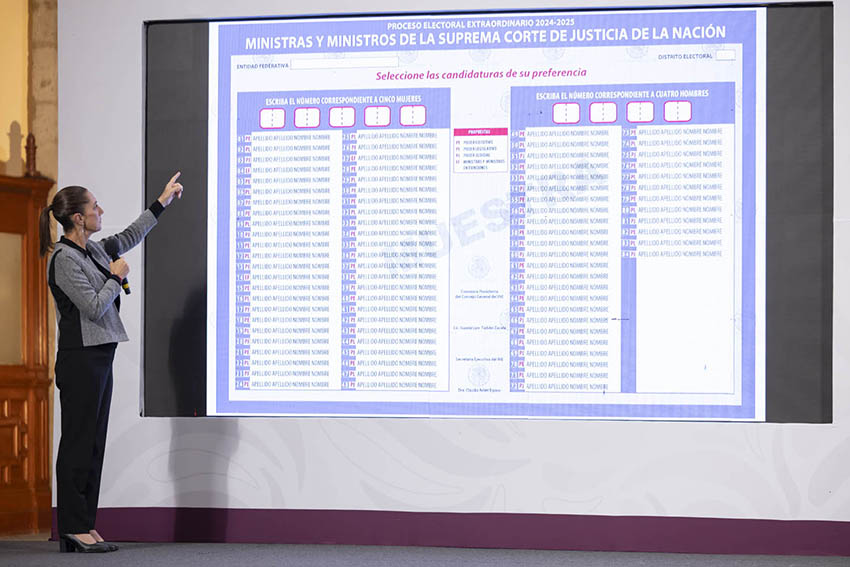
“These changes do not address ballot fatigue or the risk that the judicial election will become entangled in the dynamics of political parties,” the association said.
“… Furthermore, the creation of a ‘Coordinating Commission’ to standardize evaluation criteria confirms that the 2025 Evaluation Committees lacked the technical methodology necessary to ensure profiles of excellence” among judicial election candidates, JUFED said.
Before last year’s judicial elections were held, civil society organizations filed complaints against some candidates, alleging that they had links to organized crime or the Guadalajara-headquartered La Luz del Mundo religious sect, whose leader is a convicted sex offender.
In its statement, JUFED also said that if judicial elections have to be held, their purpose should be limited to filling “real vacancies” created by “natural causes (resignation, retirement or death).”
JUFED expressed its opposition to other aspects of Sheinbaum’s reform bill, and asserted that the staging of more judicial elections “without specific criteria regarding functionality” will cause Mexico’s justice system to “collapse.”
Bloomberg News reported in February that just over five months after the judges elected last year were sworn in, Mexico’s court system was “in disarray,” and that companies operating in the country were “increasingly steering clear” of it.
In a separate statement on Wednesday, JUFED referred to what it called “the dismantling of the professional justice system in Mexico” — i.e. the replacement of long-serving judges with people with limited or no experience in the judiciary.
It also said that hundreds of judges who lost their jobs after last year’s elections are still owed “extraordinary payments.”
“It is imperative that the public see an undeniable reality: The current authorities are not even complying with what they themselves designed to their liking. The 2024 judicial reform was promoted under the banner of ‘justice,’ but today, in practice, it has become an instrument for persecution and dispossession,” JUFED said.
