
Hello again, and welcome back to Fast Company’s Plugged In.
For a decade, Google’s I/O developer conferences have told one consistent story: The AI age is here, and Google aims to lead it. The company’s progress can be measured by the AI-infused product announcements it makes during the show’s keynote. On Tuesday, CEO Sundar Pichai and other executives packed I/O 2026’s three-hour presentation so tightly with news—spanning Google Search, the Gemini app, Google Docs, Gmail, YouTube, Android, and beyond—that it threatened to explode.
For one of those presenters, Google DeepMind CEO Demis Hassabis, this year’s announcements are part of a long arc of personal history dating back to his childhood fascination with teaching machines to think. In 2010, that quest led to Hassabis, Shane Legg, and Mustafa Suleyman cofounding the artificial intelligence research lab DeepMind, which Google acquired in 2014 and merged with another research arm, Google Brain, in 2023. The journey will continue as Google DeepMind pursues the goal of achieving Artificial General Intelligence—AI that’s at least on par with human thinking across an array of domains.
Even among the technologists most responsible for AI’s achievements to date, opinions on when AGI might be a reality vary wildly. Google Brain’s cofounder, Andrew Ng, thinks it’s decades away. But Hassabis believes we’re already on the cusp. “2030 is when I expect it to arrive, either plus or minus a year,” he says.
Regardless of how much work lies ahead, AI has already reached a critical juncture simply by being a part of everyday life. Its increasing presence in Google products will make its promise and pitfalls more tangible to billions of people. When I caught up with Hassabis this week, he spoke exuberantly about the products and features unveiled at I/O. But he was at least as energized when talking about the problems AI can cause, and what Google is doing to mitigate them. And he underlines that advancing the science of AI remains “my main passion.”
“It’s complicated, because you’ve also got the most voracious competition in tech history going on,” he told me. “I won’t pretend that it’s easy. But I think we get that balance right better than anyone else.”
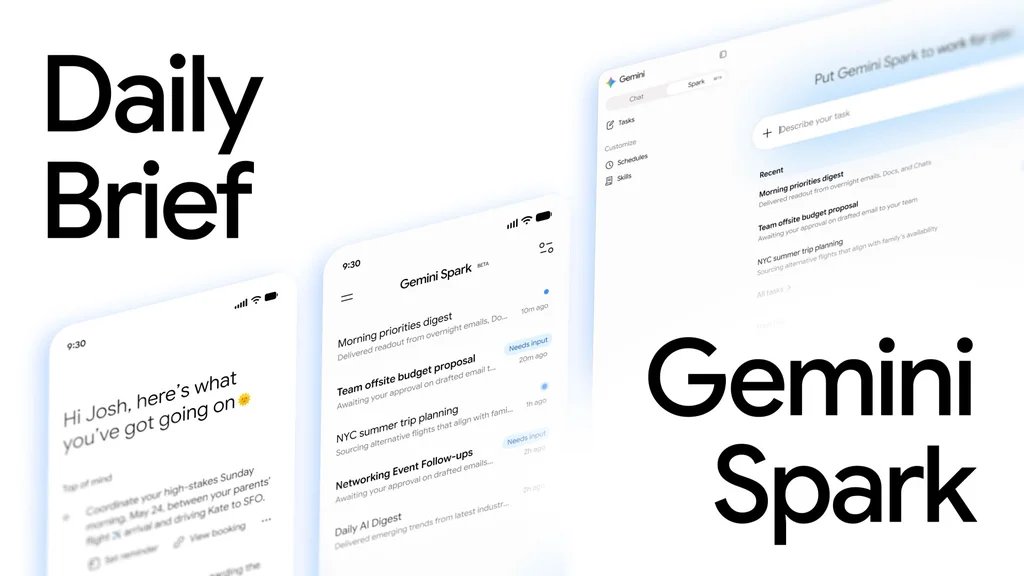
By definition, every new AI feature that Google comes up with builds on technologies that were once research breakthroughs—often originating years ago at DeepMind or Google Brain. When I ask Hassabis about Gemini Spark, Google’s new AI agent, he points out that DeepMind’s earliest research involved agentic AI, in the form of game-playing algorithms. “AlphaGo was an agent,” he says. “Even our original Atari work . . . they were agents. Maybe we were a bit ahead of our time.”
Over the last year or so, agents have emerged from the lab. Yet they still haven’t gone entirely mainstream. Running the best-known one, OpenClaw, requires considerable technical aptitude, a willingness to risk things going awry, and—many enthusiasts conclude—a budget big enough to dedicate a Mac Mini to the job. By contrast, Gemini Spark runs 24/7 in the cloud, connects only to apps you expressly authorize, and, for now, just works with other Google services.
“The sweet spot is to help everyone with these agents, not [just] people who are very technical,” says Hassabis. “But also to make sure it’s actually secure, reliable, and robust, and you have full control over what it has access to. One of the main issues with OpenClaw is it’s just very insecure. I wouldn’t recommend it for any real work. I haven’t used it for any of my real stuff, because it might leak everything.”
Spark is rolling out first to users who subscribe to Google’s high-end $100/month AI Ultra plan. Bringing it to the masses will involve its “adapting to the average person, adapting their workflows to this type of agentic assistance,” says Hassabis. “It’s probably going to play out over the rest of the year, would be my guess.”
Asked which of I/O’s myriad announcements he’s particularly excited about, Hassabis singles out Gemini Omni Flash, a new AI model that lets users feed in text, images, video, and audio as part of their prompts. It will debut in the Gemini app, Google Flow video editor, and YouTube Shorts, where it will output video. Eventually, it will also be able to generate other forms of media.
“What people are going to be able to do is experiment between different modalities,” says Hassabis. “‘Here’s a video input, here’s a music output, here’s an image input. Give me a video output.’ I just want people to be incredibly creative with it.”
Of course, existing tools such as Google’s own Nano Banana have already shown that AI media generation’s being amazing and readily accessible has its downsides. People can easily make stuff that looks real, but isn’t. Perhaps worse, media that’s legit could come under suspicion for being AI fakery.
Google has been working on ways to bring transparency to a piece of media’s origin for years. In 2023, it introduced SynthID, an identification technology for AI-generated content; since then, it’s watermarked over 60 years of video and 100 billion images. The company has also championed C2PA Content Credentials, a standard for tracking whether imagery was created with a camera or AI and how it’s been modified.
Now Google is making it easier to determine an image’s provenance by building these technologies into widely-used experiences such as the Gemini app, Android’s Circle to Search, and Google Search’s AI Mode. The flurry of I/O news even included an announcement from OpenAI: It’s throwing its support behind SynthID by adding support for it to ChatGPT, Codex, and its API.
“I think it’s great that the whole industry is coalescing around watermarking that is robust,” says Hassabis. “That’s what was needed, really, to then go the next step, which is having sites automatically identify [content authenticity]. Or you can imagine even browsers eventually doing that, so there’s almost no effort in terms of verifying something.”
After waxing enthusiastic about SynthID, Hassabis segues to cybersecurity. Is Google wrestling with the same kinds of sobering issues as Anthropic is around AI’s ability to find and exploit software vulnerabilities? (The latter decided its Claude Mythos LLM was too dangerous to release just yet.) “Definitely,” he says. He points out that Google is in a pretty good position to help developers secure their apps in the AI era, thanks to assets such as its CodeMender agent and the Wiz cybersecurity platform, the company’s largest-ever acquisition.
But Hassabis adds that preventing AI from giving superpowers to bad-guy hackers is only one urgent task, and not necessarily the most sobering one. Over the next year or year and a half, he predicts, AI could accelerate chemical, biological, radiological, and nuclear (CBRN) threats. “I’m thinking a lot about what sorts of tools, monitoring systems, and other things all the frontier labs should really be working on and implementing,” he says. One such area is chain of thought monitoring, which lets researchers deconstruct a model’s thought process and look for signs that it’s engaging in deceptive behavior.
“There’s a lot that we’re sort of in the foothills of now,” says Hassabis. “Models that are super capable, which is great. And they’re agentic, also great. But that means there are more challenges and risks associated with them.”
Above all, Hassabis is motivated by AI’s potential to be, as he put it in a voiceover at the start of the I/O keynote, “the ultimate tool to solve all the world’s most complex scientific problems.” Along with running Google DeepMind, he pulls double duty as CEO of Isomorphic Labs, a spin-off devoted to commercializing its AlphaFold protein stricture prediction AI for use in drug discovery. (Hassabis and John Jumper, Distinguished Scientist at Google DeepMind, shared the 2024 Nobel Prize in Chemistry for AlphaFold’s creation.) Last week, Isomorphic announced that it had raised $2.1 billion in new funding. “You can take that as a huge vote of confidence in the progress we’re making over there,” Hassabis says.
As AlphaFold edges closer to real-world impact, other Google DeepMind research projects of similar long-term ambition are coming along in earlier stages of development. For instance, the company is collaborating with the U.K. government to build an automated science lab that will use the Gemini LLM and robotics to investigate areas such as superconducting materials and nuclear fusion.
Hassabis cherishes the part of his job that involves allocating sufficient resources for such efforts. “Obviously, there’s never enough compute for the ideas that you have,” he says. “But I think we’ve done that historically very well at DeepMind, originally, and now Google DeepMind—just protecting blue-sky research.” Even during I/O week, with its profusion of evidence that Google knows how to productize AI, his mind is racing ahead to what’s next.
You’ve been reading Plugged In, Fast Company’s weekly tech newsletter from me, global technology editor Harry McCracken. If a friend or colleague forwarded this edition to you—or if you’re reading it on fastcompany.com—you can check out previous issues and sign up to get it yourself every Friday morning. I love hearing from you: Ping me at hmccracken@fastcompany.com with your feedback and ideas for future newsletters. I’m also on Bluesky, Mastodon, and Threads, and you can follow Plugged In on Flipboard.
More top tech stories from Fast Company
The OpenAI lawsuit became a master class in what not to put in writing
As private messages from Elon Musk, Greg Brockman, and other tech leaders spilled into public view, the trial underscored a growing reality of corporate life: nothing stays private forever. Read More →
The era of ‘good enough’ AI has arrived
As frontier AI models get pricier, cheaper and locally hosted alternatives are becoming powerful enough for most users. Read More →
San Jose mayor Matt Mahan wants to prove he’s not just another ‘Silicon Valley guy.’ Will Californians buy it?
Meet the billionaire-backed, pro-AI mayor vying to be California’s next governor. Read More →
This beautiful, biophilic phone case is on a mission to reduce your screen time
Want to keep your terrarium alive? You’ll have to put your screen down. Read More →
SpaceX’s biggest business risk? Politics
The company’s pre-IPO filing acknowledges the many levers of government that could supercharge, or stall, its ambitions. Read More →
LinkedIn declares war on AI slop
The job networking site plans to target low-quality AI posts that distract its users from finding value on the platform. Read More →
