
“Everybody wanted the same thing, which was to see those five characters together on the screen”
– CANNES 2026: The British director discusses her new film adaptation and shooting in Birmingham for the first time
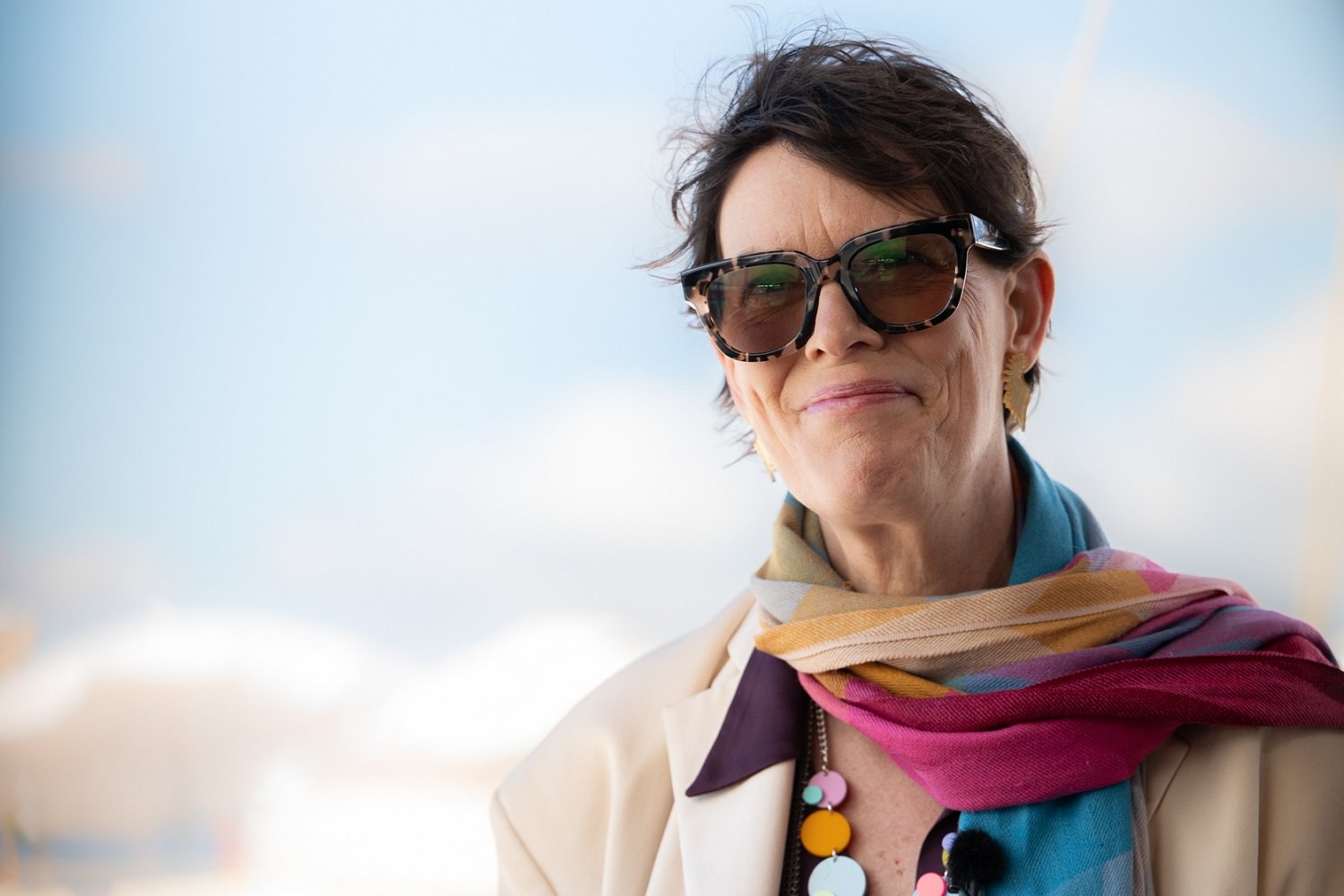
(© Delphine Pincet/Quinzaine des Cinéastes)
Clio Barnard is known for filming Bradford and the North of England, as well as for her deeply human characters and the limitations they face. Now, with her new film I See Buildings Fall Like Lighting, premiering in the Directors’ Fortnight at the Cannes Film Festival, she heads to Birmingham, where a group of five childhood friends try to stay together despite everything. Cineuropa met with Barnard in Cannes to discuss her adaptation of Kieran Goddard’s novel of the same name.

Cineuropa: What was it like to shoot in Birmingham, which is in the West Midlands of England, unlike Bradford, where your previous films were set?
Clio Barnard: It was a big change for me. The films in the “Bradford trilogy” grew out of one another, beginning with the first time I went there in 2008. It has been a long time, and I have developed a long relationship with the people who live there. So yes, it was very different in that sense. I did not write the script for this film, so I was not able to do what I had done with the other films, which was to workshop the script. But Kieran Goddard, who wrote the novel, was really our way in; he welcomed us with open arms and introduced us to this particular place, a social club called the Crown, which became our production base, rehearsal space and set. All the pub scenes were shot there, with our production designer, Jane Levick, transforming the space.
This film shares a sense of rootedness with your previous work. How did you achieve that?
That’s really good to hear as it was something I was initially worried about… But thanks to Kieran and his brother Tom, the Crown, and the actors’ willingness to jump into all that, everything came together very naturally. We had a big open casting in the social club and the mix of actors and non-actors was warmly embraced by the cast.
Can you tell me more about adapting the novel with the help of Enda Walsh who’s recently worked on Die My Love, to achieve such a polyphony of voices here?
That’s a lovely way to put it! I really love Enda Walsh’s work, so I was thrilled to get an email from him asking me if I would be interested in reading the novel, which at that point wasn’t published, in order to collaborate as a director. I loved the characters and the way the politics of it were told through them. The novel consists of five internal monologues, which makes it difficult to adapt into a screenplay, but thankfully, when the three of us met, we got on like a house on fire. Then Enda wrote the screenplay very quickly. He did ingenious things in order to externalise those internal voices. It was a pleasurable collaboration, with everybody wanting the same thing, which was to see those five characters together on screen.
Cineuropa: It’s an alternation of perspectives that we become immersed in. But can you talk a little about the use of tight close-ups and those moments of direct address to camera?
That was a kind of experiment intended to match the novel’s five portraits. The one I absolutely wanted to include was Shiv’s, played by Lola Petticrew, because I wanted her to look directly at us. She is an extraordinary character and, in the novel, you can read a great deal about what is going on in her mind, which is harder to convey on screen without using voiceover.
How did you approach it together with cinematographer Simon Tindall?
The idea was that all the characters had a different relationship with time. Cinema, too, has a very particular relationship with time, so I wanted to shoot those portraits on film. Then we matched the rest of the footage we shot to those portraits, so that they would share the same qualities.
How do you cast a collective protagonist, and how much preparation did you do with the actors individually and as a group?
I worked individually with each of them and talked about their characters, but I am also sure they made many decisions on their own. Then we worked together as a group too — we did a lot of dancing during rehearsals, as it was very important that they bonded as a group. They all completely understood that this was what they needed to do, but they also spent time together outside rehearsals. I know they all went out for meals together and some of them went on nights out with the locals too. They were doing their own thing while also developing the group dynamic.
