
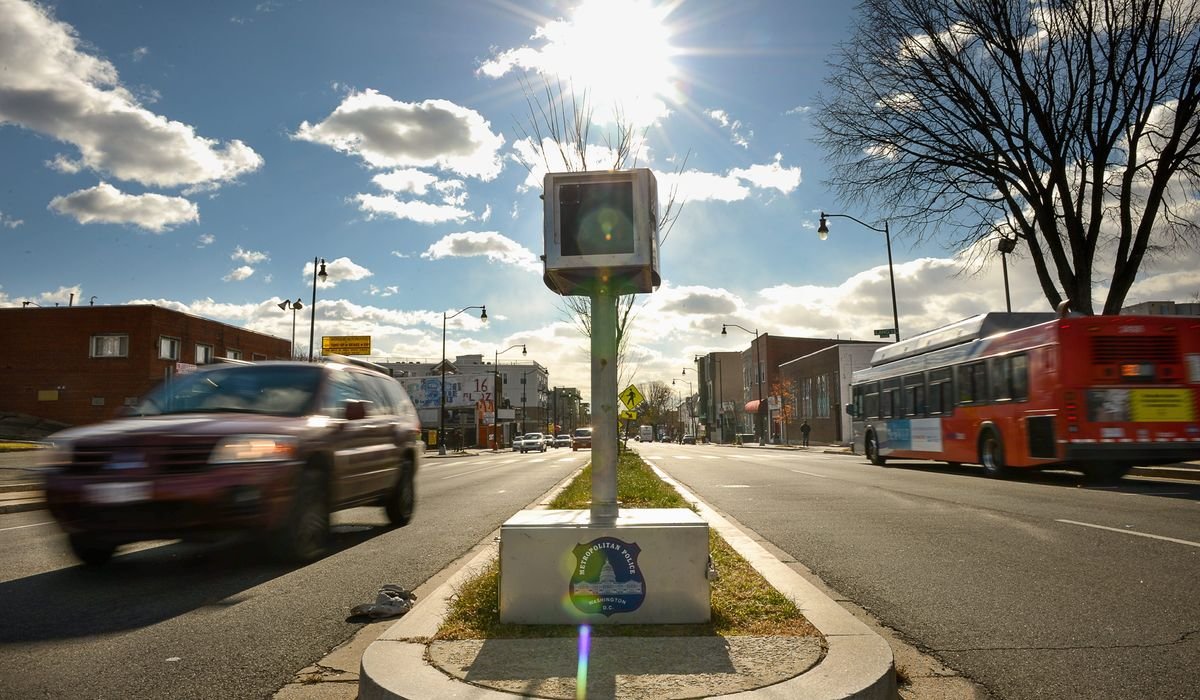
Red-light runners and speeders who routinely trigger automated traffic cameras in the District at specific locations and times of day are not the focus of enforcement operations by the city authorities tasked with keeping the roads safe.
A recent Washington Post story found that traffic cameras have recorded a number of motorists who repeatedly speed or run red lights at the same place and time of day — and owe the city tens of thousands of dollars in unpaid citations. Assigning officers to those locations and times would allow the city to apprehend the violators and collect the outstanding fines.
But neither the Metropolitan Police Department, which can ticket and arrest drivers for traffic violations, nor the Department of Public Works, which impounds cars with unpaid fines, targets the small group of motorists who regularly flout traffic laws.
“We do not target any individual, we target data,” said police Sgt. Terry Thorne, the head of the Traffic Safety and Special Enforcement Division. “We’re never going after a single person if they are going through the speed camera.”
The District Department of Transportation told The Washington Times it will request a tow only if a parking enforcement officer discovers a vehicle that has hundreds of dollars in outstanding tickets while attempting to cite it again.
A DDOT spokesperson said the city’s Department of Public Works does not request “blitzes” on specific drivers who continue to accrue fines.
Both Metropolitan Police and DDOT suggested the Office of Attorney General for the District of Columbia, which handles criminal traffic prosecutions, could provide a list of drivers regularly captured by automated traffic cameras.
The Washington Times made multiple requests to the OAG for comment, but the office did not respond.
Traffic data shows that some scofflaws, many of whom live in Maryland and Virginia, have made a habit of breaking road rules in the same parts of the District.
A vehicle with Maryland tags received more than 180 tickets in one year along an eight-block stretch of Alabama Avenue SE, according to records cited by The Post. Another car with a Maryland license plate racked up nearly 110 tickets from a camera on Bladensburg Road NE.
Cameras that catch drivers going 11 mph above the speed limit, running a red light or rolling through a stop sign will assess a $100 fine, according to DDOT.
The Maryland drivers mentioned above likely owe roughly $18,000 and $11,000, respectively. Speeding fines can scale up to $500 per ticket depending on how fast the drivers are going when they are caught by the cameras.
According to the dataset, of the 103 vehicles with the most tickets in fiscal 2025, 67 had Virginia tags and 25 had Maryland tags. Only three were from the District.
But no targeted crackdown on those drivers has been implemented despite their known pattern of violations.
As the District has moved to enforcing road safety largely through traffic cameras, an archive of stop data by Metropolitan Police reveals ticketed offenses have declined in recent years.
Between July 2019 and December 2022, police handed out 143,209 tickets for moving and vehicle equipment violations on the District’s roads.
For those same types of violations between January 2023 to June 2025, the department said it issued 75,139 tickets — just over half as many.
Sgt. Thorne said his six-man team concentrates its efforts on the District’s high injury network of major roads where the most of crashes occur.
The sergeant said some areas that garner the most attention include New York Avenue NE and Southern Avenue, which straddles the border between the District and Prince George’s County. The MPD also patrols Interstates 695 and 295 for reckless driving.
If DDOT’s cameras have been flagging drivers in one corridor or another, Sgt. Clarke said the agency will pass that information along to Metropolitan Police and they will have an officer post up as a deterrent.
