
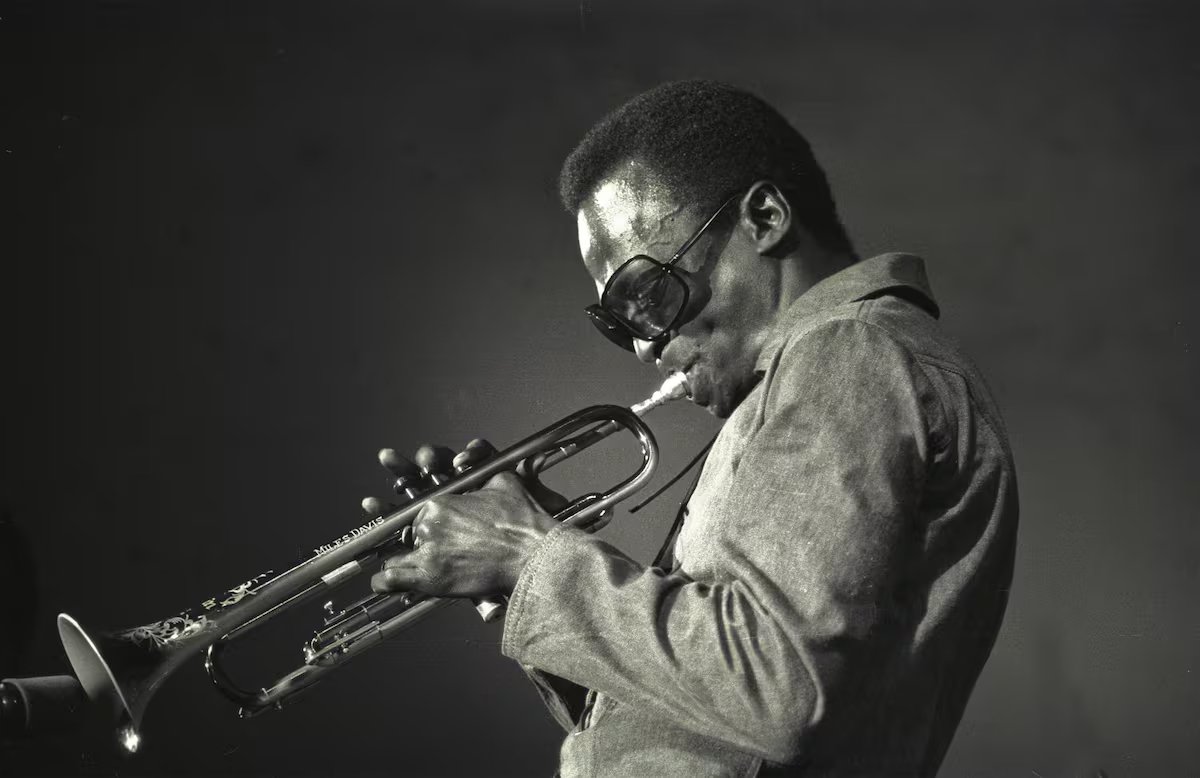
The whole history of modern jazz, from bebop to the end of the last century, can be told through his work—something that cannot be said of any other musician. Many artists sparked or led musical revolutions in different periods, but no one did so as often or as decisively as Miles Davis. Styles such as bebop, cool jazz, hard-bop, third stream, modal jazz, post-bop or jazz-rock, as well as various fusions with genres like funk, pop or hip-hop, cannot be understood without Davis’ legacy. Today, on the centennial of his birth, his importance has not diminished in the slightest, and the vast majority of his work—always at the epicenter of the musical earthquakes that drove jazz’s frantic evolution—retains the same freshness it had when it was created.
Davis was born on May 26, 1926, into a well-off family, though one of African descent, which exposed him to racist episodes that left a deep mark on him and forged a racial pride that he would bring into much of his work. He received his first trumpet at age 11, and music quickly became the most important thing in his life. During a visit by Billy Eckstine’s orchestra to East St. Louis, the city where he grew up, he substituted for one of their trumpeters and had the chance to meet Charlie Parker and Dizzy Gillespie. His path was clear: New York and the emerging bebop movement.
Although his parents enrolled him at Juilliard, a respected private conservatory that was out of reach for most Black musicians at the time, Davis threw himself into the new jazz being played at the clubs, and in 1945 he replaced Gillespie in Parker’s quintet. His time in bebop provided extraordinary training that gave him the wings to pursue his own music. That confidence showed in his leadership of the sessions that would become the legendary album Birth Of The Cool. In the late 1940s, at the height of bebop, Davis joined musicians such as Gil Evans, Gerry Mulligan and John Lewis—who were also seeking a more lyrical alternative with rich, sophisticated arrangements and an intimate approach close to chamber jazz—forming a nonet unusual for the time that reflected Davis’s disruptive temperament. The group had no notable success at the time, but years later its decisive influence was recognized.
In the first half of the 1950s, Davis was held back by a heroin addiction, but by 1954, clean and in top form, he led several foundational hard-bop recordings compiled on albums like Walkin’ and Bags’ Groove. His definitive emergence as a leader followed soon after, with two closely related milestones: his signing with Columbia Records through producer George Avakian and the formation of his first major quintet with John Coltrane, with whom he recorded four albums for Prestige—Cookin’, Relaxin’, Workin’ and Steamin’—and his Columbia debut, ’Round About Midnight, all essential hard-bop works.
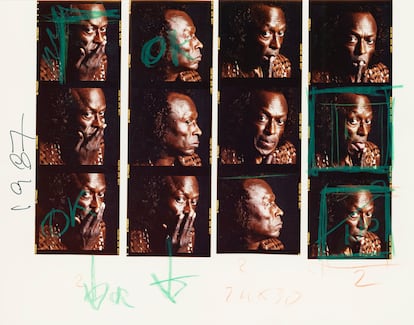
Being at Columbia was decisive: it meant access to significant resources and creative support that allowed him to record expensive albums like those he made with his old friend Gil Evans, genuine pinnacles of orchestral jazz: Miles Ahead, Porgy and Bess and Sketches of Spain. The latter was his first album produced by Teo Macero, who from then on and almost until the end became his closest recording collaborator.
A few months earlier, Davis had recorded another enormously successful album that would become not only the most important one of his career but also one of the most important in jazz history: Kind of Blue. Davis had been refining his music in search of more open ways to approach improvisation, and with this album he marked a before and after in the genre. He was not solely responsible for this evolution, but he was by far the most influential. His importance as a leader had come to overshadow his other talents, and that is one of the keys to his career: he was a notable composer and a trumpeter with a highly personal sound and language, but his greatest talent was being a leader, an ideologue and an intuitive musical director. Up to that point he had already been astute in recruiting people like Coltrane, Sonny Rollins, Cannonball Adderley, Bill Evans… But from the 1960s on he became a unique catalyst of talent, surrounding himself with young musicians who, with him, created something they could not achieve in other contexts.
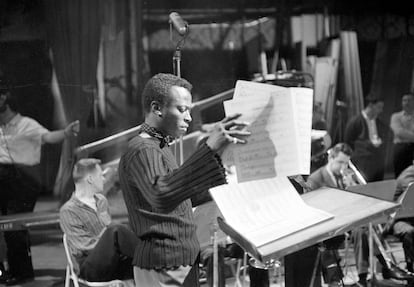
In 1964 his second great quintet took shape, featuring very young Wayne Shorter, Herbie Hancock, Ron Carter and Tony Williams—an unrepeatable group with a truly fascinating chemistry, as shown by their studio albums—such as ESP or Miles Smiles—and live recordings like the monumental Live at the Plugged Nickel.
Just as it is impossible to understand contemporary jazz without Davis, it would also be impossible without Shorter or Hancock, or without Joe Zawinul, Dave Holland, Chick Corea or Jack DeJohnette—musicians who were key to his next musical rupture. It took only two albums, In a Silent Way and Bitches Brew, to change the course of his career and jazz in general. Both works reflect the leader’s and his young bandmates’ spirit: a kaleidoscope of creators searching for something—perhaps without knowing exactly what—yet determined to go wherever necessary; and two visionaries, Davis and Macero, unafraid to pervert the organic precepts of jazz performance by manipulating recordings in the studio to create something that might not have been strictly jazz—and did not need to be. The impact was decisive and shaped the direction the genre would take in the 1970s, giving rise to bands like Weather Report, Mahavishnu Orchestra and Return To Forever, among many others.
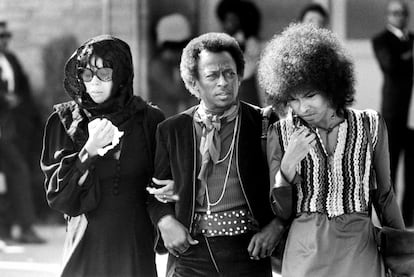
Live, Davis’s and his bandmates’ search was different but equally inspiring: their concerts with his last major quintet (Shorter, Corea, Holland and DeJohnette) and with new recruits such as Keith Jarrett, Gary Bartz or Steve Grossman were models of energy and uncompromising creativity. The live recordings from 1970 at the Cellar Door club or the Fillmore sound as vibrant as if they were recorded yesterday.
Beyond the use of electric instruments and some aesthetic aspects, Davis’s music was not yet fully rooted in rock or funk, but that openness was about to arrive, influenced by Jimi Hendrix, Sly Stone and James Brown. After the overwhelming success of Bitches Brew, his music continued to evolve, simplifying without losing its edge, until it crystallized in 1972 with his most controversial album, On the Corner. He sought to connect with young Black audiences, but what he achieved was to alienate much of his public, who generally did not understand a proposal that combined funk, musique concrète and many other elements. Years later it revealed itself as an album ahead of its time, a precursor to hip-hop and electronic music.
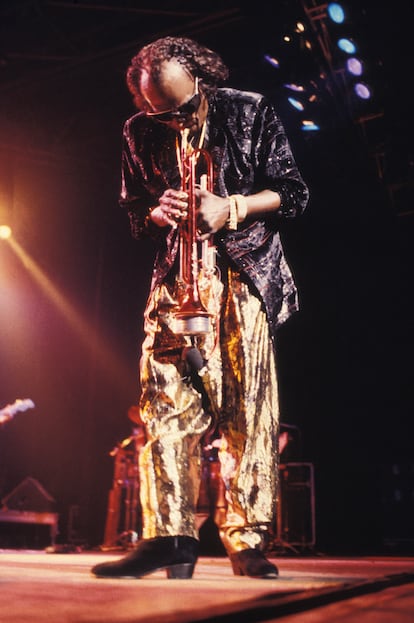
From then on Davis continued to push the boundaries of his particular blend of jazz, rock and funk, increasingly with less public and critical support, until he entered a retirement that kept him away from music for six years. When he returned in 1981 everything had changed in jazz and popular music, and he tried— with varying artistic success but a good public response— to find his place. He immersed himself in the sounds of the era, continued recruiting brilliant young players (John Scofield, Kenny Garrett…) and enjoyed his status as a living legend. His music may no longer have been as influential, but it still felt daring. Shortly before his death in 1991, he was finishing his final album, Doo-Bop, in which he plunged into hip-hop with producer Easy Mo Bee. To the end he was searching for the Black music that was yet to come.
Sign up for our weekly newsletter to get more English-language news coverage from EL PAÍS USA Edition
