
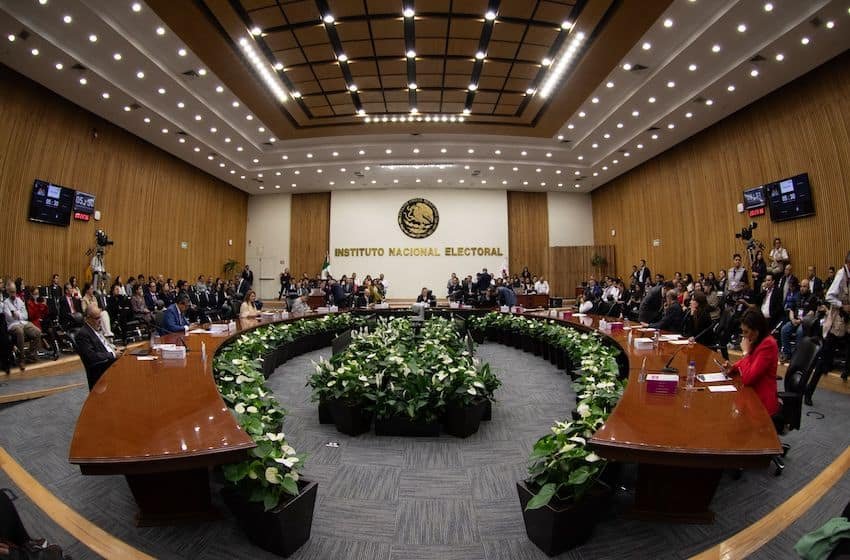
A committee of Mexico’s lower house of Congress approved on Tuesday a bill that seeks to allow elections to be annulled in cases of foreign interference.
The constitutional bill was put forward by Deputy Ricardo Monreal, the Morena party’s leader in the lower house, and has consequently been dubbed the Ley Monreal (Monreal Law).
Put to a vote in the Constitutional Points Committee of the Chamber of Deputies, the bill was supported by 28 lawmakers affiliated with Morena and its two allies, the Labor Party and the Green Party (PVEM). Nine opposition lawmakers opposed the bill.
The bill will now be debated and possibly modified in the Chamber of Deputies before facing a full vote. Morena and its allies have a two-thirds majority in the 500-seat lower house, allowing them to pass constitutional bills without the support of any opposition deputies.
How would Ley Monreal shield Mexico’s elections?
Monreal’s bill seeks to modify Article 41 of the Mexican Constitution so that elections can be annulled in cases of proven foreign interference. It also seeks to make changes to the General Law for the System of the Challenge Process on Electoral Matters and other electoral laws.
Opposition lawmakers assert that Monreal’s proposal lacks clarity.
“We’re very concerned about the ambiguity of the term ‘intervention’ by foreign individuals, organizations or governments,” said Nadia Navarro Acevedo, a deputy with the Institutional Revolutionary Party (PRI).

National Action Party (PAN) Deputy Noemí Luna said that “no one is in favor of foreign interference” in elections in Mexico, but added that “we are against legal ambiguity.”
Luna suggested that Morena could use foreign interference as a pretext for annulling the results of elections it loses.
The newspaper El Financiero reported that “the operational reach of the proposal still has gray areas.”
“In order to declare the nullity of an election under this new figure, it will be mandatory to legally prove the interference of other countries,” the newspaper wrote, adding that Monreal hasn’t specified how the process would work in practice.
On his personal website, Monreal wrote that the Federal Electoral Tribunal would be the sole authority responsible for validating whether foreign interference occurred and, in the case that it did, determining whether such interference had a decisive impact on an election result.
“Neither the government, nor any prosecutor’s office, nor any other authority would rule on this serious situation,” he wrote.
Monreal also provided examples of a range of ways in which foreign individuals, organizations and governments can interfere in elections, including through the “illicit financing” of candidates and the “systematic dissemination of disinformation.”
He and his Morena colleagues argue that the constitution needs to be modified to protect Mexico’s electoral processes from interference by and/or from foreign countries, including the United States.
Opposition Senator Téllez tells Fox News that Mexicans want US help against the cartels
Ricardo Astudillo, a PVEM deputy, said that Mexico mustn’t allow its destiny to be decided from abroad. Defending his proposal, Monreal pointed to alleged interference by the United States in previous elections in the region, such as the 2025 election in Honduras.
If Monreal’s bill is approved by Congress, proven foreign interference would become another justification for the annulment of elections. As things stand, elections can be annulled if candidates are found to have received and/or used in their campaigns ill-gotten money or public resources to which they are not entitled. In addition, elections can be annulled if candidates or parties exceed spending limits or illegally purchase or acquire television and radio advertising.
Proposal to postpone judicial elections advances
On Tuesday night, the Chamber of Deputies approved en lo general (in a general sense) a separate constitutional reform proposal that seeks to postpone Mexico’s next judicial elections from 2027 to 2028 and make other changes to the judicial reform that took effect in 2024.
President Claudia Sheinbaum submitted that constitutional bill to Congress last week. It effectively recognizes that there were a range of deficiencies in the 2025 judicial elections and seeks to address them. Just 13% of eligible voters participated in Mexico’s first-ever judicial elections, where complicated ballots with large numbers of candidates led many citizens to use cheat sheets.
In addition to seeking to postpone the next judicial elections — which could take place on the same day as a presidential recall vote in 2028 — Sheinbaum’s judicial reform bill aims to reduce the number of candidates seeking judgeships and simplify ballots, among other objectives.
Debate on the individual articles of the reform proposal was scheduled to take place in the Chamber of Deputies on Wednesday ahead of a second vote on the bill.
With reports from El Financiero, La Jornada and Reforma
