
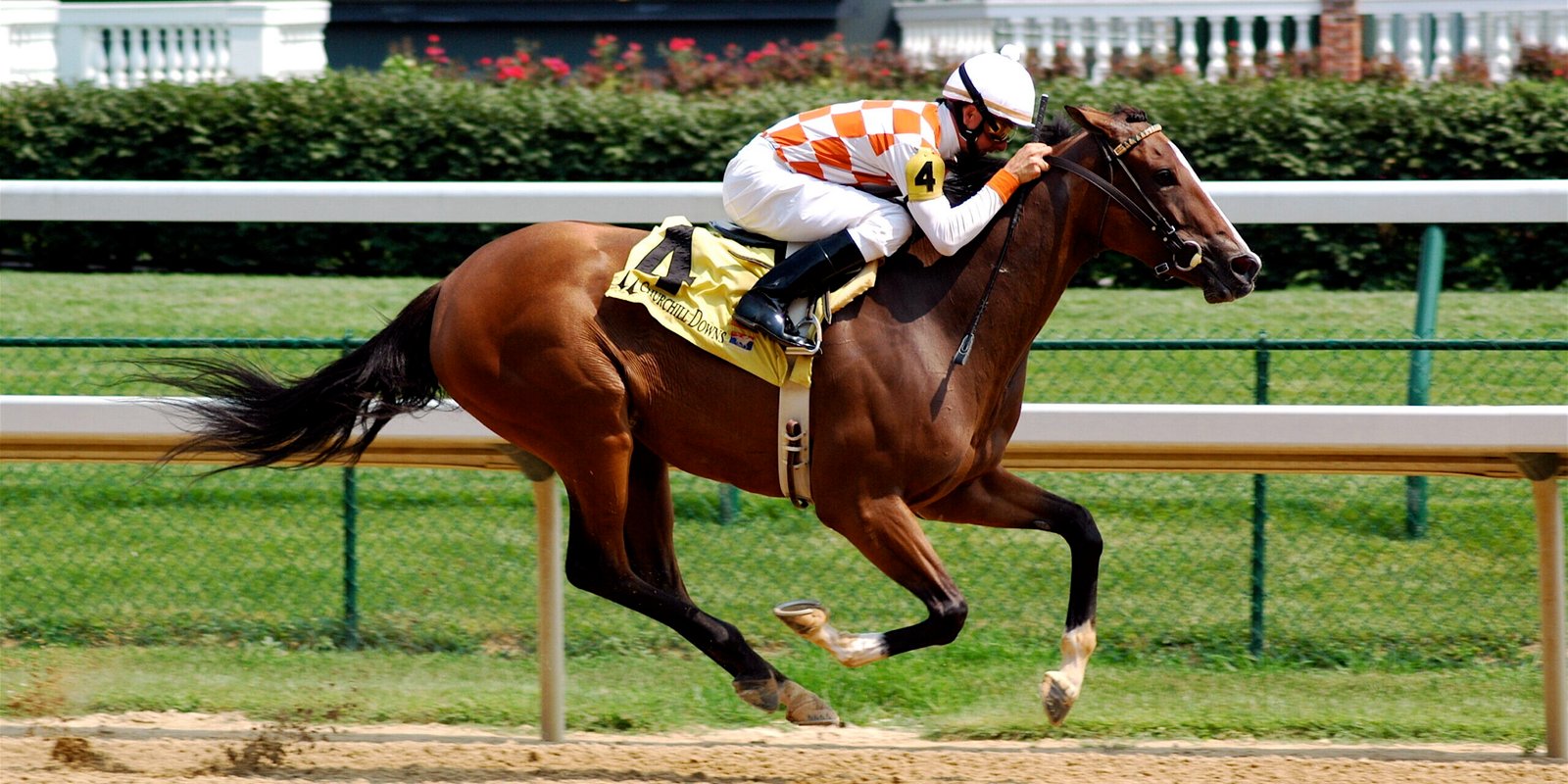
The first thing you noticed about Northlands wasn’t the horses. It was the ground, dust that caked onto your shoes like it held a grudge, cigarette butts mashed into the earth, the faint stickiness of spilled beer baking under a prairie sun that took its fleeting moment of strength seriously. This was Edmonton at the tail end of the 70s, and Northlands Park was not Churchill Downs, not Saratoga, nothing so polished it might show you your reflection. These grandstands on the prairie didn’t reflect anything. They absorbed.
My great-grandfather loved it.
He dressed as if the Queen herself might be taking bets at the dollar window, pressed shirt, hat set just so, and took me along, a six-year-old trying to understand why grown men leaned so heavily over paper. They stood in clumps near the grandstand, hunched over their racing programs like parishioners who had misplaced their faith but kept the ritual. They studied numbers the way ancient peoples once read entrails. Convinced that somewhere between a horse’s past performances and its posted odds, there was a whisper of the future waiting to be decoded.
What you had to understand about those men was that most of them actually knew horses, not as sport, but as labour. These were the sons and grandsons of homesteaders from central Alberta, men who had grown up reading an animal’s temperament through a stall door, who knew the difference between a horse that was lazy and one that was conserving. They had hitched teams in February cold, coaxed draught animals through Chernozemic mud, watched their fathers decide by feel, smell and the set of an ear which horse could be trusted and which one couldn’t. That knowledge didn’t disappear when the farms gave way to suburbs and the oil patch. It just had nowhere useful to go anymore. So they brought it to Northlands on a Saturday afternoon and aimed it at the racing form, which was not quite the same thing.
My great-grandfather, however, was less interested in the statistics.
He would drift away from the grandstand and down toward the paddock, where the smell shifted from tobacco and fried onions to something more immediate, horse sweat, hay, the thick living odour of animals that had not yet decided whether to cooperate. He went looking for the louder truths. Which jockey had been drinking past midnight. Which one was distracted by a woman who was not his wife. Which horse had taken a bad step coming off the trailer but would run anyway because money had already been promised elsewhere. Which race was meant to be won, and which merely performed.
It was not science. It was closer to gossip with a backbone, a kind of roadside anthropology dressed up as instinct. He assembled his predictions out of fragments no one could chart, let alone quantify, reading faces, silences, the way a handler avoided a question by answering a different one. And less often than he told my great-grandmother, he walked away with a few dollars and a story, while the men with their pencils and programs folded their losses into neat, private squares.
It would take me years to understand that he wasn’t just betting on horses. He was betting on the room.
The fever didn’t cross generations. I’ve never been much of a betting man. Faith, even less so. Which perhaps explains why I find myself watching the Catholic Church the way my great-grandfather watched the paddock. I don’t have money on the outcome, but I do have the uneasy suspicion that something is being decided that the program isn’t telling me.
But before the Church, a brief history of the business it used to run.
Human beings have always wanted to know what comes next. This is not greed…exactly. It is something older and more anxious, the same impulse that sent Greek city-states to Delphi with questions about war and succession, willing to cross mountains and wait in line for days in exchange for an answer that was, by design, impossible to falsify. The Oracle did not predict the future. She licensed a version of it. And the priests who managed the operation understood something that would not be formally theorized for another two millennia: that if your prophecy is ambiguous enough, the believer will do the work of making it true.
The Church refined the franchise. For roughly twenty centuries, it held something close to a monopoly on the infrastructure of divine influence, not just prophecy but intercession, the idea that the future was not fixed but negotiable, that the right prayers offered through the right channels to the right saints, might, with appropriate humility and a modest donation, be bent in your favour. It was, in the language of a later era, a futures market. You invested in outcomes you could not control, through intermediaries who claimed privileged access to the counterparty, and you hoped for the best.
The returns were mixed. The Church will be the first to admit this, or at least the second.
Then came the disrupters.
What the United States Supreme Court did in 2018, when it struck down the federal ban on sports betting, was not simply legalize a pastime. It privatized prophecy and handed it to the market, which immediately did what markets do: innovated past the original use case and kept going until the lawyers got tired. Prediction markets, platforms where you don’t only place money on teams but on outcomes, took over. Games are no longer the only gambler’s tale. Betting on events, elections, appointments, investigations, the rise and fall of public figures, spread with the quiet efficiency of a particularly motivated weed.
The theology here is worth pausing on. Where the Oracle at Delphi asked you to trust a god, and the Church asked you to trust a God plus considerable administrative overhead, the prediction market asks you to trust the aggregate wisdom of people with financial skin in the game. It is, its proponents will tell you with the ardour of the freshly converted, more honest than prayer. The odds don’t lie. The market knows.
What the market also knows, it turns out, is how to be worked.
Army Master Sgt. Gannon Ken Van Dyke, a special forces soldier involved in the planning and execution of the operation to capture Nicolás Maduro, placed over $33,000 in bets on the prediction platform Polymarket, winning more than $409,000 on his own mission. When informed of the arrest, the President told reporters: “That’s like Pete Rose betting on his own team.” He then added, apparently without irony: “The whole world, unfortunately, has become somewhat of a casino.”
Meanwhile, the White House Management Office circulated an internal memo reminding staff that using privileged information to place wagers is a criminal offense and a violation of federal ethics regulations. A memo issued, it should be noted, the day after POTUS announced a pause in strikes against Iran, roughly 15 minutes before which more than $760 million in oil futures had changed hands. Someone had to be told, in writing, not to bet on the events they were engineering. The memo named Kalshi and Polymarket specifically. Both platforms count POTUS Jr. among their advisers and investors.
Then there is the journalist. Emanuel Fabian, a military correspondent for the Times of Israel, reported that an Iranian missile had struck an open area near Beit Shemesh on March 10. More than $14 million had been wagered on a Polymarket contract tied to exactly that question. Bettors who had taken the wrong side began contacting him, demanding he change his story. One message read: “After you make us lose $900,000 we will invest no less than that to finish you.” What makes the episode genuinely vertiginous is this: more than 90 per cent of the betting volume on that contract came after the event itself, as traders fought not over what would happen but over what had already happened — and who got to say so. The market was not predicting the future. It was litigating the past, at gunpoint.
This is the part that would have made Mark Twain set down his cigar. The Oracle at Delphi was corrupt, certainly, the priests took a cut and the prophecies were calibrated to keep the clients coming back, but at least the Oracle was pretending to receive messages from somewhere outside herself. The prediction markets have dispensed with even that courtesy. There is no Apollo. There is no Vatican, no saint’s intercession, no heaven toward which your investment is directed. There is only the platform, the position, and the quite legal possibility of posting odds on an outcome you intend to produce.
America has not become a casino. That metaphor is too warm, too associated with free drinks at the nickel slots and the democratically distributed possibility of winning. What it has become is something closer to a derivatives market in which the underlying asset is reality itself, and the house, as ever, does not lose, because the house is now also writing the events.
And then there’s the Catholic Church.
An institution that ran the Western world’s prophecy infrastructure for centuries finds itself in the new millennia as something it has rarely been: a dissenting voice. In a world where strongmen from the President of the United States to Putin to Modi to Netanyahu are running hard on fear, otherness, and the very profitable business of manufactured grievance, the Church appears, somewhat to its own surprise, to be back in the paddock, trying to read the room rather than rig it. Less Caesar, more Sermon on the Mount. Less Inquisition, more open hand. When bishops pick public fights with the Global Bully and his ideological minions around the world, when the rhetoric leans less toward fortress and more toward fellowship, you notice. It is, at minimum, an unexpected entry in the field.
A less charitable reading, of course, is that this is just the long game in a new costume. After the public-relations equivalent of a very bad hangover following the Ratzinger years, the institution did what institutions do: adjusted the tone, softened the lighting, brought out a more approachable face. It is, if you squint, the ecclesiastical version of what the Americans managed going from Bush to Obama, same house, different curtains, the world briefly fooled and then not, though the curtains were admittedly quite good. The Church has been rebranding since before the printing press. It knows how this works.
And yet. There is something faintly arresting, if you look at it the right way, about an organization that once claimed to broker the future now being outflanked, on prophecy, on the monetization of belief, on the sheer brass of trying to influence what comes next, by a platform with venture-capital backing and a terms-of-service agreement less people read than even their gospels. At least the Church, in its better moments, pretended the outcome was in someone else’s hands.
My great-grandfather never tried to influence the race. He went to the paddock to observe, not to arrange. If he was wrong, he was wrong. No reinterpretation, no appeal and no steak for dinner.
He had no platform. No position. No algorithm. Just attention, and a willingness to lose.
I’d like to think Leo’s Church, in this new and slightly awkward mood, is doing something like that. Not betting on the loudest horse, or the strongest, but trying, quietly, imperfectly, to read a race it no longer controls.
