
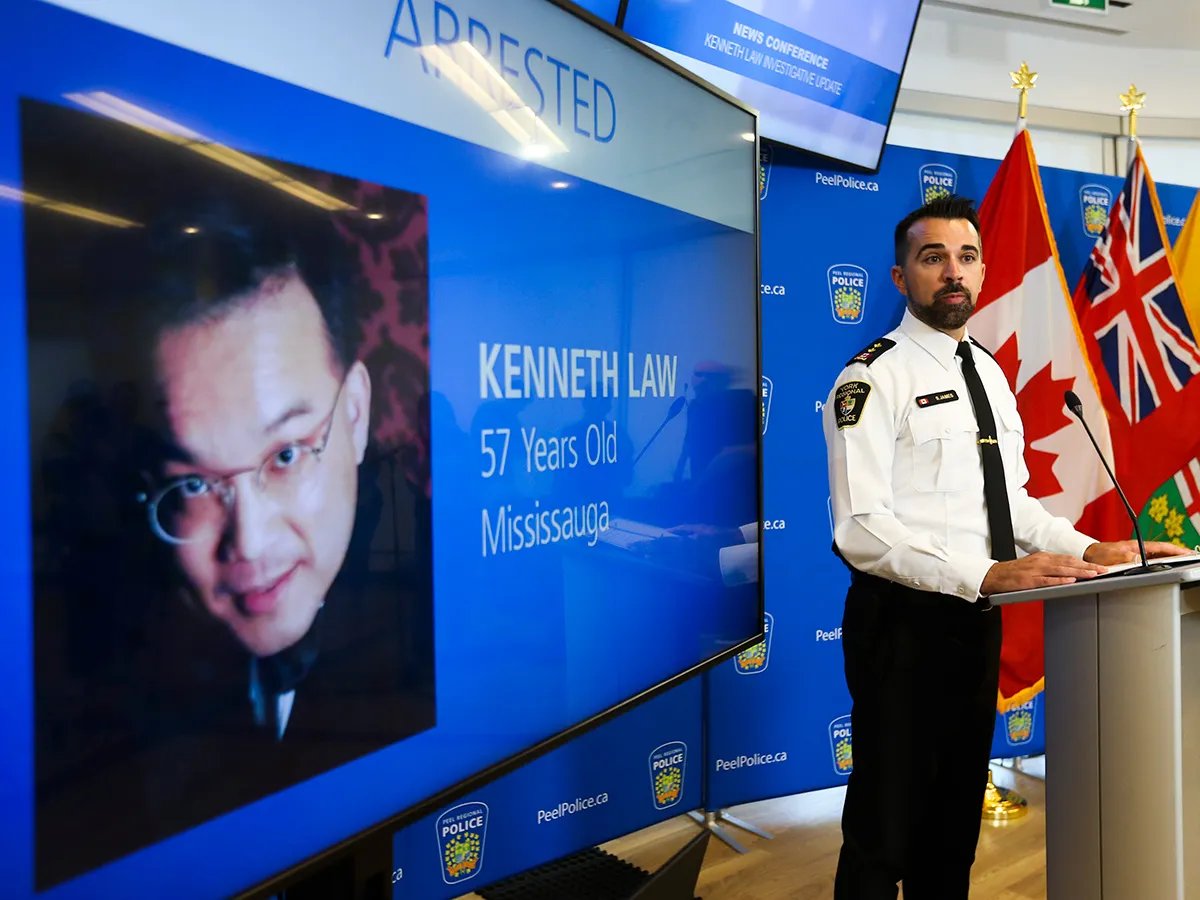
The British journalist’s sting that brought Kenneth Law to the attention of Canadian police three years ago played out with high cinematic tension.
Chasing reports of do-it-yourself poison kits marketed through an online suicide instructional chatroom and sold through a thinly disguised culinary supply website, Times of London reporter James Beal had tracked what he believed to be Law’s business to a post office box in a Mississauga, Ont., pharmacy.
Beal had spoken on the phone to a man he believed to be Law, posing as a customer. This man told him “many” of his customers had died from his product, so Beal and a photographer staked out the drug store from the parking lot on a cold winter day, hoping for a lucky break.
A man arrived in a Lincoln Town Car carrying a bunch of packages. Law was startled to be approached, Beal reported, but he was initially willing to talk, and invited the journalist to sit in his car. They spoke for six minutes.
Law grew increasingly agitated, and reportedly told Beal: “People do this but it’s not my business. It’s their life. They are killing themselves. I’m not doing anything. I’m just selling a product.”
Beal escalated the interview, confronting Law with the allegation that he had effectively murdered a young British man whose father had helped Beal track Law’s alleged online business. “If they have their intentions, I cannot stop them,” Law said, according to The Times. “Perhaps you want to stop people from buying knives?”
Law then ordered him out of the car. It was the beginning of the end for the alleged poison seller, whose business was allegedly global and has resulted in well over 100 deaths. A few weeks later, in May 2023, a week after The Times report was published, Peel Regional Police arrested Law, kicking off the most shocking Canadian prosecution in recent memory. They warned the public to be vigilant about online transactions and mailed packages, and listed several websites by name, allegedly connected to Law.
But the case will not go to trial. On Friday in a Newmarket, Ont., courtroom, Law, 60, intends to plead guilty to 14 charges of aiding suicide, according to his lawyer Matthew Gourlay. In exchange, the Crown is expected to abandon its charges of murder.
The victims include adults and children, with ages spanning 16 to 36. All are understood to have purchased poison allegedly from Law through an online store.
Law was originally charged with aiding suicide, first two counts and then 12 more, but after a few months his charges were upgraded to second degree murder, and then to first degree murder — planned and deliberate killing. This suggested both escalating seriousness of the evidence, but also perhaps an uncertainty about what specific crimes had actually been committed.
Law is expected to make his plea in front of a senior judge of the Ontario Superior Court, Michelle Fuerst, who until a few weeks ago was set to hear his trial before a jury on the far more serious charges of first degree murder. Conviction would have made Law one of Canada’s most prolific murderers, with more victims than child killer Clifford Olson, Toronto van attacker Alek Minassian, or Elizabeth Wettlaufer, a nurse who poisoned patients.
His trial would have taken place on legal territory that is both unmapped and hotly contested.
But Friday’s expected plea will instead mark the resolution of this controversial deal with the Ontario Crown, the seeds of which were planted years ago in an unrelated 2019 attempted murder-suicide that raised a fundamental legal issue about whether suicide can ever be a means of murder.
So the closing of the books on Kenneth Law also sets a crucial limit in Canadian criminal law.
Can someone be charged with murder if the deceased administers the fatal action themselves? The answer is yes, in theory. But the current leading precedent says this alleged murderer must overcome the victim’s free will. Otherwise, voluntarily taking poison is said to break the chain of legal causation from a poison seller’s actions to the death of a victim.
Because Law was allegedly nowhere near his victims when they took the poison, and indeed barely knew them when he sold it, this would be an obvious defence, and it could mean there is no reasonable prospect of convicting him of murder.
That seems to be part of the reasoning of prosecutors in recently agreeing to drop the murder charges in exchange for Law’s guilty pleas to aiding suicide.
The Supreme Court of Canada heard an appeal of the other unrelated attempted murder-suicide last year, but declined to firmly resolve this fundamental issue, drastically weakening the case against Law just weeks before his expected trial.
Many families of other alleged victims will be watching his plea closely, especially in the U.K., where Law is being sued by the family of a teenager who died by suicide, and where Law is allegedly linked to more than 100 deaths, currently under investigation by the National Crime Agency.
An online forum previously allegedly used by Law to promote his sales was fined almost 1 million pounds this month by a British government regulator for hosting illegal instructions about suicide. The Times investigation reported the theory of several grieving family members that Law used a false identity, “Greenberg,” claiming to be a retired pathologist from New York, to allegedly communicate with customers and direct them from the suicide forum to the culinary supply website, through which they would buy the poison, sodium nitrite, a salt that is used to cure meats and which is toxic in sufficient quantities.
Law has a background in business management and aerospace engineering, but when he was arrested, he had been working as a cook in the Fairmont Royal York hotel in Toronto.
His plea deal might reveal details of his alleged motivations, whether financial or ideological or both or something other entirely, but his alleged involvement already seems to have ideological aspects in the context of right-to-die activism.
Philip Nitschke, an Australian right-to-die campaigner and former general practitioner, has publicly claimed to have introduced Law, at a conference in Toronto, to the notion of sodium nitrite as an affordable and reliable means of suicide by poison.
Law’s alleged involvement in this business also coincides with personal bankruptcy and the loss of employment during the pandemic.
Behind the scenes before Law’s arrest, police forces across Ontario had been frantically trying to track packages he allegedly had already sent, more than 1,200 of them to more than 40 countries, and to arrange wellness checks for the intended recipients.
At the same time, the unrelated case of B.F., a hospital surgical nurse in Mississauga, Ont., was heading for an appeal, with a fundamental question with obvious relevance to the case against Law: Can suicide be murder?
Prosecutors believed B.F., anonymized by court order to protect her daughter and mother’s identities, had used insulin injections to poison her mother, her 19-month-old daughter, and herself, motivated by a custody dispute with her estranged husband. Both B.F. and her mother survived and recovered, but the child’s injuries to her brain and organs were life-altering.
B.F. was tried for aggravated assault and attempted murder, two counts each. A defence theory was that B.F.’s mother was an active participant in some of the actions that amounted to this alleged attempted murder-suicide, and might have injected herself with insulin.
The jury convicted B.F. of attempted murder on both, but acquitted on aggravated assault of the mother, which suggests reasonable doubt about who actually administered insulin to the mother.
Reviewing this, the Ontario Court of Appeal decided there was an air of reality to the defence theory about the mother, and that the mother’s possible participation and desire to die could have been relevant to whether B.F. was guilty of her attempted murder. Depending on her intent, the appeal court ruled, she might have been guilty of aiding suicide rather than attempted murder.
The problem was that the jury had not been instructed about the legal difference between attempted murder and aiding suicide, the same charge Law now faces, under section 241(1)(b) of the Criminal Code.
So the Court of Appeal voided the conviction for attempting to murder the mother, and ordered a new trial just on that. But this decision was itself appealed to the Supreme Court of Canada, which had the opportunity to clarify how voluntary suicide can be charged as murder, the very core of the case against Law.
It declined to do so.

It heard the case, and decided there had been no need for the judge to instruct the jury on this point. Aiding suicide was not on the table at trial. B.F. was never charged with it. It is not a lesser and included offence to murder. B.F.’s jury was not allowed to convict on it instead of attempted murder, as juries are sometimes able to do based on their well-instructed judgment, for example to convict merely on assault instead of assault causing bodily harm.
There was also “no air of reality” to the theory that the mother was an active participant in B.F.’s actions, the Supreme Court’s majority found.
Jury instructions need to be accurate and sufficient, not perfect, they decided. Instructing juries on far-fetched defence theories with no air of reality “would only serve to cause confusion and needlessly lengthen the judge’s charge.”
On the issue of whether a voluntary attempted suicide means no one else can ever be charged with attempted murder over the same incident — such as taking poison provided by the accused — the Supreme Court justices wrote that “No view is expressed.”
It said the Ontario Court of Appeal “unnecessarily complicated this matter…. The question of the legal relationship between attempted murder and aiding suicide has no bearing on the appeals.”
So the question remained. Can a person be found guilty of attempted murder for providing lethal tools that are used voluntarily by the victim? The Crown said yes, and B.F. said no.
In law, the clearest description of this problem is in the Ontario Court of Appeal’s decision, the outcome of which was overturned. But the point remains in the jurisprudence. In the case of a murder charge based on providing a suicide drug, a jury or judge should consider not only whether the accused provided the drug, “but also whether they interfered with the independent will of the person to self-administer it or not.”
The Supreme Court left this uncontradicted.
“I decline to conclusively resolve this abstract legal issue in this appeal,” wrote Justice Michelle O’Bonsawin for the majority.
For Law, this was more than an abstract issue, and this decision seems to have worked in his favour, now that the Crown has abandoned its murder prosecution.
Sentencing is expected to be argued at a later date. Aiding suicide carries a maximum sentence of 14 years.
Our website is the place for the latest breaking news, exclusive scoops, longreads and provocative commentary. Please bookmark nationalpost.com and sign up for our daily newsletter, Posted, here.
