
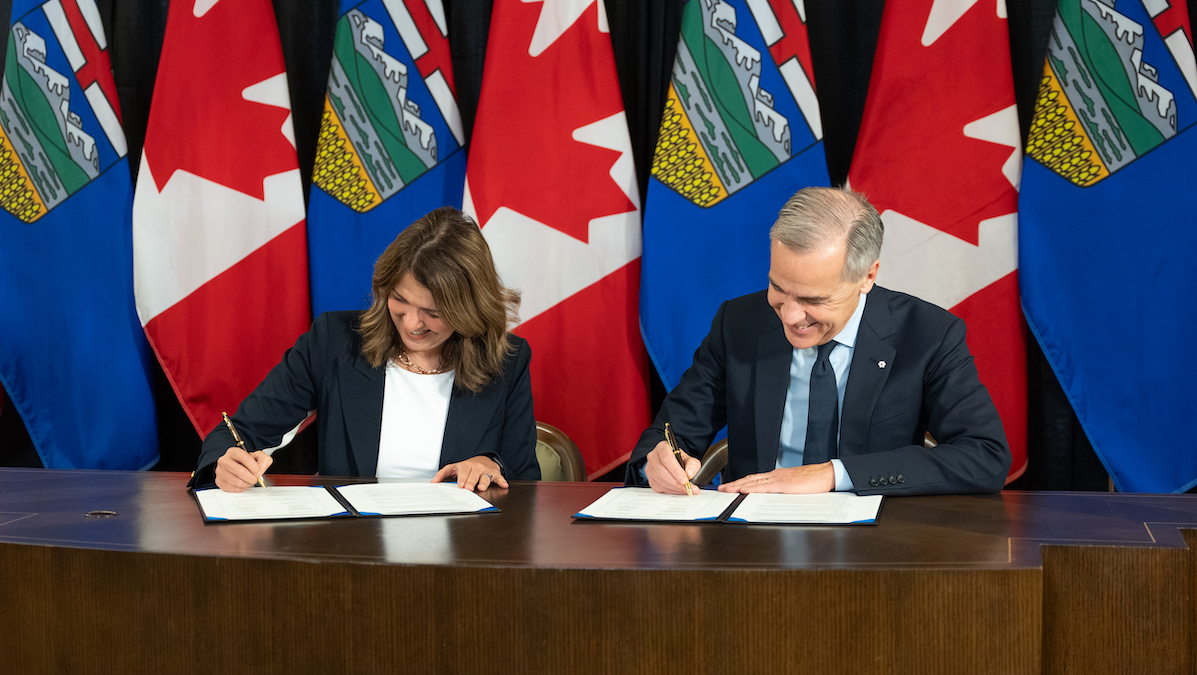
How many times do Liberal prime ministers have to learn that coddling Alberta gets them nowhere?
Justin Trudeau learned that bitter lesson when he tried to woo Alberta by putting up federal money to expand the Trans Mountain pipeline — after private builders refused to — ultimately leaving Canadian taxpayers on the hook for $34 billion.
The memory of that wildly expensive pipeline — and the fact that it won Trudeau no favour in Alberta — should have been enough to make his successor, Prime Minister Mark Carney, wary.
But no. Once elected, Carney abandoned his pre-election climate talk, cancelling a number of Trudeau-era climate measures and signing a deal with Alberta committing to support a whole new pipeline.
Last week, Alberta premier Danielle Smith demonstrated that all this appeasement had won Carney nothing when she announced that Alberta will hold a referendum that opens the door to a future referendum on Alberta separation.
Carney has gone too far
There’s no reasonable way to satisfy the separatist cause in Alberta and Carney has already gone dangerously far in attempting to do so, sacrificing the minimal progress we’ve made in the climate battle — all in the interests of pleasing Big Oil, which is the real driving force in Alberta politics.
The role of Big Oil has remained largely hidden in the current drama, as the media focuses on Smith’s self-serving behaviour.
But it’s important to note that the Alberta separatist movement isn’t just a natural, homegrown development. It was instigated, financed and encouraged by the fossil fuel industry, which has used it as a cudgel to resist climate action.
This began over a decade ago when the oil industry, frustrated that environmentalists were alarming the public about climate-related wildfires, decided to move beyond traditional lobbying and launch a campaign to mobilize grassroots support for the industry.
The campaign by the Canadian Association of Petroleum Producers (CAPP) was modelled on a campaign by the American Petroleum Institute. It has fostered a movement of right-wing activists — dubbed “petro-populists” or “extractive populists” — who trumpet the benefits of the fossil fuel industry and fiercely oppose climate action, writes Simon Enoch in “Briarpatch” magazine.
These petro-populists were influential in the “Freedom Convoy” that occupied Ottawa in winter 2022; convoy leader Tamara Lich highlighted her petro loyalties when she appeared in court wearing a sweatshirt that read “I love Oil and Gas.”
Central to the separatist cause — and more broadly to “Western alienation” — is the belief that Eastern elites have consistently sabotaged Alberta by undermining the fossil fuel industry.
Always ignored (along with Ottawa’s Trans Mountain financing) is the fact that Ottawa appeased Alberta in the mid-1980s by adopting the world oil price, thereby depriving Canadians of a lower, domestic price. (Some other oil-producing nations still provide a reduced price for domestic consumers.)
Costly for Canadians
This decision has been costly for Canadians, particularly when the world oil price soars — like now, due to the closing of the Strait of Hormuz.
Economist Jim Stanford notes: “The vast majority of Canadians (including those living in oil-producing provinces) will be significantly harmed by this price shock. The only clear winner is the petroleum industry.”
Indeed, the Canadian petroleum industry is collecting tens of billions of dollars in windfall profits and will continue to do so as long as the strait remains closed.
The industry pays royalties and taxes in Canada, but the bulk of its gigantic windfall will end up outside Canada — since the Canadian industry is mostly foreign-owned, as political economist Gordon Laxer has documented.
Although a Canadian windfall profits tax on the oil industry would make sense, no such idea will even be considered as the national debate focuses on how to keep Alberta happy.
But let’s be clear about what we’re appeasing. Unlike the Quebec sovereigntist movement, with its deep linguistic and cultural roots, the Alberta separatist movement has been shaped and nurtured by corporate interests — and foreign corporate interests, at that.
This article was originally posted in the Toronto Star.
