
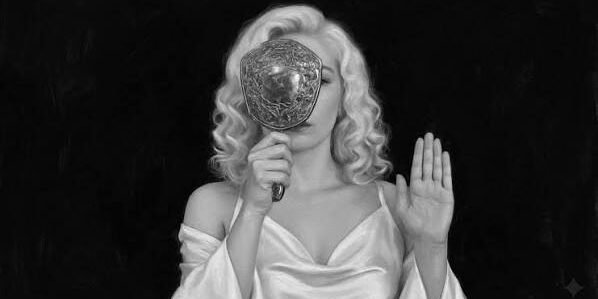
Consider for a moment what it would be like to be a fly on the wall at a cocktail party hosted by Marilyn Monroe and her husband, Arthur Miller, when the only guest is Norman Mailer. Now, imagine that turned into a play.
American Devotion, a fictional play by Franca Miraglia, explores the intersection of fame, politics and power in 1957 America. The play is set in Monroe and Miller’s Connecticut farmhouse just after Miller has been called to testify before the House of Un-American Activities Committee at the height of McCarthyism.
Miller was Monroe’s third husband. Monroe was Miller’s second wife. Their marriage lasted five years on paper from 1956 to 1961.
Their guest, Norman Mailer, a Pulitzer Prize writer, journalist, and filmmaker, was obsessed with Monroe’s life and death despite never having met her.
For added context, it’s helpful to note that Mailer had a total of six wives, one of which he famously stabbed with a penknife during a party at the couples’ home in 1960.
The play in reference, American Devotion, explores a fictional universe where Mailer successfully engineers a coveted invitation for cocktails with the reclusive couple.
Inspired by a passage from Miller’s 1987 autobiography, Timebends: A Life, in which Miller admits that he regrets not inviting Mailer to the couple’s home for dinner. That snub appeared to fuel Mailer’s vengeful writings about Miller, Monroe and her death.
Mailer’s bio-novel, Marilyn: A Biography (1973) was his creative interpretation of Monroe’s life. In 1980, Mailer wrote a second imagined autobiography titled, Of Women and Their Elegance. His play Strawhead, co-written with Richard Hannum, an adaptation of Women and Their Elegance, focused on imagined interviews between Monroe and Mailer during the last hours of her life. Mailer went so far as to cast his daughter, Kate Mailer, as Monroe.
American Devotion delves into the ravages of celebrity culture that’s reliant on fickle fans; the expectations placed on art and the need to remain relevant. The play also explores political paranoia and the personal cost of public loyalty.
Playwright Franca Miraglia puts two larger-than-life men together in a room. They then have to figure out how to pass the time while they wait for the notoriously late Monroe to finally make her entrance.
Eventually, the debate devolves into a battle, pitting Miller’s brains against Mailer’s brawn. This culminates in an epic, “take no prisoners” fight with Monroe as the ultimate prize. But, never underestimate a brilliant woman, because Monroe knows the dynamics stating, “Two men together in the same room. Of course it’s a competition: one wins, the other doesn’t.” And, Monroe ultimately has her own plans.
Misha Harding portrays Monroe in Miraglia’s production. It will be making its world debut June 4 in Toronto. Harding believes very few people, past or present, are as iconic as Monroe.
“Everyone carries an image in their head of who she is. A favourite movie, what she looks like, what she sounds like. It’s hard to imagine any actor living up to that blonde bombshell image. But ‘Marilyn’ was just that: an image, a persona, one carefully and consciously curated by the woman herself,” Harding told rabble.ca via email.
What struck Harding most was the conflicting duality within Monroe that’s reflected in her own writings. Despite being emotionally perceptive, fragile and deeply vulnerable, Monroe had a poetic optimism and grounded sense of humanity.
Often portrayed as the dumb blonde or the victim of circumstance, Monroe was a self-educated, self-made success in an industry dominated by powerful men. By leveraging her sharp skills as a comedian and reclaiming her sexuality, Monroe cleverly and consciously crafted an unforgettable persona while risking her career by pushing back against the studio system, demanding better roles, fair pay and creative control. In fact, Monroe even co-founded her own production company, Marilyn Monroe Productions, with Milton Greene in 1955.
Her strong moral compass and capacity for empathy meant Monroe spoke openly about the sexual abuse she experienced as a child while she used her substantial influence to give a hand-up to other women, most notably Ella Fitzgerald. In order to help Fitzgerald get a booking at the Mocambo nightclub, Monroe promised to sit in the front row each and every night.
When asked how it feels to play such an objectified and misunderstood woman as Monroe, Harding replied, “It’s a deeply exciting, and truthfully intimidating, honour. I may be depicting a fictional version of Marilyn, but she was a real person. And, given how well-known she is, I think it’s safe to say that playing her comes with certain expectations. For me, the challenge is finding the balance between giving audiences a sense of the icon they recognize and portraying a more intimate, complex interpretation of the real woman behind the persona.”
Miraglia remembers always having an outsized fascination with Monroe. “It is crazy to think that many of her contemporaries dismissed her as a “starlet” or a “sex symbol” and yet she has endured all these years. June 1st will be the 100th Anniversary of her Birthday and the number of special exhibits, events and celebrations around the world planned to honour her is amazing!” Miraglia told rabble.ca.
She remembers watching Some Like It Hot as a young woman and being enthralled with Monroe’s mix of pure sexiness and strong sense of self-worth. That confirmed for Miraglia that she did not need to fit nicely into any box “others” used to define her.
Miraglia wrote American Devotion over 12 years ago. While it had many close calls, it never got a production partially because some felt McCarthyism was a forgotten part of US history.
Miraglia had almost given up on getting American Devotion produced. Then Trump got elected for a second term and the US history of dabbling with fascism during McCarthyism suddenly seemed relevant and worth exploring.
“Suddenly the rising tide of fascism around the world with strongman political leaders that use fear fueled by social media to control populations, makes it worthwhile to take a closer look at McCarthyism and specifically how it pressured actors, screenwriters, directors and entertainers to “name names” of friends with ties (real or imagined) with communism. And if they didn’t cooperate with the House of Un-American Activities (HUAC) then they risked being blacklisted and silenced along with financial ruin,” said Miraglia.
“Speaking truth to power is something that needs to be protected – our media, our artists, our schools all need to have this fundamental right protected as the first-line of defence against the encroachment of fascism,” she added.
As a Canadian playwright, Miraglia believes we can’t look to the US and just assume that nightmare couldn’t happen here. She highlights the obligations of citizens. Those of which require each of us to be informed, stay vigilant and hold politicians responsible for delivering on social and economic policies that best serve the country and all of its citizens.
June 1, 2026 would have been Marilyn Monroe’s 100th birthday. In celebration of that momentous occasion, By the Word Productions is presenting the World Premiere of American Devotion. And, the timing couldn’t be better as America and the world slogs its way through three and a half more years of Trumpism and everyone with a social conscience or sense of social justice is being labelled a communist while women are relegated to being blonde, dumb and obedient.
