
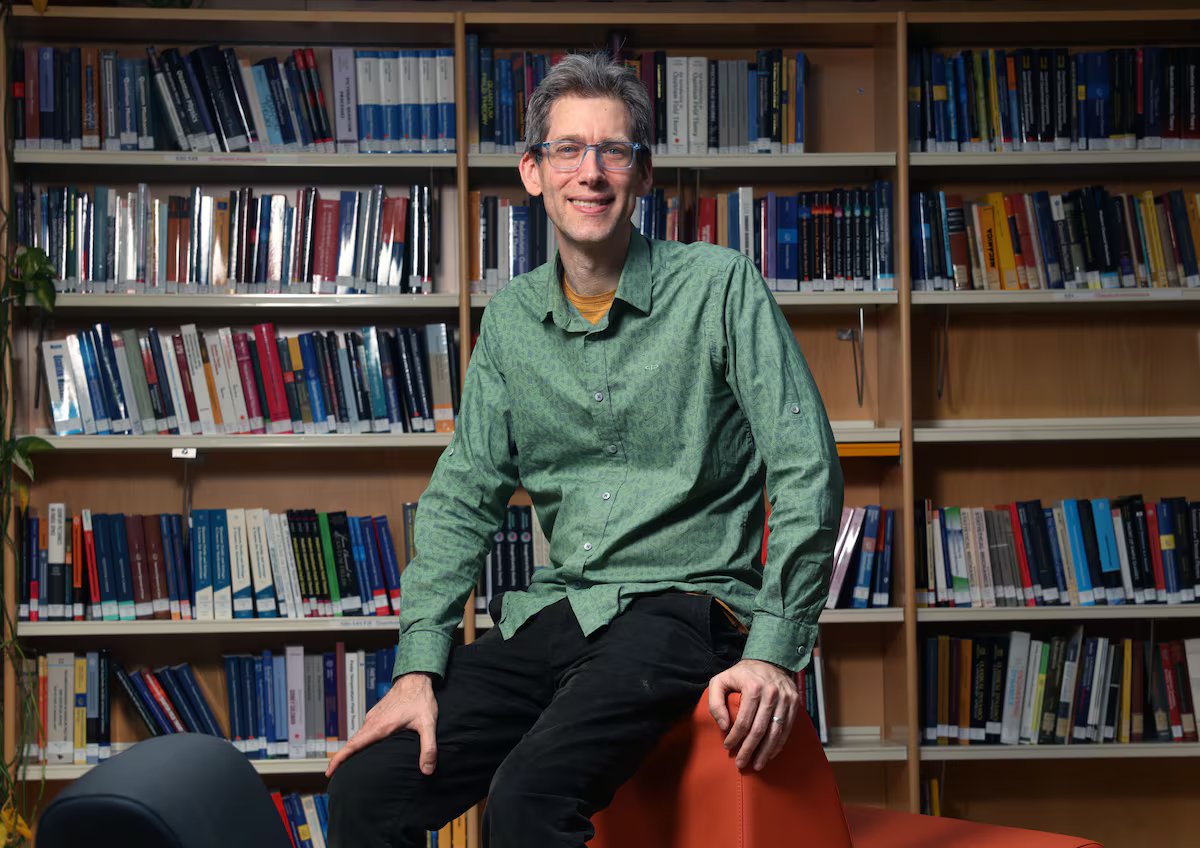
Aram Harrow has spent 25 of his 46 years working in quantum computing. He is a researcher at the Massachusetts Institute of Technology (MIT) and is best known for co-developing the HHL algorithm in 2008, considered one of the first demonstrations of an exponential advantage of quantum computers over classical ones. This June marks the end of the year he has spent at Spain’s Institute of Mathematical Sciences (ICMAT) in Madrid, where he speaks with EL PAÍS.
Quantum computing has spent years promising astonishing breakthroughs. But in 2022, ChatGPT arrived, and AI dethroned it as the technology most likely to solve humanity’s biggest problems. Harrow, however, explains that now it finally seems possible that quantum computers and quantum software — two separate challenges — may actually begin to deliver results.
Question. What is the worst prediction you have made in these 25 years?
Answer. I have been too pessimistic. I always said it would take 10 to 15 years. Now I think we have to be prepared for interesting quantum computers to appear sooner, in the range of thousands of qubits.
Q. Really?
A. We already have little quantum computers. The next step is when they can do something useful that is impossible for our current computers. That’s when quantum computing will have arrived.
Q. Will there be a “quantum day” like the arrival of ChatGPT?
A. It will be gradual. We already had the day when Google ran its quantum computer, and no classical machine could simulate what it did. That day came and went.
Q. That’s true. There was even a Spaniard on the project. But that milestone passed.
A. And we keep going.
Q. Where are we now?
A. We’ve reached a higher point, but only a little bit higher. Regarding software, one thing we have achieved is better error correction.
Q. It’s not headline material.
A. Exactly. One way to view it is like Moore’s Law for classical computers. Every 18 months they would get better. Some people talk about something called Schölkopf’s law, which is similar, and suggests that qubit quality improves every year in quantum computers. What ultimately determines whether we can build a scalable quantum computer is how many operations you can perform on a qubit before noise ruins your data.
Q. And does that law work?
A. It’s steadily improving. Each year the noise rate goes down a bit. There are two axes. On the one hand, the noise rate gets a little bit better each year; on the other, the challenge is integrating more qubits. You need to advance both at the same time.
Q. Quantum algorithms are ahead of the machines.
A. When you think of quantum algorithms, imagine you’ve been waiting 20 years for a car to be built. While you build roads, parking lots, even car washes, you’re preparing everything and imagining what the car will be like. There are things you can do, and others you only figure out once you have the car.
Q. That is, the computer.
A. One field where we’ve just seen that is AI. Some of its algorithms were developed in the 1960s and didn’t work well until they were given all the data they have now. You couldn’t have predicted they would work well. You just had to try them and then you saw it. Something similar happens with quantum computers: there is a lot we know only on paper. We know the chemistry will work. But also, as they start to be built, we’ll learn much more.
Q. What do you mean by chemistry?
A. One major application is simulating a molecule for chemistry or materials science problems, and another one is breaking encryption codes. Both could happen sooner than expected.
Q. Molecules and the end of encryption are the examples we always hear.
A. Those of us who work on software for quantum computers always want to find more tasks they can do. On the one hand, we want to do more efficiently the things we already know they can do. We’ve known for 30 years that quantum computers can simulate molecules. But it was inefficient. Regarding encryption, I don’t think people should wait 10 years to change their encryption schemes.
Q. Maybe the day of the big headlines will be when quantum computing breaks traditional encryption. Then we’ll say it has finally arrived.
A. It is already here now. It’s not having an economic impact now. Its main use so far is to figure out what we will do with future quantum computers.
Q. What impact will consumers feel directly?
A. Perhaps a drug. Even in the fields where it’s useful, such as simulating molecules and materials, quantum computers seem good at problems different from those current computers already master. So the most likely outcome is that we will simply do more of those activities: more chemistry, more materials science, because we can discover more.
Q. The AI boom has triggered astronomical investment. Will the same happen with quantum computing?
A. I would love quantum computing to become that big. But I think its applications won’t be so broad. Everyone sees how AI can be useful in some part of their work. Quantum computing will be very useful, but for fewer things.
Q. Will it be a smaller sector?
A. Yes. Think how many people use a supercomputer today. There are some problems that really need a supercomputer to be solved. But most people do not work with one in their day-to-day lives.
Q. Has all the hype around quantum computers been a problem?
A. Sometimes people have unrealistic expectations that this will solve every problem in the world. It’s amazing that quantum computers are a possibility, that the way our universe can solve mathematical problems is not what we always imagined. Since the Greeks, we’ve thought solving a mathematical problem meant following step-by-step instructions. If you want to multiply two numbers, you first take these digits, then do this and that. Everyone assumes information must be processed that way. The fact that quantum mechanics says the universe can process information in a very different way, and that we can harness that to solve things we otherwise couldn’t, is thrilling. Whether it will have great economic utility is another question. That it is intellectually thrilling doesn’t mean it will solve every problem, nor that we’ll live like Ant-Man.
Q. How do you explain quantum then?
A. It’s as if my job were a magician. Even if it’s crazy, it follows rules. There are things you can’t do.
Q. You can’t teleport yourself.
A. No. You could say it’s exciting that there are black holes, but that won’t change your life. But there are indirect uses of quantum computing that could be very interesting. One of my favorites is building fusion reactors. They’ve tried and failed for a very long time. Some think a better approach would be a smaller reactor with a stronger magnet based on new superconductors. Superconductivity is a quantum effect in materials that’s poorly understood. There are many mysteries about superconductivity that people have struggled with for a long time, and a quantum computer could help to understand them. So one road to fusion energy could be better superconductors, and one road to that could be quantum computers.
Q. But is that possible?
A. Right now I work on improving the simulations that quantum computers perform on materials. And when that works on quantum machines, it will help to understand the materials used in superconductors. There are many steps where that may lead to better fusion energy. I don’t want to promise it will happen, but it’s an example of what we could hope for.
Q. Has AI led to fewer scientists working on quantum computing?
A. It’s hard to know because many other things are changing at the same time. Our field is still growing. Would it have grown even faster without AI? It’s hard to say. There have always been people who do a PhD in quantum computing and then work on something else. Previously, they might have gone to work at Google or a financial firm. Today they go to work for an AI company. This happens with physics PhDs all the time.
Sign up for our weekly newsletter to get more English-language news coverage from EL PAÍS USA Edition
