
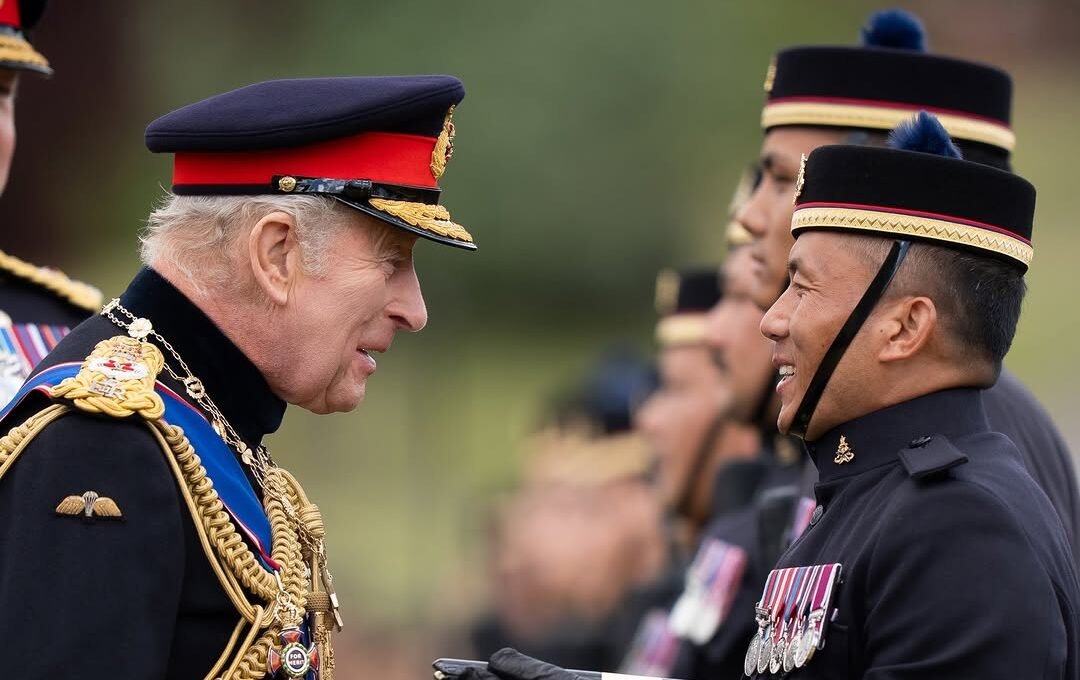
King Charles III visited the King’s Gurkha Artillery at Larkhill on Friday for the regiment’s Formation Parade, marking the creation of the British Army’s first dedicated Gurkha Artillery unit.
Speaking in his role as Captain General of the Royal Regiment of Artillery, Charles addressed the assembled soldiers. His words captured both the history and the weight of the moment. The Royal Family’s official Instagram account shared his remarks: “As Captain General of the Royal Regiment of Artillery, it gives me the greatest pride on this most significant day to witness the formation of your new regiment – The King’s Gurkha Artillery.” He then turned to Nepali for his closing line: “Ajur din ramro cha!” – which translates to “Today is a good day!”
Larkhill, home to the Royal School of Artillery in Wiltshire, was a fitting location. The regiment was formally established in April 2025, and Friday’s parade served as its public landmark.
The King’s Gurkha Artillery draws on more than two centuries of Gurkha service to the United Kingdom. Soldiers from Nepal have fought alongside British forces since 1815, following the conclusion of the Anglo-Nepalese War. Their service record spans both World Wars, the Falklands, and Afghanistan. Gurkha soldiers earned a lasting reputation for courage across all of those conflicts.
For most of those two centuries, Gurkha units served primarily in infantry roles. The new artillery regiment marks an evolution in how the Brigade of Gurkhas is structured within the broader British Army. It gives the brigade capabilities it hasn’t formally held before, suited to the demands of modern warfare.
Plans call for the regiment to grow to more than 500 personnel by 2029. That’s a real commitment for a unit formally established just over a year ago. To mark the formation, a new cap badge was commissioned – the first in 14 years. The badge reflects both the Gurkha heritage and the regiment’s place within the Royal Regiment of Artillery. For a regiment with this kind of lineage, that emblem carries real weight.
Charles’s choice to address the regiment in Nepali was a deliberate one. The greeting connected directly with the soldiers’ background. It went beyond the formal script of a military ceremony to acknowledge the culture that shaped these men. Gestures like that carry meaning at events where heritage and service meet.
Charles has maintained a consistent connection to military life throughout his public career, both as Prince of Wales and now as King. His father, the late Prince Philip, held a similar dedication to the armed forces across decades of public service. The Larkhill visit fits within that tradition. The formation of an entirely new regiment sets it apart from a standard review or anniversary visit, though. This was something different.
The King’s Gurkha Artillery will continue building toward its 2029 target. For the soldiers who stood at parade on Friday, that future is now officially underway.
