
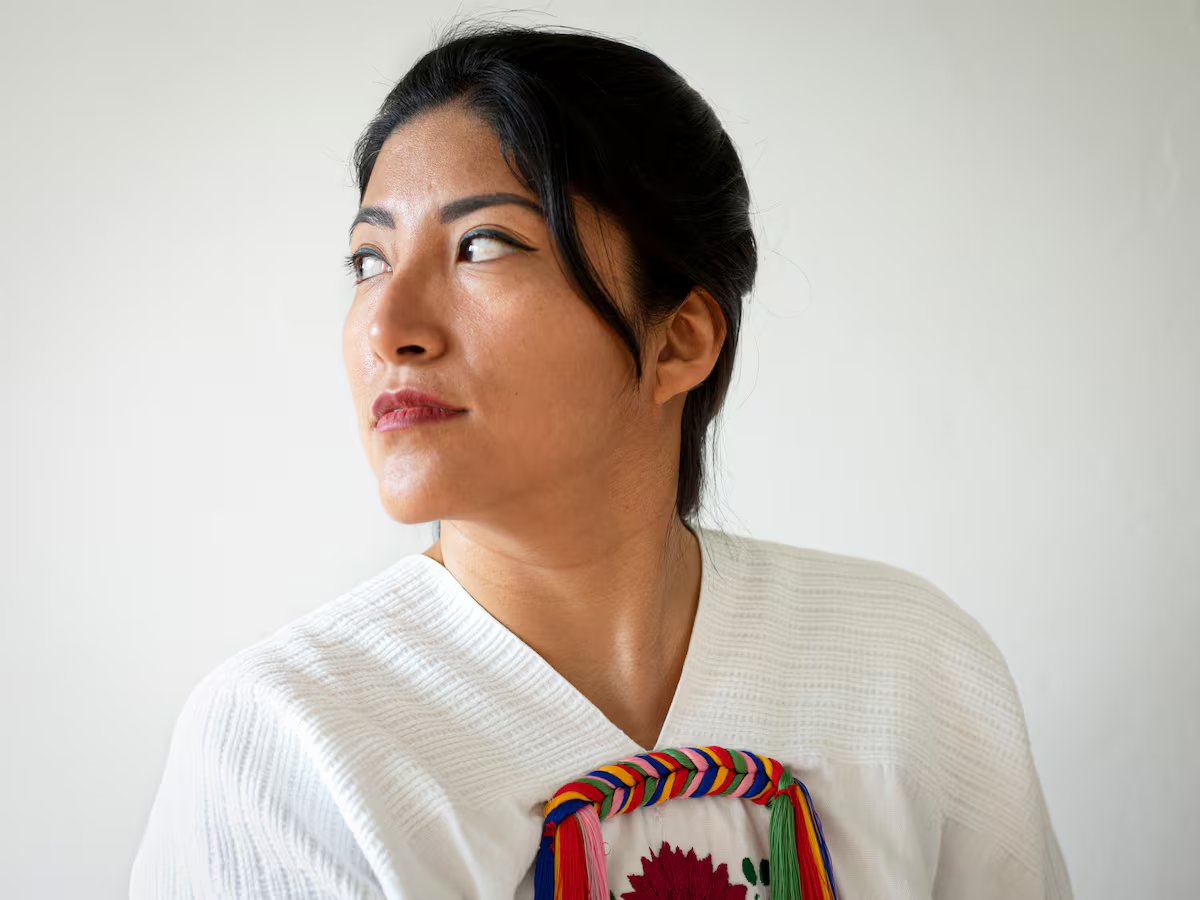
In each photograph by 37-year-old Citlali Fabián, you can find the story of an encounter, as well as an attempt to portray memory with dignity. For her series Bilha, Stories of My Sisters, the artist — who hails from the Yalateca Indigenous community in the Mexican state of Oaxaca — was named Photographer of the Year at the 2026 Sony World Photography Awards, run by the World Photography Organization. This is one of the most prestigious recognitions in her field.
Eight photographic portraits — taken and manipulated by the artist — strengthen the legacy of activists in Oaxaca who defend water, territory, linguistic diversity, women’s rights, native corn varieties and local cinema.
Fabián has been a fellow with the Magnum Foundation, as well as a National Geographic Society explorer. She’s also part of the Women Photograph and Indigenous Photograph collectives. In 2018, her series Mestiza was selected as one of the 13 favorite photo stories by The New York Times and, in 2023, she was invited by World Press Photo to serve as a regional judge.
She now lives in London in the U.K., and describes herself as a photographer from the Yalalteca community and as a first-generation migrant. She grew up in Oaxaca City: there, she remembers receiving the rolls of film that arrived at her father’s shop to be developed. “The connection with the people and the understanding that they were collecting memories marked me in a way that I can’t separate from my life,” she says in an interview with EL PAÍS.
Later, she studied photography and won a scholarship to visit the George Eastman Museum — the oldest museum dedicated to photography — in Rochester, New York. There, she recognized her community in photographs taken by Lola Álvarez Bravo and Mariana Yanpolski, prominent 20th-century Mexican photographers.
“It was inspiring to find so many photographs of Oaxaca in an archive and to think that my grandparents had been to those places,” she says.
Among captions like “unnamed” or “a place known as Sierra Norte,” she encountered descriptions far removed from what was familiar to her. “It was very powerful to see my grandmothers in portraits and to find people whose names were no longer known. That gave me the motivation to continue taking my photographs,” Fabián recalls.
Image as ritual
At a time when cameras have become part of everyday life, the Indigenous artist evokes the memory of her grandmother and transforms photography into a ritual.
“For me, photography — and the ritual of being photographed — are connected to understanding the practice as an extension of memory. My grandmother saw photography as a very special moment: if I told her I wanted to take her picture, she would go and do her hair and get ready. She only had one photograph of her mother, and it’s the only memory she has of her. I began to understand how photography can be a moment to reconnect with memory; it can be incredibly powerful as a tool for rediscovering yourself.”
In Fabián’s work, the ritual goes beyond the moment of pressing the shutter. It’s in the cotton thread that runs through a series of black-and-white photographs of her ancestors, in the image of herself as a child, printed on fabric inside a hoop that holds her embroidered memory of the Sierra Norte of Oaxaca; and in a seed sprouting from her navel, captured in wet‑plate collodion (a photographic technique) in her series Ben’n Yalhalhj – I’m from Yalálag – Soy de Yalálag.
Her work involves reconnecting with her territory. It’s rooted in physical spaces, but also in the extended relationships of a family tree and a migrant community. “In the region I come from, photography wasn’t accessible until recently. Being able to preserve a memory in this way is a privilege. How do you honor that privilege? Not necessarily with the camera, but with the image.”
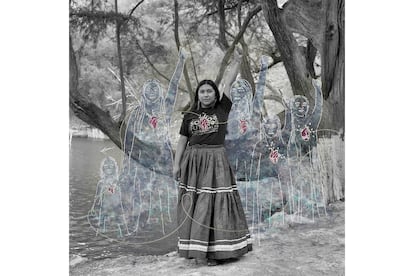
Just as the materiality of an image is important, so is the individual and collective process behind each of her photographs.
Fabián explains it this way: “I see how my context impacts the way in which I create. With the colonizing and patriarchal history of photography, our perspectives and ways of creating are more necessary than ever, especially in the world we live in, where we encounter so many narratives that erase identity. Like war coverage in Palestine, for example: many media outlets continue to perpetuate the colonizing gaze of turning a human being into the ‘other,’ someone without an identity.”
Collectivizing the process
With her camera in hand, Fabián proposes something different. And, with the award-winning series Bilha, Stories of My Sisters, she demonstrates the possibility of practicing photography through a shared process, keeping collective memory in mind.
“In this series, the photographic act took a back seat,” she explains. “By the time we began each session, we had already had coffee, we had talked for at least two hours, and I could understand the spaces they liked for their portraits. That’s what made the difference: the photo was important, but the connection we could achieve and my interest in their stories were even more so.”
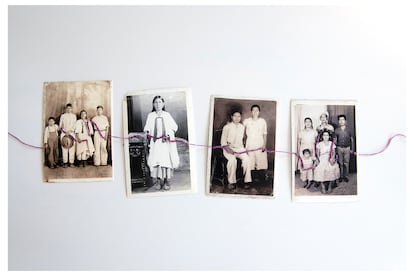
More than a description of her creative process, Fabián speaks of a methodology in progress and an artistic and political proposition. “I seek to find a world in which the person portrayed can feel included in the decision-making process around the photograph in which they’re being represented,” she says.
This process doesn’t end with the photo shoot, but continues with the review and selection of images for the series. “As a photographer, I might have preferred other images visually, but the important thing about this gesture is to honor their decision. If you don’t feel comfortable with what I believe is the best photo, then it isn’t the best. And that must be respected,” she clarifies.
For her, it’s a matter of representation and creative responsibility. “As creators from the Global South, we have that responsibility. Not only to our own communities, but to the communities of the Global South that have never been represented with dignity — in ways that allow us to find ourselves in the images. I hope that, when people see my images, they can find a space where they can say, ‘Yes, that’s me.’”
Fabián celebrates her professional recognition as a shared achievement with the people who participated in her series. She also celebrates that, through each image, their stories can travel farther into the world. But her greatest dream is to give the series the material form of a book and bring it back to each of her communities, so that children can see themselves represented — to look at the photographs and say, “yes, that’s us.”
Sign up for our weekly newsletter to get more English-language news coverage from EL PAÍS USA Edition
