
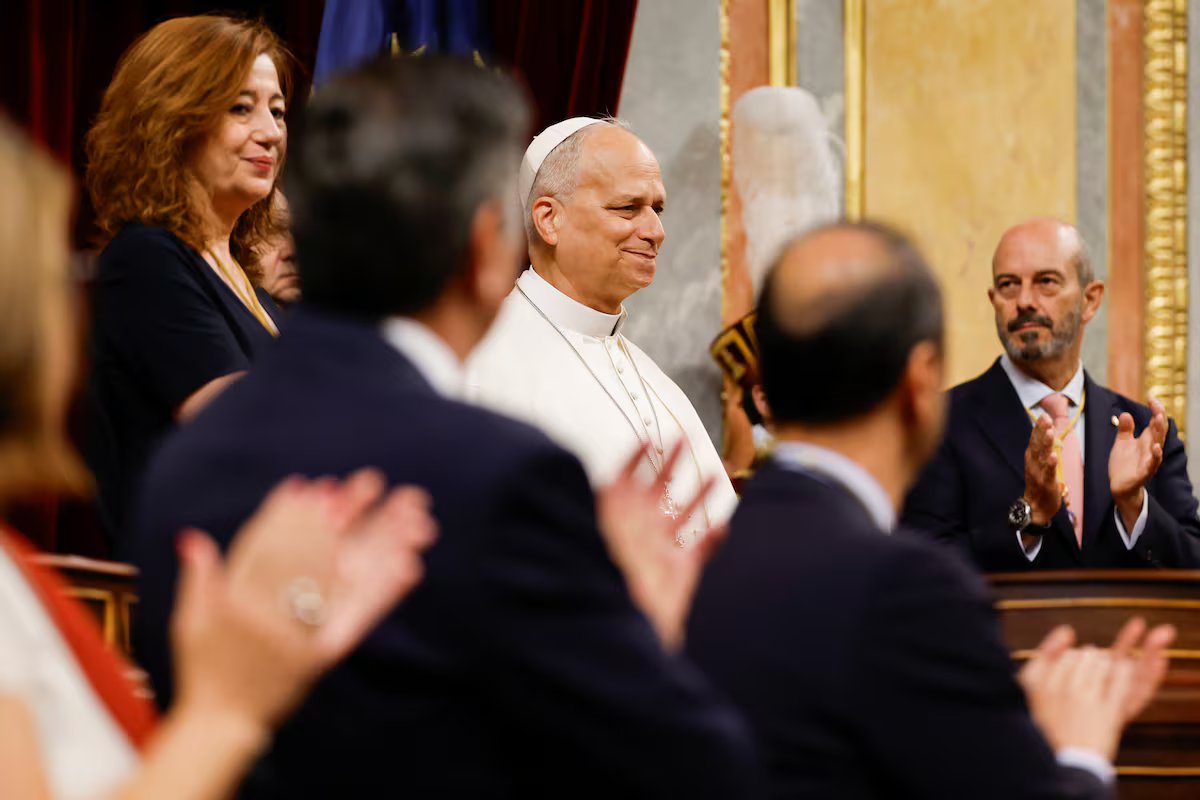
Pope Leo XIV delivered a historic speech on Monday inside Spanish parliament in a joint session of both houses, where he stressed that the moral value of political decisions must prevail “over mutable social consensus” and lamented “the permanent denigration of the adversary.”
Much of his address, which lasted half an hour and was met with seven minutes of applause, was devoted to condemning discrimination against migrants and policies that forget their dignity as human beings. “Wherever a person is discriminated against because of their origin, the principle of the equal dignity of all human beings is violated,” he said.
“Those who exercise public responsibility have a special duty to guard their language in order to ‘disarm speech.’ Firmness does not require contempt; disagreement does not entail humiliation,” he warned in an appeal to tone down verbal aggression and polarization in politics. “The world is undergoing a profound spiritual and cultural crisis, which is manifested in multiple forms of violence, polarization, and mutual distrust.”
After initially keeping a low profile, the pope has this year begun to reveal himself as a global voice against far-right populism. In a speech to the diplomatic corps accredited to the Holy See on January 9, 2026, he said that “in our time, the weakness of multilateralism is a particular cause for concern at the international level. A diplomacy that promotes dialogue and seeks consensus among all parties is being replaced by a diplomacy based on force, by either individuals or groups of allies. War is back in vogue and a zeal for war is spreading.”
Leo XIV arrived in Madrid on Saturday for a weeklong visit to Spain — the first by a pontiff in 15 years — and has since made a point of meeting with migrants and homeless people. On Sunday he officiated a mass that attracted 1.2 million people, according to local authorities.
On Monday, during his address to the national legislature, Leo XIV was very clear in his global call for “a peace that requires diplomatic courage” and respect for international law “above the interests that profit from war.” He also reiterated his opposition to rearmament policies.
On immigration, he said that the drama of migration challenges the conscience of nations and the ethical foundation of the international order. He said that it is a problem that “exceeds any purely demographic or economic reading: it is fundamentally a moral and legal issue.”
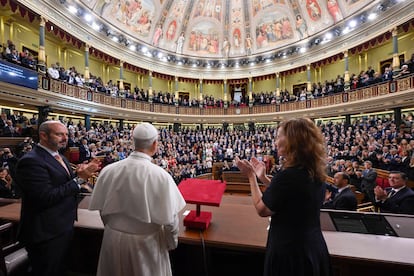
“The situation of migrants and refugees demands a response that focuses on people, addresses the causes that force them to leave and goes beyond the mere management of flows. From this arises a twofold requirement of social justice: offering safe and legal routes, a respectful welcome and real possibilities for integration; and at the same time promoting the right to remain in one’s own land,” he said.
The pope did not mention child sexual abuse by Catholic clergy in his speech in Congress, although house speaker Francina Armengol reminded him that Congress commissioned an investigation into clerical sex abuse in 2022. Later the pope delivered an address to the Conference of Bishops in which he referred to abuse within the Church as a “plague” and asked the bishops to ensure that “every person who has been hurt” can find “a sincere ear, a welcoming environment, protection, and real changes that bring healing.” EL PAÍS has been investigating cases of abuse by the Spanish Church since 2018.
Sign up for our weekly newsletter to get more English-language news coverage from EL PAÍS USA Edition
