
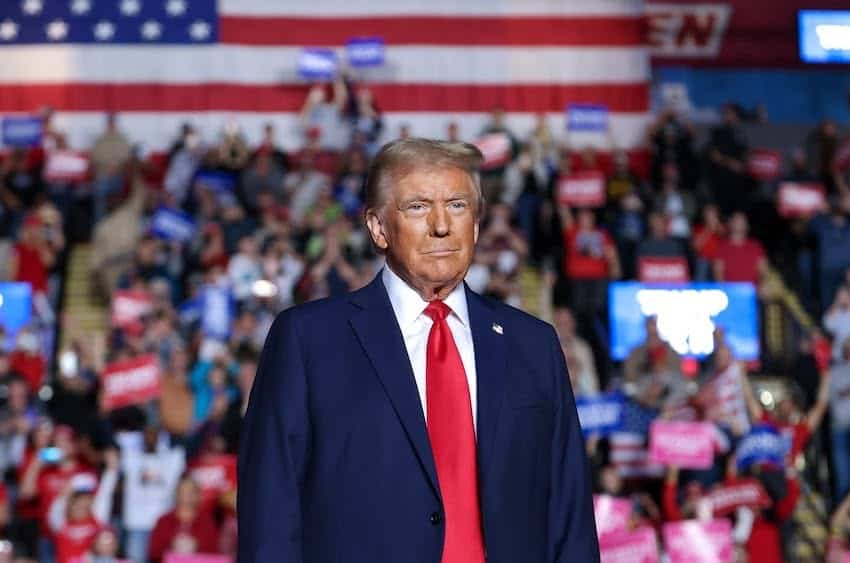
U.S. President Donald Trump said Wednesday that he is not seeking to renew the United States-Mexico-Canada Agreement (USMCA), the free trade pact that superseded NAFTA in 2020 and is subject to a review process this year. However, he subsequently softened his language, saying that he didn’t know whether he would renew the trilateral trade pact during the formal review talks.
In the Oval Office, a reporter asked Trump how confident he was about being able to renew the USMCA, which governs around US $2 trillion in annual trade between the United States, Mexico and Canada.
(Galo Cañas/Cuartoscuro.com)
“Well, I’m not looking to renew it,” the U.S. president said.
“… I mean I made the deal, and the primary reason I made the deal is that NAFTA was the worst trade deal I’ve ever seen,” Trump said.
“…USMCA did one thing that I loved. After six years it comes up for renewal. I don’t know that I’m going to renew it because to be honest with you, the United States … doesn’t need anything that Canada has, we don’t need anything that Mexico has, but they need everything that we have,” he said.
“And they have to treat us better. You know, with Mexico and Canada we have trade deficits. We should have surpluses with them. We don’t need their cars, we don’t need their lumber, we don’t need their energy, we don’t need anything that they have,” Trump said.
He subsequently said that the USMCA — which underpins deep economic integration in North America — was “sort of a good deal” but a “great deal for one reason: it gave the right to terminate.”

Any country can withdraw from the USMCA by giving the other two parties six months’ notice. Even if the United States refuses to renew the deal in 2026, the earliest the trade pact itself could lapse — assuming no one uses that exit clause — is 2036
Trump’s remarks on Wednesday were similar to comments he made about the USMCA and North American trade in January.
“I want to see Mexico and Canada do well, but the problem is we don’t need their product,” he said at the time.
Trump also said in January that the USMCA provides “no real advantage” to the United States and is “irrelevant” to him.
His remarks on Wednesday came after Mexican and U.S officials held bilateral USMCA talks in late May. Economy Minister Marcelo Ebrard subsequently notified U.S. Trade Representative Jamieson Greer and Canadian Trade Minister Dominic LeBlanc that Mexico wishes to extend the USMCA for an additional 16 years to 2042. Canada also wants to extend the trilateral pact.
Trump’s Oval Office remarks cast doubt on the likelihood that the three countries will reach an agreement to renew the USMCA. However, they don’t necessarily mean that the United States will oppose the renewal of the pact or withdraw from it. It would appear more likely that the Trump administration will seek to make changes to the agreement so that it is more favorable to U.S. interests. The threat to withdraw from, or “terminate,” the USMCA could help it to achieve that.
A second round of Mexico-U.S. trade talks is scheduled to take place in Washington, D.C., next week.
Ebrard: Mexico is ‘prepared’ for the USMCA review
On Wednesday morning, just a few hours before Trump offered his views on North American trade, Economy Minister Ebrard spoke at President Claudia Sheinbaum’s press conference about the upcoming talks with the United States.
“We have the next round of conversations with the United States next week,” he said, noting that Mexico’s delegation would be in Washington until at least Thursday June 18.
“We’re going to be there the 15th, 16th, 17th and 18th. On the 18th I have a long meeting with the person responsible for the [USMCA] review negotiations for the United States,” Ebrard said, referring to Ambassador Greer.
“We’re going to be focused [on trade talks] the whole week. … If it’s necessary we’ll stay until Friday,” he said.
Ebrard said that Mexico is “prepared” for the review talks and has its “arguments” ready. In addition to seeking agreement on an extension of the USMCA, Mexico is looking for tariff relief from the United States, which last year imposed duties on Mexican vehicles, steel and aluminum.
On Wednesday morning, Ebrard framed the very act of holding talks with the United States as a win for Mexico.
“It wasn’t known if we were going to have these formal talks or not. … They are underway and we’ll be there next week,” he said.
Later in the press conference, Ebrard highlighted that — despite the United States’ imposition of tariffs on various Mexican exports — Mexico is in a better position than other countries around the world vis-à-vis trade with the U.S. Indeed, the vast majority of the trade of goods between Mexico and the United States — worth US $872.8 billion in 2025 — occurs tariff-free thanks to the USMCA.
For Mexico, Ebrard said, trade with the U.S. is “cheaper” than it is for “many competitors.”
“For example, it’s more expensive for Vietnam, for the European Union, for many countries of South America as well,” he said.
“So we have a favorable position thanks to the calls the presidenta has made to President Trump and the things we have worked on [with the United States],” Ebrard said.
“The goal is to maintain that position during this process of review of the agreement,” he said.
Ebrard said that the review of the USMCA doesn’t have to be concluded on July 1, but rather the formal review — with representation from the United States, Mexico and Canada — commences on that date.
Mexico News Daily
