
An Indian national convicted of carrying out a Bishnoi gang extortion attack at the Victoria-area home of Punjabi singer AP Dhillon claims the gang has vowed to kill him if he returns to India.
In testimony from a B.C. prison, Abjeet Singh Kingra told an Immigration and Refugee Board (IRB) hearing Thursday that the gang has threatened his family.
“I got the news that this gang was threatening my family in India, and they said if I went back they would kill me,” said Kingra, who insisted he didn’t realize he was working for the Bishnoi gang at the time of the fiery September 2024 attack.
“As I’m not a member of their gang — they’re thinking that I’m helping the police here as I was the first one that was arrested.”
‘Even I was surprised’
Kingra’s revelation came during an admissibility hearing aimed at determining if he should be deported to India because of organized criminality.
The 26-year-old was sentenced to six years for arson and firearms offences last fall for his role in the incident that saw Kingra and a co-accused set vehicles ablaze and fire 14 shots from a handgun into the front of Dhillon’s home.
Kingra is serving his time at Mission Institution. The admissibility hearing is the first time since pleading guilty that he’s spoken publicly at length about his role in the attack.
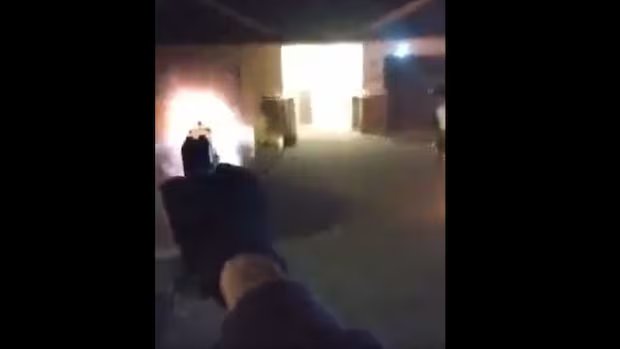
Kingra claimed he didn’t realize the Bishnoi gang was involved until he saw the video he filmed of himself firing the gun turn up on social media.
“Even I was surprised that it was everywhere on the news channel in the morning,” he said, speaking in a faint voice through a Punjabi interpreter.
“If I would have known earlier that Bishnoi gang is involved in it and it would have been that serious — extortion and all that — I would have [refused] at that point.”
Kingra claimed holding his admissibility hearing in public puts himself and his family at risk, but the IRB member overseeing the tribunal rejected his bid to make the proceedings private.
“My family was already getting threatened, and now it would be 100 per cent for them because the things will be out in the media,” Kingra said.
“And if I went to India — definitely — they would kill me.”
‘Maybe I’m an idiot’
Kingra came to Canada in 2018 on a study permit.
He told the hearing he did construction, security and delivery work in Surrey until he moved to Winnipeg, where he met Vikram Sharma, a co-accused who is believed to have since fled Canada.
Kingra said he met Sharma through a friend while he was working at a moving company.

He claimed Sharma offered him $4,000 to join him for the attack, but said he was told Dhillon’s house would be empty.
According to court records, although Dhillon was not home, the musician’s roommate narrowly missed injury or death as Sharma lit two vehicles on fire in the driveway and Kingra fired 14 shots at the house — all in view of a security camera.
Kingra said Sharma paid him in cash after the attack. He claimed he never asked who they were working for or why anyone would give him money to fire a gun at the home of a total stranger.
He was asked at one point why he thought Sharma asked him to help.
“I don’t know — maybe I’m an idiot,” Kingra answered. “That’s why.”
‘He said it was needed for proof’
The federal government listed the Bishnoi gang as a terrorist entity last year, claiming that “specific communities have been targeted for terror, violence and intimidation.”
Named after imprisoned founder Lawrence Bishnoi, the gang emerged from Punjab in northwest India into a multimillion-dollar global criminal enterprise rooted in drug smuggling and extortion.

According to evidence presented at Kingra’s sentencing, Dhillon fell into the gang’s crosshairs by producing a music video featuring Salman Khan, a Bollywood star targeted for hunting a type of antelope revered by the Bishnoi community.
Kingra repeatedly claimed he couldn’t remember details about events surrounding the extortion attack.
He said Sharma provided him with the weapon and also gave him a phone before the shooting so that he could record himself.
“He said it was needed for proof. Only with the proof you can get money,” Kingra told the hearing.
“I gave the phone to Vikram. After that, I don’t know who posted it.”
‘I don’t know any of them here in Canada’
Both Kingra and Sharma are also facing charges in connection with a separate arson and shooting that occurred prior to the Vancouver Island case, at the home of a Surrey resident who had been subject to extortion threats.
But Kingra was not asked about that case during the admissibility proceeding.

Jasbir Sandhu, counsel for the Minister of Refugees, Immigration and Citizenship, asked Kingra about the hours following the attack on Dhillon’s home, when the two fled from police before crashing their vehicle and catching a ferry back to the Lower Mainland.
Kingra said they booked a flight back to Winnipeg, and he then went back to work.
He said he doesn’t follow the news, and while he claimed to have heard of violence involving the Bishnoi gang in India, Kingra said he wasn’t aware of news reports in this country.
“I don’t know them,” he claimed.
“I never met them here and I don’t know any of them here in Canada.”
But in his final submissions, Sandhu noted that Kingra’s testimony was contradicted by his guilty plea and by remarks made by the judge who sentenced him, who spoke about the Bishnoi gang’s role in the crime.
The same judge noted the possibility of deportation as one of the consequences of his actions.
The standard to determine immigration inadmissibility is reasonable grounds to believe, which is less than the balance of probabilities required in civil court and a much less demanding standard than the beyond a reasonable doubt required for a criminal conviction.
The decision on Kingra’s admissibility has been reserved until Monday.
