
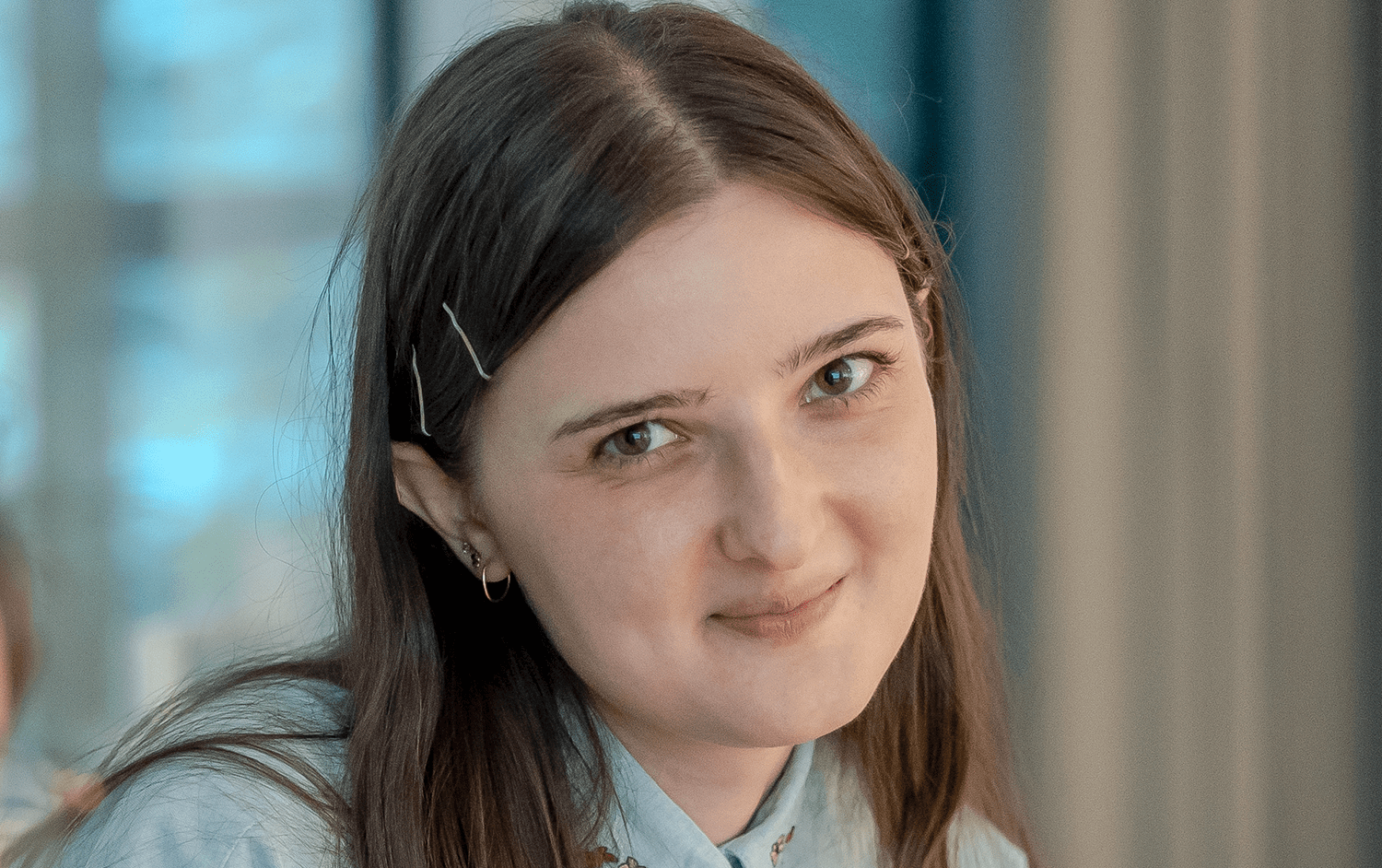
– The animation director was part of a focus on Moldova at the Czech festival Anifilm
Every year Anifilm, the animation film festival organised in Liberec, dedicates a section to emerging animation artists from an Eastern European country. This year, the Eastern Promises section was dedicated to animated short films from Moldova.
Mihaela Mîndru had two films in this section, Dog, Bread and the Flowers from Tomorrow and Children of the Black Sea, which were both inspired by her childhood memories. The latter, which was part of Anifilm’s student competition as well, recalls the resigned atmosphere of the vacations spent in a children’s sanatorium in Serhiivka, Ukraine. In the film the playful, unfiltered childlike mindset collides with the rigorous, impersonal conventions of a medical institution.
Cineuropa: Your animated short film, Children of the Black Sea, is based on a personal experience. Can you elaborate on that?
Mihaela Mîndru: I tried to really reach into my childhood memories. I went to the sanatorium multiple times, but I had to ask my parents, because I no longer remember how much time I spent there. When I was thinking of a topic for my graduation film, my mum sent me an article about how this place, the children’s sanatorium, got bombed by the Russians. It was a weird coincidence, which really made it clear for me that I should make a film about it. I could not find any other information, but it might have been destroyed completely, so mine could even be the last remaining memories of children who were there.
You often use traditional motifs and elements from folklore. It appeared in this film, and in your other animation, Dog, Bread and the Flowers from Tomorrow, as well. What is your relation to folklore?
I love taking inspiration from folklore. In Moldova, especially in the countryside, it is very common even today. People do not regard it as art, but it is. Everyone thinks that a little rug or a painting is nothing special, it is just there to make the house look pretty, while I think it is really beautiful. I always try to take inspiration from the little things that I see at home.
In your film you used a voiceover with children. How was the process of recording it?
It was not easy, to be honest. I was in France, but I wanted to do the recording with Romanian-speaking children, so I had to do it during my stay at home for the Christmas holidays. I asked my teacher from elementary school if I could go to one of her classes and find some children there. It happened spontaneously. We had to do all of it in just one hour, without a separate room for recording, so all the other children had to stay silent, which was quite challenging, because children are never perfectly silent.
My ex-teacher recommended to me the most well-behaved children, but I was not pleased with how they read the text. They were the best in the class, too shy, and always wanting to do everything very well. Of course they were cute, but it did not work out for the film. Finally, the children who can be heard in the film were the “bad”, misbehaved ones, whom the teacher tried to talk me out of working with. I think it sounds better with them speaking.
What are your future plans?
The two films screened in the Eastern Promises section were my graduation projects. Now I am working on my first professional film, which will be a resumption of these two stories. It will also be a childhood memory, but told in a different way. Now I am in the process of writing, as well as applying to residencies and pitching programs. Hopefully, next year it will go into production, and I will be able to show it to the public soon. I am making it in France, but I really want it to be a French-Moldovan co-production.
