
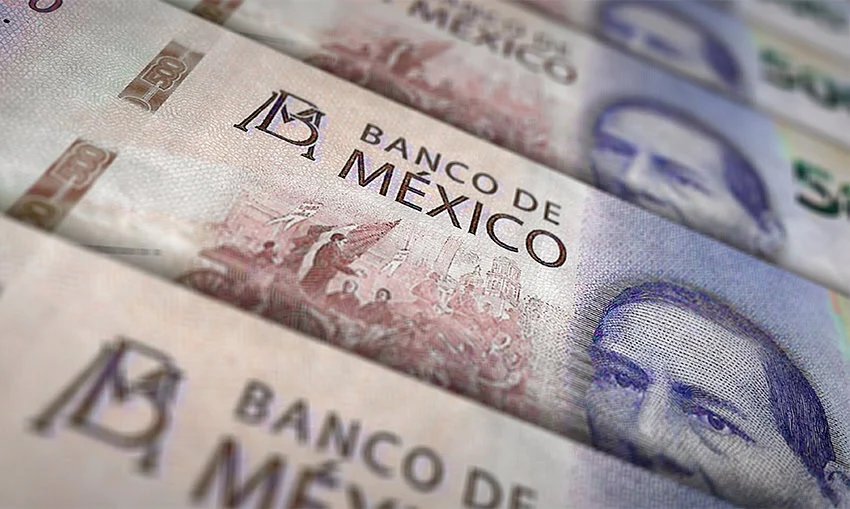
The peso rebounded on Thursday after U.S. President Donald Trump suggested tensions between the United States and Iran were easing.
At Friday’s opening, the exchange rate stood at 17.20 pesos to the US dollar, nearing its low point of the year. The lowest point so far was the 17.13 pesos per US dollar rate that it reached on Feb. 18.
“The peso is benefiting from the increased risk appetite among investors, stemming from the progress in the Middle East negotiations,” financial services holding company Grupo Monex said.
Gabriela Siller, director of economic analysis at Banco Base, said the peso’s attractiveness is also supported by “a weakening U.S. currency and increased appetite for emerging market assets, in an environment marked by expectations of interest rate cuts by the U.S. Federal Reserve.”
Siller also said Mexico’s currency is benefiting from “a drag effect from the Colombian peso,” which is gaining against the US dollar because of the greater probability that the right-wing candidate will win the presidential elections in Colombia.
In Thursday’s wholesale trading, the peso strengthened by 16 cents (0.94%) after Trump mentioned on his Truth Social network that the U.S. and Iran had agreed to a “very strong memorandum of understanding” to stop the fighting.
Mexico’s currency is on pace to see a weekly appreciation of more than 1.5%. Since the new year began (with the peso at 18 to the US dollar), the accumulated appreciation is slightly above 4.4%.
The news about the Middle East also boosted the Mexican Stock Exchange (BMV) as the benchmark S&P/BMV IPC index rose 3.33% to 66,977.05 points, interrupting a six-day losing streak. Traders attributed the rebound to more than Trump’s optimistic comments, saying that bargain hunting and bets on heavyweight stocks also paid off.
The performance of the BMV was in line with global stock markets,which closed with strong gains, driven by renewed hopes for a Middle East agreement.
Excelsior newspaper said the financial outlook is also influenced by the latest macroeconomic data, which show different realities on both sides of the Mexico-U.S. border:
- Higher inflation in the U.S. could influence the Federal Reserve’s upcoming decisions.
- Industrial growth in Mexico — strongly supported by the construction and manufacturing sectors — is a positive counterweight as industrial activity rebounded more than expected in April, posting its best performance since March 2021 and contributing to exchange rate stability.
With reports from La Jornada, El Financiero and Excelsior
