
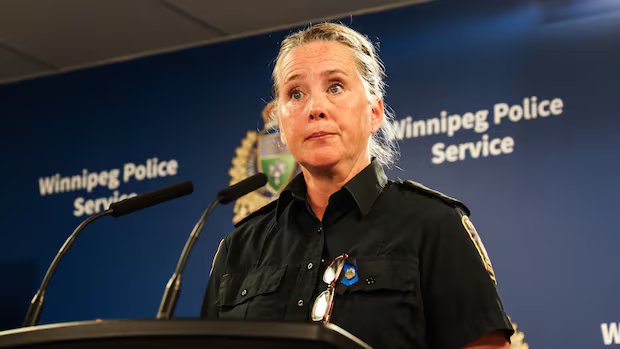
Violent, nihilistic extremism targeting kids online is an “escalating threat” across Canada and the U.S., Winnipeg police say, and they’re urging parents and caregivers to learn the warning signs so they can step in before it’s too late.
The networks of predators target children and youth on platforms many use every day — including Roblox, Minecraft, Snapchat, TikTok, Discord, Steam, Telegram and Twitch — and have been increasingly flagged as threats by authorities across the country, including the RCMP and the Canadian Security Intelligence Service.
At a news conference on Friday, Winnipeg police described how predators comb through those platforms in search of posts about vulnerabilities they can take advantage of — from body image and mental illness to loneliness, bullying and family conflict.
They exploit those struggles “by fabricating shared experiences to build false trust, then systematically introduce victims to increasingly violent and disturbing material,” including child sexual abuse, animal torture and gore, to try to desensitize them, Winnipeg Police Service Const. Claude Chancy told reporters.
After that, they move the victims into private online spaces where grooming escalates to extortion — and where young victims are coerced into harming themselves, their siblings or their pets and sometimes forced to livestream it, police say.
The extortion is typically not used for financial gain, Chancy said, but instead “to extract more material and to ultimately push victims” to kill themselves or others.
“This is grooming, it’s coercion, it’s extortion — almost cult-like,” Const. Andrea Lefort, who police described as an expert on violent extremism, said at the news conference. “Many of these kids, they are being forced to continue to commit some of these acts, and they can’t get out of it until there’s some type of police intervention and therapy intervention.”
CBC’s The Fifth Estate investigates a group called 764 and related organizations that form a global satanic, neo-Nazi network of violent extremists that target children online.
While police would provide few details of local cases they have investigated or are still looking into in Winnipeg, they say they’ve seen both victims and the real-life violence that originated online involving local people.
“This is happening. This is real. That’s why we’re bringing this forward,” Chancy said.
The networks behind these tactics, which include organized groups such as the Com Network, 764, MKY, O9A and the True Crime Community, aren’t motivated by ideological change, police say, but by “the destruction of society.”
“Members of these groups, particularly younger ones, escalate behaviours not out of genuine ideological commitment, but in pursuit of online validation and recognition — with the perceived risk of law enforcement attention sometimes serving as a badge of honour rather than a deterrent,” Chancy said.
Warning signs
He says warning signs can include unexplained injuries, markings or signs of self-mutilation, sudden withdrawal from family or longtime friends, and secretive or distressed behaviour around device use.
Others include exposure to disturbing content or unfamiliar online contacts, and changes in mood, language or expressed worldview.
“This isn’t just a child that’s maybe breaking curfew, or that seems a little sad or a little bit down. We’re talking about children that are having a complete change in their behaviour,” Lefort said, adding victims as young as eight and perpetrators as young as 11 have been identified across Canada, .
She said young victims can also end up becoming perpetrators themselves by bringing in others, in an attempt to “get the heat off them.”
Chancy says police have been giving presentations to groups that might end up being a first point of contact for victimized youth, including first responders, health-care professionals, schools and animal services, to help them recognize warning signs.
‘Can’t arrest our way out’
Lefort says the outreach and education police are doing is a critical part of responding to the growing threat.
“We can’t arrest our way out of this problem. It’s global. We’re talking about tens of thousands, is the best guess, of these online predators. So if we can’t arrest our way out of it and locate predators, the best thing that we can do is reduce the victimization pool,” she said.
“When I say it’s a conversation that I think parents need to have with their kids, it’s a conversation — it’s not outright panic, you know, start throwing devices out the window and freaking out.”
Lefort said she thinks people also need to “get away from thinking of it as, ‘Is it in our city?’ Like maybe, a local crime trend, you know, vandalism, that type of thing.”
“It’s a global problem,” she said. “And many of the investigations are actually transnational, where we might have, let’s say, a victim in France and a perpetrator in Alberta, or vice versa.”

A 26-year-old man from Quebec City is now facing terrorism charges, accused of promoting the ideology of 764, an online network centred on violent extremism. RCMP say 764 targets children and teens through platforms like Roblox or Discord, with the aim of manipulating, recruiting and radicalizing them into violent acts.
Resources exist for kids targeted by these groups, Lefort says, including the Edmonton-based Organization for the Prevention of Violence, which she said is focused on turning kids away from violent extremism and has a presence in Winnipeg.
Police said anyone with information about a child who might have been targeted or victimized is asked to call them at 204-986-6222 or report it online at cybertip.ca. Anonymous tips can be submitted to Crime Stoppers by phone at 204-786-8477 or online at manitobacrimestoppers.com.
More details about warning signs and resources are available on the Winnipeg Police Service website.
