
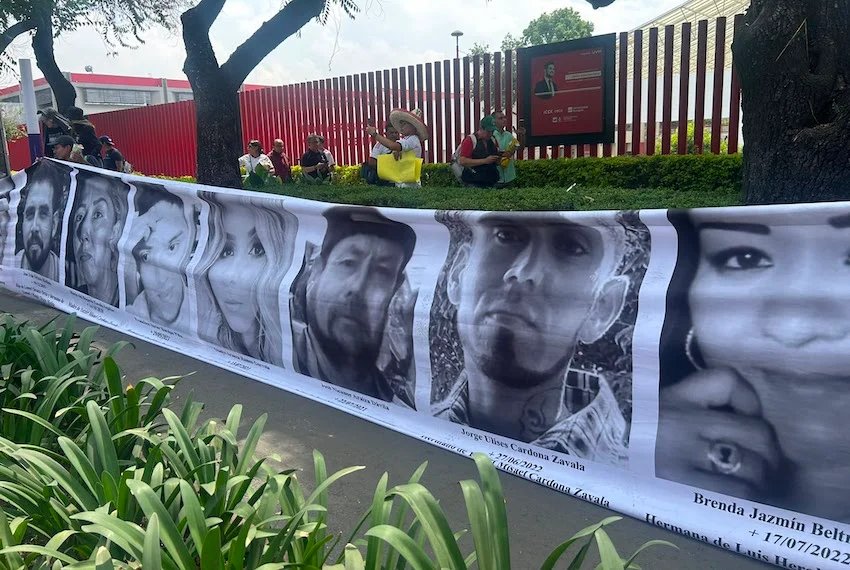
The Cerro Antonio Park in Coyoacán, Mexico City, smelled of damp soil and morning cigarettes on June 11, the day of the 2026 FIFA World Cup opener: Mexico against South Africa. But like any other day, it was also Mexico’s searching mothers against the state.
Mothers representing the Butterfly Collective (Colectivo Mariposas) donned green jerseys, the same hue as the men’s team kit that half the city was wearing, except theirs were printed with the faces of their disappeared loved ones.
The group of mothers took to Tlalpan Avenue, the rally growing quickly into the hundreds as it linked up with other protests marching toward Mexico City Stadium, to highlight the insecurity that persists and to demand government action.
“All eyes” are on the World Cup, said Irma Martínez Nicolás, who has been searching for her son, Felipe de Jesús Olvera, for seven years. “So that’s why we’re doing this today: to make the situation visible and to show that it’s not a lie, it’s real.”
“Just as the World Cup is important, so are the lives of our children,” said Geneveva Grijalva, who is “digging high and low” to find her daughter, Elizabeth López Grijalva, who went missing in 2025.
Amid the numerous handheld posters, a group of supporting students unfurled a 15-meter-long banner with about 250 photos of the disappeared — fewer than 1% of the more than 130,000 officially registered missing persons in Mexico, a number that is climbing every day.
Disappearances have soared by more than 200% in the last decade, driven in large part by the expansion of organized crime. The state’s “War on Drugs,” launched by former President Felipe Calderón in 2006, fostered widespread collusion between cartels and state actors — and in many cases, security forces themselves became perpetrators of enforced disappearances.

According to the Inter-American Commission on Human Rights (CIDH), at least 70,000 unidentified bodies remain in state custody due to structural deficiencies that slow down or hinder their identification. The CIDH has alleged “alarming impunity,” as it is families themselves who do most of the searching.
“Our government does nothing. It doesn’t defend us. It doesn’t care about us. So that’s why we’ve become searchers, experts, lawyers, trying to find our children however we can,” Grijalva says.
Camila, whose name was changed to protect her identity, says her son was murdered at just 17 years old, a student and lover of football. “There’s no investigation, no arrest warrants, there is no justice.”
The sheer trauma of a loved one going missing is harshly amplified by the neglect of the authorities. “I’ve been through many difficult situations, but this one finished me because my life ended, my health ended,” Martínez said. Her son was 16 years old when he went missing in 2019.
According to Grijalva, the prosecutor’s office lost her file and the genetic test needed to find her daughter. “The prosecutor’s office and our authorities just sit around, and all we receive is contempt, scolding, indifference. They don’t care about our pain.”
One of the things that aggravates Martínez the most is the feeling of being directly cheated by her own president.
According to Martínez, as mayor of Mexico City, Sheinbaum held direct talks with families of the disappeared in neighboring México state, where cases of missing persons are highest, along with Jalisco and Tamaulipas.
“We talked face to face. I simply told her: I’m not looking for someone to blame. I’m looking for my son, and I want him back. And she said, ‘I don’t have the power yet. But when I do, we’ll get him.’”
“Now, how long have you been in power?” she asked. Sheinbaum is now approaching her 21st month in office after assuming the presidency in October 2024.
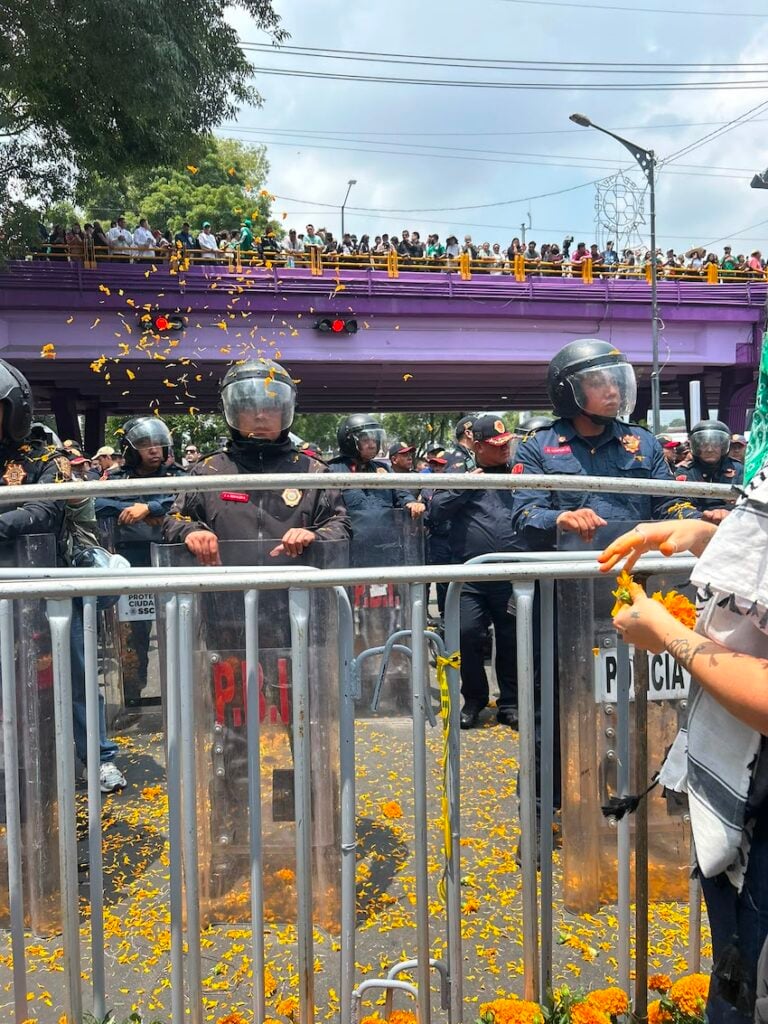
At midday on Thursday, the march came to a head in the neighborhood of Santa Úrsula. Access to the stadium had been cut off as part of the government’s Operation Last Mile, and hundreds of riot police assembled around the barriers.
The government’s vigorous defense of the stadium and the police mobilization against protesters stood in stark contrast to its inaction to locate the disappeared.
“The police, why aren’t they protecting us?” Camila questioned. “Why aren’t they protecting our children in the street?”
A grieving young man scattered marigold petals on an unflinching policeman. “Look at me! These are the tears of the disappeared,” he cried.
Numerous groups are protesting the World Cup in Mexico, including the National Coordination of Education Workers (CNTE), anti-gentrification activists, LGBTQ+ rights groups and agricultural workers.
In addition to raising awareness of their respective causes, collectives across the board are protesting what they say is an inequitable distribution of resources and the disregard of public needs in government spending for the World Cup — which has amounted to approximately US $3 billion on infrastructure improvements.
“They spent millions and millions supposedly fixing things, because they didn’t make any real repairs,” Martínez said.
For the groups protesting the World Cup, the government’s response can be summarized by the lilac-painted overpasses that line Tlalpan Avenue: a superficial makeover that hides, rather than addresses, the violent reality of Mexico for many.
Right before the match kicked off at 1 p.m., six planes soared over the stadium, their smoke trails painting the Mexican flag, while mariachi music boomed down the street. For the students protesting, the image of Mexico being presented to the world during the tournament is an illusion meant to appeal to other countries.
“If I had to say something to foreigners to give them a general idea, it would be that all the beauty that covers our country is stained with blood,” said Raquel, whose name was changed to protect her identity.
While President Sheinbaum said that protests would be allowed to go on throughout the World Cup period, the government has not issued a direct response to any groups beyond the CNTE teachers’ union.
The madres buscadoras are demanding justice for the disappeared. This includes government transparency on the true number of missing, the declaration of a national emergency, protection for searchers and improved forensic investment capacity.
Some mothers demand a direct conversation with Sheinbaum, or a change in government entirely.
In the shadow of the World Cup, the families of the missing want to remind the Mexican government that the ball is in their court, and that the priority should be “locating the disappeared, fighting the drug cartels and stopping the violence,” they said, not the football.
Millie Deere is a journalist working between Mexico and the United Kingdom.
