
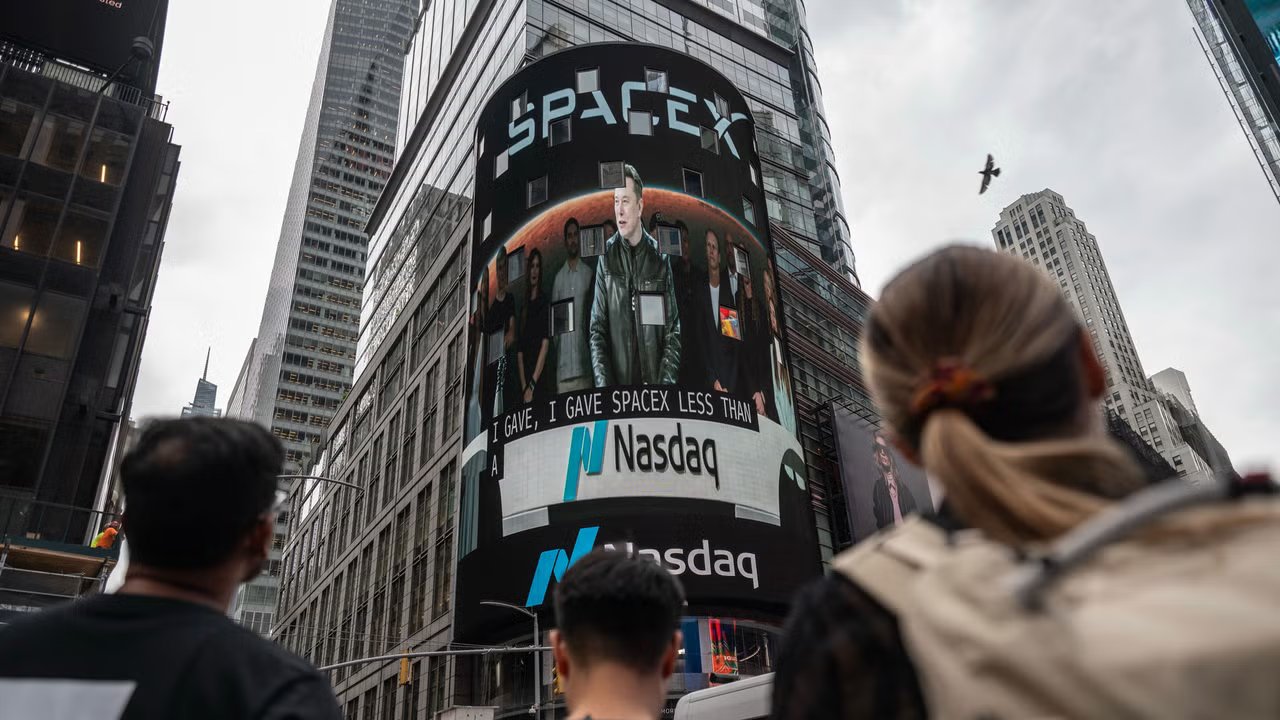
SpaceX finally went public on Friday, marking one of the most profitable stock market debuts ever. The move stands to make Elon Musk, already the world’s wealthiest person, even wealthier, while turning many employees and early investors into millionaires and billionaires overnight.
It’s been a long road for SpaceX. Founded in 2002, the company has built an array of businesses around one key achievement: mostly reusable rocket launches that have drastically reduced the cost of sending things into space. Today, SpaceX sells national defense satellite launch services, supports commercial space tourism, provides satellite internet to consumers and transportation companies, and works with NASA on programs including the International Space Station and Artemis.
Through Starship, its next-generation vehicle now undergoing testing, the company aims to expand even further, including by launching new satellite constellations and accelerating plans for the Moon and Mars.
SpaceX also leaves another legacy: a generation of startups founded by former employees. They have taken the company’s hard-charging mentality and focus on first-principles engineering to new ventures that could one day follow in its footsteps.
“A lot of this has to do with Elon and his personality and his ability to attract these types of people,” Robert Rose, a startup founder who led software development for the Falcon 9, told Fast Company earlier this year. “But he also just created an environment that those types of people want to be in.”
Here are a few examples. For a broader look at companies founded by SpaceX alumni, see Fast Company’s database of more than 400 SpaceX alum founders, the largest publicly available resource of its kind.
Parallel Systems
Like SpaceX, Parallel Systems is trying to reinvent a critical piece of transportation infrastructure. The company develops autonomous, battery-electric rail vehicles and, according to its website, aims to replace some short-haul trucking. It was founded by Matt Soule, who previously spent more than a decade at SpaceX.
Antares
Backed by the Department of Energy, Antares is building fission microreactors that it hopes will bring nuclear power to a range of sectors, on Earth and in space. The company is also eyeing government customers. As part of a government evaluation, Antares recently passed a critical milestone, achieving a self-supporting nuclear chain reaction.
Reliable Robotics
Reliable Robotics, founded by SpaceX alum Robert Rose, is developing autonomous cargo aircraft. The company has already flown pilotless aircraft in tests and earlier this year raised $160 million at a valuation of roughly $1 billion.
Castelion
SpaceX brought rocket launches to a lower cost and greater scale. Castelion is trying to do something similar with hypersonic weapons, which travel at more than five times the speed of sound. Like SpaceX, the company is leaning heavily on Defense Department work and pitching itself as a path to deterrence.
Shinkei
Shinkei wants to reinvent how people kill and eat fish. The company has built a robot called Poseidon that uses computer vision to identify fish and kill them more humanely. The goal is to preserve freshness while reducing the suffering fish experience when they are left to suffocate. Shinkei provides the technology to commercial fishermen and sells the fish under the label “Seremoni Grade.”
