
During the NFL’s 2024 AFC championship game between the Baltimore Ravens and the Kansas City Chiefs, play was stopped when a drone entered restricted airspace over the stadium. The operator later pleaded guilty to violating national defense airspace. Thirteen months later, a wild-card playoff game featuring the Ravens and Pittsburgh Steelers was suspended for the same reason. According to the NFL security chief, Cathy Lanier, unauthorized drone incursions over NFL stadiums jumped from 67 in 2018 to 2,845 in 2023—an increase of 42x. For most of that time, the league had almost no legal mechanism to stop them.
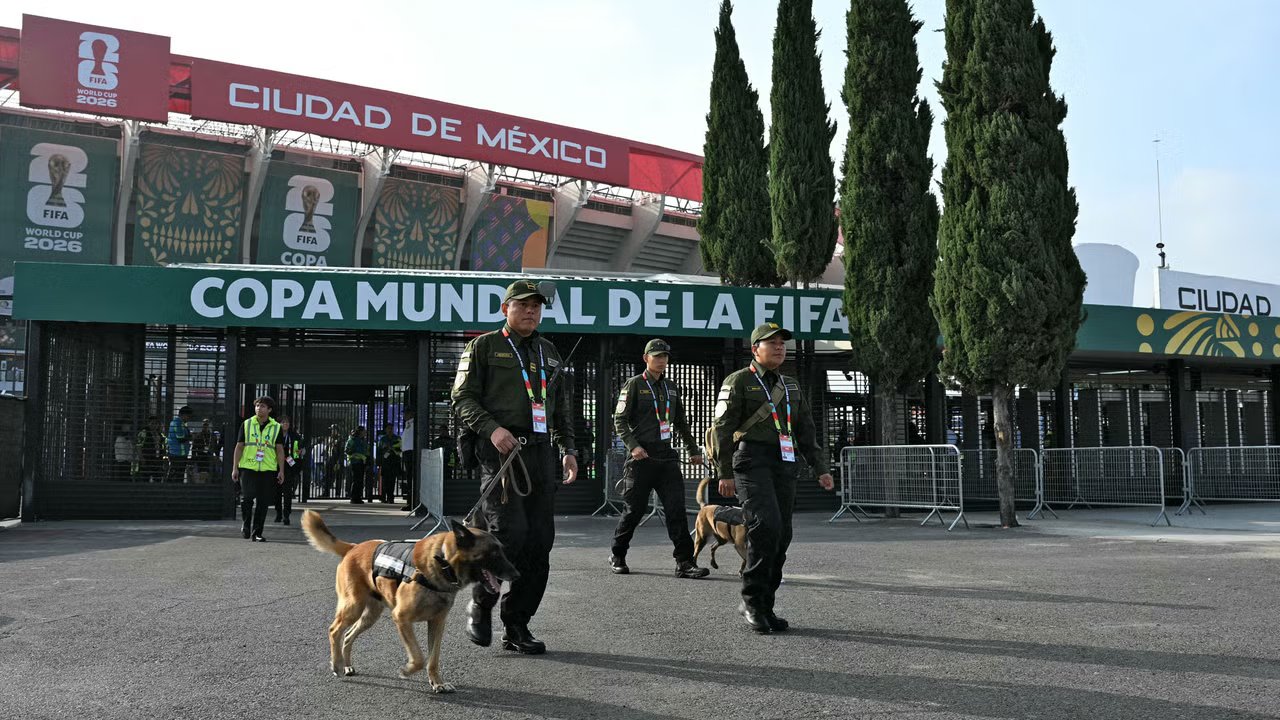
The 2026 FIFA World Cup is now underway. It opened Thursday in Mexico City, where host nation Mexico faced South Africa in front of a packed stadium. Now, the action has moved to U.S. soil: 48 teams, 104 matches, 11 American cities, and more than five million tickets sold across the soccer tournament.
The U.S. federal government has committed more than $1 billion to World Cup security through two separate grant programs from the Federal Emergency Management Agency: a $625 million FIFA World Cup program for general security preparedness, and a $500 million Counter Unmanned Aircraft Systems program specifically targeting drone threats, with the first $250 million of the latter already awarded to host states. The Department of Homeland Security established a dedicated Program Executive Office for Unmanned Aircraft Systems in January, while the White House built its own task force via executive order (with President Donald Trump serving as chair).
Taken together, the investment and technology being deployed to protect this event are impressive. But the harder question—and the one that remains largely unanswered—is what happens to all of it when the tournament ends in July.
THE DRONE PROBLEM AND WHY IT’S HARDER THAN IT LOOKS
Drones are small, fast, widely available, and increasingly autonomous. In a packed stadium, the wrong response to a rogue drone can be nearly as dangerous as the drone itself. Jamming radio signals can disrupt stadium communications. Kinetic intercept systems can scatter debris into crowds. Neither is acceptable with 80,000 people below.
“Traditional methods like jamming or kinetic interceptions are often described as brute-force approaches because they can have significant side effects,” says Zohar Halachmi, chairman and CEO of D-Fend Solutions, whose EnforceAir system is deployed globally by military, homeland security, law enforcement, and critical infrastructure agencies.
The company’s approach centers on software-driven radio frequency cyber takeover: identifying a rogue drone, assuming control of it, and guiding it safely to a designated landing zone, all without disrupting the communications or physical environment around it. The system also lets operators designate authorized drones—broadcast, logistics, and public safety aircraft—so only genuinely unauthorized aircraft are targeted.
“It moves the defense from a blind tool to an intelligent one that understands the specific needs of the venue,” Halachmi explains.
For years, intercepting a drone in the U.S. was a federal-only authority. Local law enforcement could watch an unauthorized drone fly over a packed stadium and legally do very little. That changed on December 18, 2025, when Trump signed the Safer Skies Act into law, giving state and local agencies a legal path to detect and mitigate credible drone threats.
But implementing those regulations came with a catch: The deadline fell 180 days after signing, landing squarely in the same month the tournament began. So while the authority now exists on paper, the operational infrastructure needed to act on it is still catching up.
WHAT HAPPENS ON THE GROUND
Unauthorized drones are only one part of the security challenge. Inside and around the stadium, officials are also trying to manage tens of thousands of people in motion, hundreds of simultaneous camera feeds, and security teams that can watch only so much at once. The traditional model of operators staring at banks of screens doesn’t scale to an event this large.
“Traditional systems rely on operators to actively monitor dozens of feeds at once, which simply doesn’t hold up in a live environment with tens of thousands of people,” says Jordan Shou, Vice President of Marketing at Lumana, which won the Security Industry Association’s Best Video Surveillance Management System award at ISC West 2026.
At the scale of the World Cup, Shou argues, the core challenge is not camera coverage but human capacity. Lumana’s platform transforms existing IP cameras into AI agents that analyze footage and raise only meaningful alerts in real time, with the company reporting up to 90% fewer false alerts and 10x gains in staff efficiency.
“Instead of humans watching video, AI continuously monitors every camera feed in real time and surfaces only what matters,” he tells Fast Company.
Of course, camera placement, lighting, and resolution all affect what any AI model can detect with confidence (and those constraints also apply to human operators). When systems ignore that reality and generate too many low-confidence alerts, operators start treating every notification as noise. Lumana’s platform is built around that problem, using multilayered verification to filter signals before they reach a human and prioritizing alert quality over volume.
THE OTHER HALF OF THE PROBLEM
Here is where the $1 billion story gets more complicated.
“There is an old truism that the security apparatus only expands; it never retracts,” says Matt Bailey, an independent democracy and human rights advocate and the founder of Neon Civics, a research consultancy focused on privacy and civic life.
Jay Stanley of the American Civil Liberties Union, who has spent years tracking the intersection of drone technology and civil liberties, sees the same pattern from a legal angle: “There are very few legal barriers to extending the use of special-event surveillance infrastructures, and all too often they persist long after the event is a distant memory.”
Bailey goes further. After the terror attacks on September 11, 2001, increasingly invasive airport security became routine. It then expanded to mass transit, then into digital life—facial recognition, biometrics, and government-issued records required simply to access apps and websites. The World Cup, he argues, follows the same logic.
“Hardware is durable. Service contracts are durable,” Bailey says. “And the AI and surveillance software continuously ‘improve’—which means not only does the hardware not come down after the sporting event, but it also has a tendency to get bigger over time, by default.”
The precedent is well documented. After the 2013 Boston Marathon bombing, temporary cameras installed along the race route were incorporated into the city’s permanent surveillance network. In France, AI surveillance deployed for the Paris Olympics in 2024 as a limited experiment was being pushed toward permanence by politicians before the Games had even ended.
The pattern is already visible at the venues hosting this tournament. When the U.S. Men’s National Team played its opening match last week against Paraguay at SoFi Stadium in Los Angeles, the 2,000 or so food and beverage workers staffing that game were doing so under a historic contract they won just days earlier. Represented by Unite Here Local 11, they secured restrictions on AI and automation and explicit privacy protections, including a prohibition on FIFA’s forcing workers to surrender sensitive personal information for tournament accreditation.
Reem Suleiman, senior campaigns director at Fight for the Future, a nonprofit advocacy group for digital rights, calls it a sign of what collective pushback can achieve and said she hopes it spreads. “We certainly hope to see more of this in the other cities,” Suleiman tells Fast Company.
But the workers are only part of the story. For the millions of fans attending matches across 11 American cities, the surveillance infrastructure is already in place—and whether those attending have any meaningful say in how it operates remains largely unresolved. “Which doesn’t leave me optimistic that attendees will be given ways to opt out,” Suleiman adds.
Companies like Lumana and D-Fend can point to policies around data governance, operational boundaries, and human oversight. But voluntary guardrails are not the same as public accountability. The harder question is not what any one vendor says it will or won’t do. It is who governs the infrastructure once the event that justified it is over.
THE GOVERNANCE GAP
The governance infrastructure to match that concern doesn’t yet widely exist, but Bailey points to a place to start. Every state has a designated State Administrative Agency that receives and manages federal security grants, sitting between the federal money and the local agencies spending it, with no consistent requirement to explain itself publicly.
Those agencies, alongside elected officials and attorneys general, are the first place residents should be demanding answers about what was deployed, why, and on what timeline it gets wound down, Bailey says. “We should be able to have a meaningful, fact-based discussion after the World Cup ends about how these investments panned out,” he notes. “Was it worth it from a financial, security, and democratic freedoms standpoint?”
That conversation is especially urgent before the 2028 Los Angeles Olympics—a larger and more complex event in one of the most densely populated cities in the country. California’s Consumer Privacy Act gives the state meaningful tools, but only if enforced aggressively. “I would think of this as a stress test,” Bailey says. “How can California even more zealously define and protect privacy based on what worked and what didn’t when FIFA came to town?”
The playbook is being written this summer, under maximum pressure, with the world watching. The more than $1 billion being spent to protect the tournament is the part everyone can see. The harder question is what gets built around it, who controls it after the crowds go home, and whether public officials will be forced to account for it before the next mega-event arrives.
