
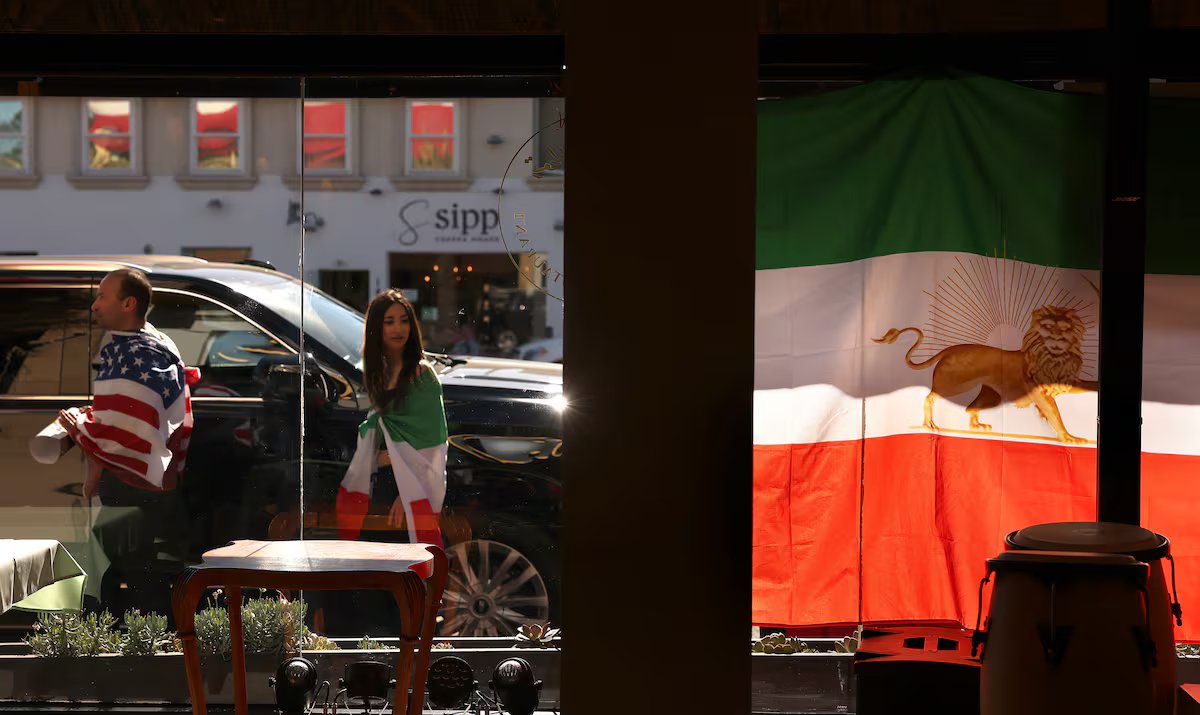
Near the famous Beverly Hills neighborhood there is an area of Los Angeles with a curious name: Tehrangeles, a portmanteau of Tehran and Los Angeles. It does not have the glamour or purchasing power of the TV-famous zip code, but lately it has drawn a lot of attention. For decades it has concentrated a significant number of Iranian businesses and is the destination for the large Iranian community living in the United States, far from the ayatollahs’ regime. After four months under the spotlight because of the war between the two countries, the current buzz is that Iran’s national team will play its first two World Cup matches in the Californian capital: on June 15 against New Zealand and June 21 against Belgium.
“No, that national team does not represent Iran; it represents the Islamic Republic of Iran,” Roozbeh Farahanipour says forcefully, having become, amid the silence of most residents, almost a kind of spokesman for the Persian community in the area. “The anthem they will sing, and the crest and flag they will wear, are those of the regime. I will not go to the stadium. I am allergic to those symbols; I don’t even want to see them,” he states.
The focal point of the area is Persian Square — in reality just an ordinary street intersection — and there the flag flying is that of the Iranian opposition: a tricolor (green, white, and red) bearing a lion and sun instead of the Islamic emblem. Iran’s sports minister, Ahmad Donyamali, has already threatened that if he sees the opponents’ banner inside the stadium, the team will withdraw. “We have informed FIFA that we will leave as soon as we hear political chants,” he warned this week.
The World Cup fixture adds another element of tension to an extremely grave conflict, and it cannot be ruled out that, whatever happens inside the venue, protests against the Iranian regime could take place outside. Calls to demonstrate are already circulating on social networks. “This is not just a match; it is a propaganda vehicle for the regime. And also for the other side. I think we should demand accountability from FIFA, because these three matches could be moved to Canada. Why are they being held in the United States while the two countries are at war? It makes no sense,” says Farahanipour, who has lived in Tehrangeles for 26 years. “In 1999 I was the leader of a student movement and was sentenced to death. I escaped the country and came here. Since then, I have lived, worked and served the Los Angeles community. I have two restaurants,” explains the man, around 60, sitting at the table of one of them, a Greek establishment.
Within a few meters are several bookstores, restaurants, a pizzeria, a market, a paperwork service to process documents, and the carpet shop of Alex Helmi, one of the area’s most veteran and well-known merchants. At the entrance to his store he has a photograph with George H. W. Bush. But like almost everyone else, he refuses to talk about the team’s imminent arrival in Los Angeles.
FIFA decided that the team’s base camp, which was to be in Arizona, would be moved to Tijuana, Mexico, a co-host, although it elected to maintain the United States as the venue for Iran’s three group-stage matches. The third match will take place in Seattle on June 26, against Egypt, an event the international federation had also planned to make the Pride match, in support of LGBTQ+ rights — a decision that angered the two states, which condemn and prosecute homosexuality. The team will fly to each match and, after the final whistle, cross the border again. The delegation reported on Sunday that, in addition to the 15 officials who were denied visas for belonging to the Islamic Revolutionary Guard Corps (the powerful parallel military force that the U.S. considers a terrorist organization), two other members of the communications staff have also been refused entry.
Of the roughly half a million Iranians or people of Iranian descent living in the United States, most live in Los Angeles. The 1979 Islamic revolution multiplied arrivals. The team’s visit has sparked protests that extend beyond Persian Square. Last Tuesday, a group gathered in front of City Hall to denounce that the Iranian government is using the World Cup to launder its image.
“Before this war, at every international event, athletes showed civil disobedience against the regime,” Farahanipour points out. “In January, several female footballers did not sing the national anthem in Australia; some were forced to seek asylum and others had to return to Iran because their families were taken hostage. We also saw gestures at international chess and taekwondo competitions. Even in the national soccer team, in 2009 during the Green Movement, many players wore a green wristband on the field. Why not this time? Because of the war. The natural reaction of ordinary people is to rally around the regime and the central government to defend territorial integrity. I do not blame them; I know nationalist sentiment is huge right now. For us, as people who promote civil disobedience, our task is to make sure we win people over at the right moment,” Farahanipour states in the center of Tehrangeles, that small Persian island that is currently living in discomfort, even anger, over the national team’s trip to their city. And it could still get worse: if the United States and Iran finish second in their groups, they would meet in the last 32 on July 3 — but that game would be staged in in Dallas.
Sign up for our weekly newsletter to get more English-language news coverage from EL PAÍS USA Edition
