
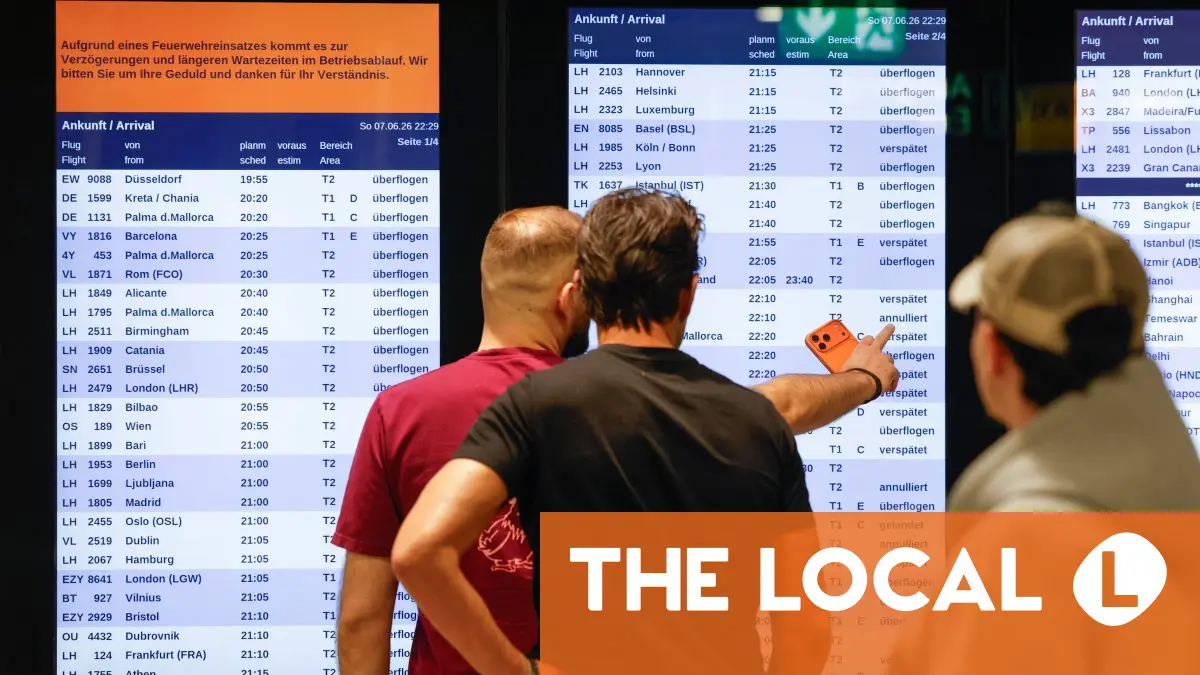
EU countries have finally agreed on a raft of reforms around air passenger rights that covers everything from compensation for disruption to seating rules for those travelling with children. So how will the changes impact you and why have airlines reacted angrily?
Welcomed by consumers and criticised by airlines, the provisional deal has to be formally approved by both Parliament and Council within six weeks.
It will become effective 12 months after the publication on the EU Official Journal.
Compensation
The deal maintains the right for air passengers to be reimbursed or re-routed, and to claim compensation, if a flight is delayed by more than three hours, if it is cancelled with less than 14 days notice, or in case of denied boarding.
Despite attempts by some governments to introduce a flat payment that would have cut payouts, the compensation for delayed or cancelled flights remains based on the distance: €250 for journeys up to 1,500 km, €400 for journeys within the EU or between 1,500 km and 3,500 km, and €600 for journeys over 3,500 km.
For the longest trips, air carriers will be able to reduce compensation by 50 percent if they offer re-routing or if the delay is less than four hours.
Airlines do not have to provide compensation if delays or cancellations are due to ‘extraordinary circumstances’ beyond their control, including natural disasters, war, weather conditions, unruly passengers, or strikes.
Air operators will have to take care of stranded passengers providing refreshments every two hours of waiting time, a meal after three hours and every five hours thereafter for up to three meals per day and, if needed, hotel accommodation for a maximum of three nights, and free transport to and back from the hotel. Internet access and two phone calls should also be guaranteed free of charge.
If airlines do not provide such assistance, passengers may make their own arrangements and request reimbursement.
Passengers with disabilities and reduced mobility will have the right to compensation, rerouting and assistance if they miss a flight because the airport did not help them reach the gate on time. They will receive priority assistance and will be able to travel with their mobility equipment and assistance dogs without having to pay extra insurance.
How to get compensation
A new element of the regulation is that airlines will have to provide in electronic format, and maximum 96 hours after arrival, clear instructions to passengers on how to claim compensation.
Passengers will not be obliged to have a user account with the airline or use a specific app to receive this information. They will have nine months to file a compensation request, while airlines will have 30 days to complete the payment or explain the refusal.
Along the process, airlines will have to offer passengers at least one ‘free and efficient way’ to communicate with them.
Re-routing
According to the new rules, passengers can choose to be re-routed following the cancellation or denied boarding to their flight. In this case, airlines have to offer an alternative route within three hours. This can be to an alternative airport, by a different route, on another airline or on other transport modes. Passengers can also be rerouted in a higher class at no extra cost.
If an airline does not offer re-routing within three hours, passengers can make their own arrangement and claim reimbursement of up to 400 percent of the original ticket price, a measure that target especially low-cost carriers.
Travelling with children
Under the new rules, air carriers will have to ensure that children below the age of 14 and the person accompanying them are seated next to each other without paying extra. The same applies to pregnant women and passengers with disabilities and reduced mobility.
Carry-on luggage
Another novelty, upon which the Parliament insisted, is the right to carry on board one small luggage without additional fees. The displayed air fare will have to include carry-on luggage, to make it easier to compare prices, but airlines may offer cheaper tickets to people travelling without hand luggage.
Boarding passes
Passengers will also be able to obtain boarding passes digitally without being requested to have a user account with the airline or a specific application. The agreement specifies that airlines cannot deny boarding to passengers because they used their own printed version of a digital boarding pass.
In addition, correcting name spelling errors or getting a printed version of a boarding pass after check-in will not incur additional fees.
No-show
New rules prohibit ‘no-show’ clauses by which airlines can cancel the return or deny boarding because a passenger didn’t take an outbound flight.
New label
These rules apply to passengers flying within the EU, arriving in the EU from a non-EU country on EU airlines, and departing from the EU to a non-EU country on either an EU or non-EU airlines. The Commission will assess within three years whether they should be extended fully to non-EU operators.
Meanwhile, the Commission will introduce a voluntary EU air passenger rights label that airlines can display during the booking process.
Consumers vs airlines
Current rules on air passenger rights have been in place since 2004. The Commission proposed a revision in 2013 but it took 13 years for the European Parliament and EU governments to come to an agreement, with MEPs taking the side of passengers and EU governments that of airlines.
“This agreement marks an extremely important step forward for the millions of Europeans who rely on air travel every day,” said European Parliament President Roberta Metsola.
EU transport Commissioner Apostolos Tzitzikostas said the deal found “the right balance” of “preserving Europe’s world-leading passenger protection while creating a fair, predictable and workable framework for the aviation industry”.
“EU air passenger rights… will remain the strongest in the world,” he added.
But associations representing airlines were critical of the agreement. Airlines for Europe (A4E) said: “Obliging airlines to artificially inflate prices by including the cost of hand baggage in the displayed airfare contradicts established EU law protecting opt-ins instead of opt-outs.”
Montserrat Barriga, Director General of the European Regions Airline Association (ERA) added: “Many regional airlines operate thin routes, connect peripheral communities, and often fly from a single base with limited spare aircraft and no instant rerouting options. You cannot force rules designed for long-haul onto regional airlines and expect connectivity to survive.”
Consumers group, however, welcomed the reform.
Agustín Reyna, Director General of European Consumer Organisation BEUC commented: “Now, we need to make sure these rights are respected and that consumers have access to redress because only 38 percent of eligible passengers exercise their rights today.”
