
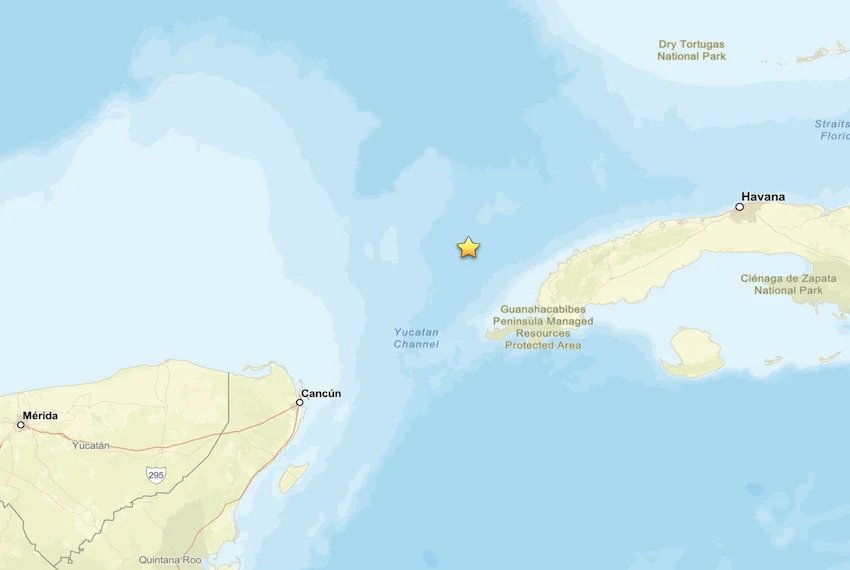
Eight days after a 6.1 magnitude earthquake shattered glass windows and damaged facades at hotels in Cancún, a second quake measuring 5.1 was recorded shortly after noon on Monday, again startling residents across the Yucatán Peninsula, which is not prone to earthquakes.
Both temblors were centered off the coast of Cuba, the first with an epicenter 118 kilometers offshore from Mantua, Cuba. The second on Monday sparked concern of a tsunami reaching Mexico’s Quintana Roo coast, but state authorities quickly ruled out that idea and are concentrating instead on inspecting for any structural damage.
Seismic activity is not often felt on the Peninsula, even though the Oriente Fault — an underwater fracture zone considered one of the most active tectonic boundaries in the Caribbean — runs along the south of Cuba.
At their closest points, the distance between Cuba and the Yucatán Peninsula is less than 200 kilometers (120 miles).
Quintana Roo authorities established communication with municipal officials to activate emergency protocols. Inspections of critical and vulnerable infrastructure (airports, shopping centers, public buildings and tourist areas) were carried out in coordination with local agencies and special procedures were publicized.
Thus far, there have been no injuries or casualties reported, and no major structural damage.
Residents are encouraged to contact civil protection authorities or emergency services as needed, particularly to report cases of structural damage.
The governor’s office assured the public that there was no tsunami risk for the coasts of Quintana Roo and urged citizens to remain calm and stay informed through official channels.
Last week’s Caribbean quake was actually preceded by a small, shallow temblor in the state of Yucatán, about 370 kilometers (230 miles) west of Cancún. Though it might have seemed random, seismologists say a local fault line there has caused a few low-intensity tremors lately.
With reports from El Herald de México, Novedades, The Cancun Sun and Infobae
