
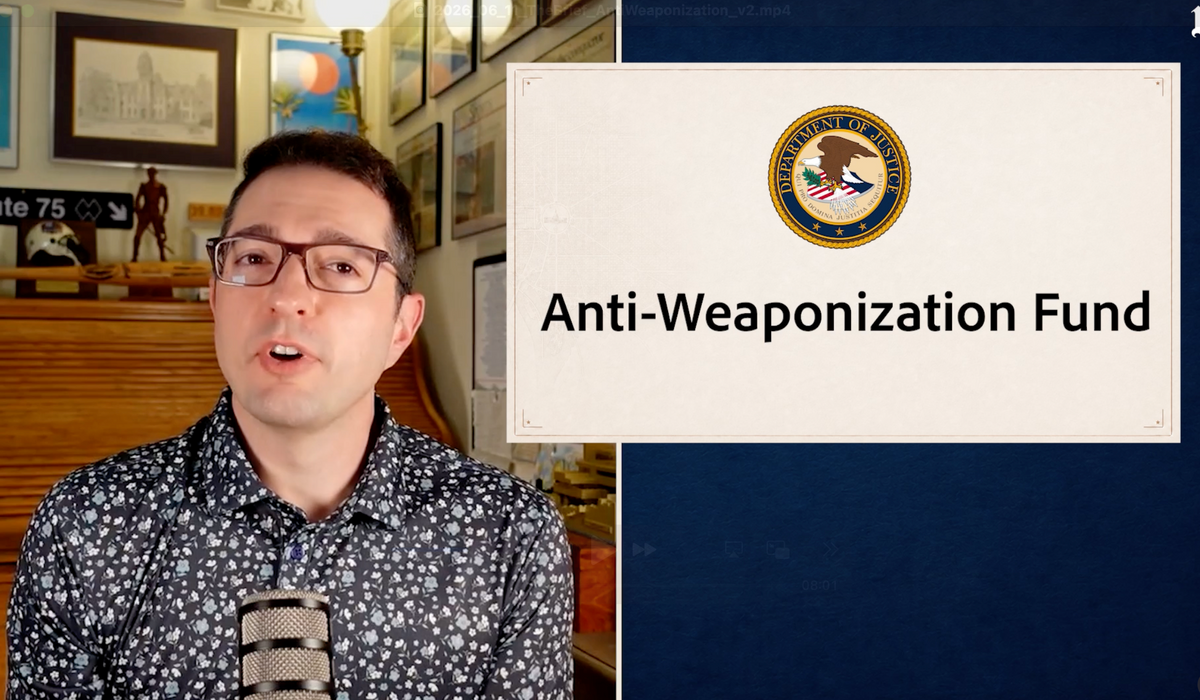
The Anti-Weaponization Fund was billed as a remedy for years of government overreach. But as George Gerbo reports, the Trump DOJ’s plan collapsed under pressure from federal courts, skeptical Republican senators and questions about who would really benefit.
The Anti-Weaponization Fund may be down — but is it out?
Is the anti-weaponization fund dead? President Trump doesn’t sound convinced.
Are you looking for a way to revive it?
Well, look, it was up to me. I’d pay them the kind of money that they deserve.
That was President Trump speaking in an interview on Meet the Press, defending the idea behind the controversial plan his own Justice Department now says is dead:
But we are not moving forward with the fund, period.
The fund was a nearly $2 billion plan for people who claimed they were targeted by government actions, actions they believed were politically motivated. But the plan quickly ran into resistance, some from inside Trump’s own party.
Former Vice President Mike Pence said this on NBC:
I think that the weaponization fund is a bad idea from the start.
Pence wasn’t alone. Senate Republicans raised enough concern that GOP leaders made clear they wouldn’t pass a major immigration and border funding bill unless the administration made major changes to the plan.
The concern wasn’t just cost, it was power. The fund would have put the executive branch in charge of deciding who was wronged, who gets paid, and how taxpayer money is used.
For Republicans, that raised a hard question. If the government abused its power, is the answer to give it more?
In this episode, we’ll take a look at how the Anti-Weaponization Fund collapsed, why Republicans split over it, and whether the idea behind it could come back in another form.
To understand what the fund was born out of, let’s take a look at a legal battle most people have forgotten about.
For years, President Trump and his family were pursuing a lawsuit against the Treasury Department and IRS seeking $10 billion in damages.
Trump’s adult sons and family organization alleged a former government contractor illegally leaked his private tax records to the media during the president’s first term in 2019 and 2020.
The contractor, Charles Littlejohn, was convicted and sentenced in 2024 to five years in prison on crimes related to the disclosures, which included the tax information of thousands of wealthy Americans, not just Trump.
Deciding not to fight the suit in court, the two sides sat down to settle. But instead of Trump receiving part of the damages he was seeking, the DOJ agreed to a unique settlement. They would drop the lawsuit if the government created a public claims fund.
The price tag? A specific, symbolic $1.776 billion to denote the year of American independence.
The federal government can and does provide compensation from a variety of funds, but generally of a very specific nature.
These include the September 11th Victim Compensation Fund, which was established to compensate for physical harm or death caused by the 9/11 terrorist attacks or the debris removal efforts that followed, as well as the Civil Penalty Fund, which the CFPB uses to provide money to people who have been harmed by companies that break federal consumer financial protection laws.
Both of those examples have specific eligibility restrictions to qualify for a payment. Contrast that with the anti-weaponization proposal, which was broader, more political, and controlled by Trump and his own administration.
Republicans accepted the concern about weaponization, but many rejected the idea of the fund itself.
I think it’s an insult to think to these Capitol Police officers here that people could be eligible, not likely, to get compensated after they… They pled guilty to attacking a police officer. I mean, it’s absurd. Nobody in where I come from except any rational explanation for that. And we just need to get rid of it, move on.
In general, I support what Senator Tillis is trying to do to make sure that the weaponization fund is not just mostly dead, that it’s truly dead if you follow the illusion.
Do you take the acting attorney general at his word that the fund is dead for now, or do you want to pass a bill to specifically outlaw it in the future?
I want to make sure it’s… not mostly dead. I want to make sure it’s completely dead.
The DOJ wanted to pull the money from something called the Judgment Fund. This arcane fund was created by Congress in 1956 to pay settlements and lawsuits against the federal government.
The appropriation for the fund is permanent and indefinite. The original idea was that it would eliminate the need for Congress to pass a bill each time an individual claim came up.
An important note here: an agency may only ask for payment from the Judgment Fund if money isn’t legally available to pay from the agency’s own appropriations. That was a concern to Maine Republican Senator Susan Collins:
Amounts in the Judgment Fund have traditionally been used for the payment of specific claims against the government, but not for future claims that have yet to be brought.
It is true that this is unusual. That is true. But it is not unprecedented, and it was done to address something that had never happened again either. So there is an unprecedented nature of what we did yesterday in response to years and years of weaponization.
In its initial announcement, the Justice Department did include some parameters for the fund, saying it would be open to anyone regardless of party affiliation, and that the recipients and amounts paid would be reported quarterly to the Attorney General.
There was also a sunset date to the fund, December 1, 2028, after which no claims would be processed.
Control of the fund, however, would have political influence.
A panel of five members appointed by the Attorney General were to administer the fund. One of those five would be selected “in consultation with congressional leadership,” likely meaning people like John Thune and Speaker of the House Mike Johnson would be involved. A clause was also included to allow the president to remove anyone he didn’t like from the board.
For GOP senators who were already trying to pass the immigration and border security bill, negotiations ground to a halt upon the announcement of the fund. And that was before federal courts moved in and issued their own restrictions.
In May, U.S. District Judge Leonie Brinkema issued a temporary injunction to freeze the fund’s money. Simultaneously, in Florida, U.S. District Judge Kathleen Williams went a step further by officially reopening the original Trump-IRS lawsuit to investigate whether the entire settlement was what she called a fraud on the court.
Supporters of the idea say settlements are necessary due to the actions of previous administrations, specifically Democrats, who “weaponized the federal government against ordinary Americans.”
Critics object to the fund as only benefiting the president’s allies and the possibility it could be used to pay rioters who assaulted police officers at the U.S. Capitol on January 6, 2021.
Is the idea of this fund truly dead, as Attorney General Todd Blanche told Congress?
It appears to be an open question, with Trump in his characteristic, ambiguous way saying he doesn’t know and not putting the idea to rest.
Is the $1.8 billion DOJ fund dead or is it on hold?
It’s, uh, I’d have to ask the lawyers, I don’t know. I know one thing, the weaponization… Are you talking about the weaponization fund?
Yeah, what’s your decision?
The weaponization fund, as far as I’m concerned, was a beautiful thing.
Congress could take steps to block the creation of such funds in the future, but after finally muscling through a $70 billion immigration enforcement package, there might not be any more political capital left to attempt it.
To that point, while finally passing the immigration enforcement package, an amendment to ban the creation of the anti-weaponization fund failed 49 to 50.
The Trump administration will likely attempt to find other ways, and potentially other funding sources, to carry out what it was trying to do.
It will have to do so amid the president’s attempts to end the war in Iran, curb inflation, which has spiked again, and orchestrate a bevy of events surrounding the nation’s 250th anniversary.
Likewise, expect even more pushback, not just from inside the Beltway, if the administration proceeds, correcting what critics see as an abuse of government power.
Read more:
