
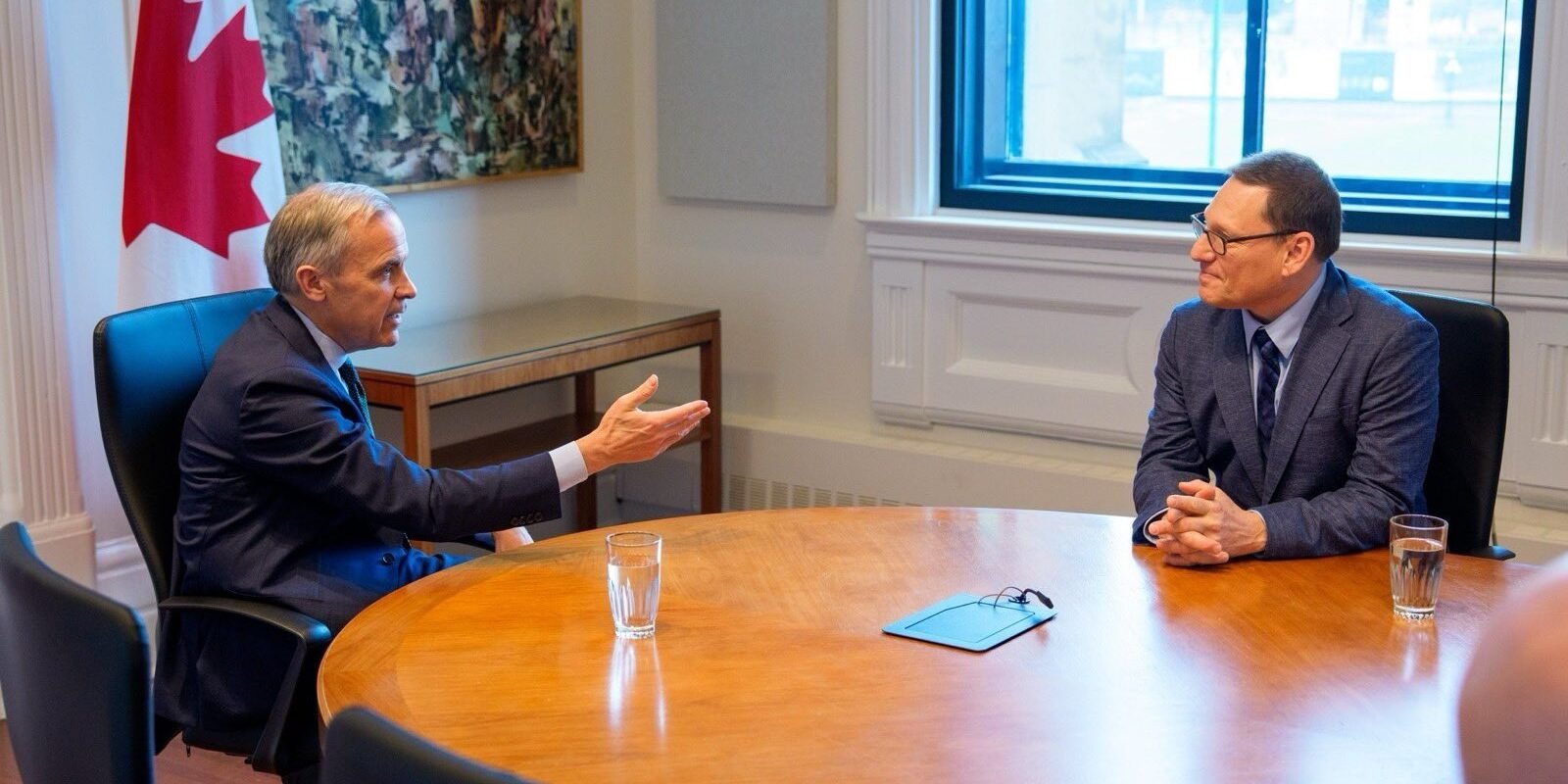
Surprisingly, the much-depleted federal New Democrats, and especially their still-new leader Avi Lewis, appear to be having an impact on at least some of the Mark Carney Liberals’ policy choices.
Lewis’ first public act after becoming leader was to call for a halt to something called “surveillance pricing.”
That odd-sounding phrase refers to the retail practice of snooping on a customer’s online presence to tailor a price to that person.
For example, a mother of a child with a bad respiratory infection might search online for remedies. Then, when she ordered medicine from a pharmacy it would charge her more than other customers – having learned of her desperate need for the medicine through internet snooping.
When Lewis proposed the federal government ban that “creepy” practice – which is more common in the U.S. than in Canada, but is growing here – there was general silence and indifference, including from the Carney government.
Ontario Premier Doug Ford predictably answered that he was against such a ban because he believes in a “free market, capitalist society.”
By contrast, next door in Manitoba, Wab Kinew’s New Democratic government has introduced legislation to ban this predatory and intrusive practice.
Evan Solomon (sort of) takes on surveillance pricing
The federal government broke its silence on June 15 when Mark Carney’s minister for Artificial Intelligence and Digital Innovation Evan Solomon tabled the Protecting Privacy and Consumer Data Act.
Part of that legislative package takes aim at surveillance pricing.
Solomon’s Bill (C36) has a number of goals, including protecting children’s personal information and allowing people to delete personal information.
One of those goals is to discourage businesses and other organizations from “unfairly using personal information, such as inappropriate surveillance pricing.”
This is a Liberal government. And so, as is their wont, when they take on big business, they do so gingerly – and slowly.
The new Act will not prohibit surveillance pricing outright, as does the Manitoba legislation. It merely promises unspecified regulatory measures.
Plus, this part of the Act will not come into effect until 2028.
NDP leader Lewis was quick to jump on the Carney government’s weak response, compared to his own party’s proposal and to Manitoba’s new law.
However, the mere fact that Evan Solomon felt it necessary to address the problem of what he called “algorithmic pricing and unfair data usage” shows the NDP is influencing the national policy conversation – despite its tiny contingent of MPs.
In drafting the new Act, Solomon was careful not to use the precise words “surveillance pricing”. Perhaps the Carney Liberals do not want to give another political party any measure of credit for even part of their legislation.
But anyone who has been paying attention will know that this issue did not appear to be on the Liberals’ radar until Avi Lewis put it there.
Carney tilts socialistic in his new food security strategy
On another front – the price of food – the Liberals have again taken a leaf from the current NDP’s playbook.
On June 11, the Prime Minister introduced his government’s National Food Security Strategy with much fanfare.
Carney chose the Ontario Food Terminal in Toronto as the backdrop for his announcement.
The Terminal is an Ontario-government-owned food wholesale operation, set up in the 1950s, at a time when governments believed it was necessary to increase public sector involvement in the economy.
Its original (and continuing) purpose was to help Ontario producers compete with their increasingly aggressive and well-financed U.S. competitors.
The Terminal was an appropriate place for Carney’s food security announcement, because it foreshadows a big piece of what his government is now proposing.
The new federal food security strategy includes over $3 billion worth of measures. One billion dollars of that will go to creating a network of food terminals throughout the country, on the model of the publicly-owned one where Carney spoke.
Where large-scale terminals are not feasible, Carney proposes creating smaller food hubs. These would be especially useful for remote and northern communities.
The strategy explains the purpose of terminals and hubs this way:
“By bringing many buyers and sellers together, terminals help independent grocers stay competitive by giving them access to affordable products without relying on supply systems owned by large retail chains and they expand access to fresh produce in underserved communities.”
- Diminish the near-monopoly control of the small number of large corporate chains, such as Loblaws and Sobeys, which currently dominate Canada’s food industry.
- Create new, publicly-owned sources of supply for small, local, and independent retailers.
- Make food more affordable for all, especially for underserved communities.
Sounds pretty socialistic to this writer. And at least one major piece of Carney’s strategy appears to echo what New Democrat Avi Lewis has been advocating since 2025.
Lewis’ full suite of proposals go way beyond public-owned wholesale terminals. He has championed a series of “public, non-profit [retail] grocery stores from coast-to-coast.”
The New Democratic leader would also have the federal government set up a “public farms fund” to help municipalities buy food-producing land thus preventing that land from falling into the hands of profit-seeking developers.
But there is one Lewis policy idea Carney almost seems to have adopted wholesale.
The NDP leader has proposed that the federal government create local and regional “food infrastructure hubs”. Food could thus be processed, stored and sold “outside of corporate value chains.”
That idea – which has been in the public domain since Lewis first floated it in the fall of last year – sounds a lot like Carney’s just-announced food terminals and hubs proposal.
Imitation is the sincerest form of flattery.
But New Democrats should not let it go to their head.
Political parties in a multi-party democracy do not merely exist to compete for power. And opposition parties should not see as their sole function to persistently damn the party in power – whatever it does.
The late NDP leader Jack Layton used to say he favoured “proposition over opposition”.
There is plenty the Carney government has been doing that should legitimately anger folks on the progressive end of the political spectrum.
But, perhaps to their surprise, New Democrats are discovering that sometimes, with persistence, their progressive message can have an impact.
That might be especially true for Canada’s current Prime Minister.
Mark Carney still aspires to be seen as an enlightened leader, concerned with the environment and social justice – even if a good deal of what his government is doing betrays that ambition.
