
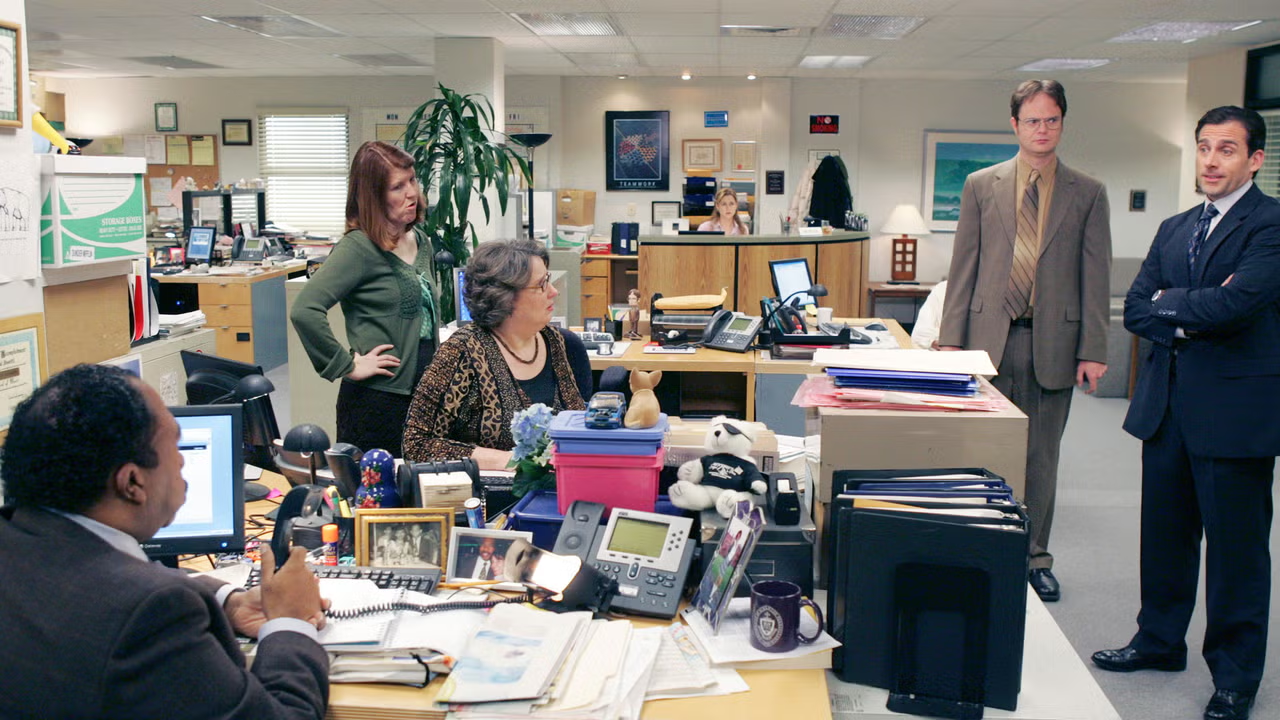
Michael Scott, the hapless regional manager at the center of the American version of “The Office” played by Steve Carell, believed he was the world’s best boss. He even had the mug to prove it.
Meanwhile, for most of the show’s 2005-2013 run, his employees endured pointless meetings, cringed through his speeches and quietly counted the hours until they could leave. The joke worked because so many viewers recognized something universal: the gap between how bosses see themselves and how workers actually experience them.
That gap is no longer just a sitcom premise. It may be the central reason American workplaces are in trouble.
In the U.S., only about 30% of part-time and full-time employees say they are engaged at work, according to an annual Gallup survey. That’s the lowest level in more than a decade.
Determining whether an employee is engaged boils down to a single question: Does the work matter to the person doing it? Engaged employees are invested in the outcome of their work. Disengaged ones have stopped caring.
I’m a cultural historian who has written extensively about workplace culture, including the book “The Authentic Leader: The Power of Deep Leadership in Work and Life.”
And I believe that when more than two-thirds of the workforce is checked out, it’s evidence of a widespread leadership failure.
What gets said behind closed doors
One reason why most workers aren’t engaged on the job has to do with their psychological safety, meaning whether they feel they can speak up, ask questions or admit mistakes without being punished. I have been tracking the gap between psychological safety as a stated value for employers and the lived reality of their employees for years.
Amy Edmondson, a leadership and management scholar, has pioneered research in this area. Teams with that have high levels of psychological safety outperform those that don’t, she’s found.
When employees feel psychologically unsafe, they go quiet, contributing to the widespread lack of engagement that Gallup has identified. Most workplace research relies on employee surveys, which capture what workers are willing to say in the moment. But those surveys don’t always capture what workers truly feel.
The 2026 Psychological Safety Study that the Center for Organizational Effectiveness, a consulting firm, released in March 2026 took a different approach. The study draws on anonymized clinical conversations with workers at over 100,000 companies, organizations and government agencies that employ 88 million people around the world. The data was drawn from what employees told licensed counselors in confidence.
Both studies estimate the scale of related problems.
Memorable scenes lampooning bad managers in ‘The Office’ never get old.
Workers are running on empty
The Center for Organizational Effectiveness study identified the top three concerns impeding psychological safety in workplaces around the world.
Globally, the top concern is work-life balance, specifically when job demands consistently exceed the time and energy workers have to meet them.
The second is job-performance anxiety. That’s the stress of trying to meet a supervisor’s vague or constantly changing expectations.
The third is contending with unclear objectives. Many workers simply don’t know what they are aiming for, what their priorities should be or in which direction their employer actually wants to head.
That third finding connects directly to Gallup’s results. Only 46% of American workers feel that they clearly know what their employers expect from them, down from 56% in 2020.
A work-life imbalance
The Center for Organizational Effectiveness noted a different shift in the United States: For American workers, being stretched thin has become the new normal.
Work-life balance has displaced workplace trauma—harassment, violence or sustained high-stress environments—as the leading concern for American employees.
Chronic exhaustion is now a hallmark of employment, whether you work in an office or from home.
Employee fears of seeing their jobs eliminated due to the rise of artificial intelligence or a weak economy are adding to a perception of imbalance.
Same problem with different causes
The Center for Organizational Effectiveness’ report highlights distinct trends in different places.
For example, in France, the top workplace concern is a lack of room for professional development. With workdays kept short by strict labor laws, access to learning opportunities and, as a result, career mobility tend to be limited.
But unlike in the United States, work-life balance does not appear in France’s top three concerns.
American workers feel they cannot breathe. French workers feel overlooked and stagnant.
A lack of clarity about how well they’re doing their jobs ranked as a top concern for workers in 11 countries, including the Philippines, Vietnam, Brazil and Mexico.
The workers who registered that concern are frustrated by their managers’ unclear goals and shifting priorities. This data suggests that corporate leaders are not defining what good performance means, which translates into their employees becoming risk-averse, which limits innovation and entrepreneurship.
“The Office” captured this dynamic perfectly. Michael Scott’s staff never knew what he actually wanted, because he didn’t know either.
Priorities shifted along with his moods. Success was whatever pleased him that afternoon.
The humor came from watching competent people freeze, hedge and stop trying because the target kept moving. Played for laughs on television, the same pattern in a real workplace produces exactly what the data shows: workers who play it safe because they cannot see the standard they will be judged against.
Even in what should be a lighthearted exchange with his staff, Michael Scott’s moodiness leaves employees confounded.
What employers are misreading
Employers are not ignoring these problems. They are misreading them.
Executives’ and managers’ intentions are usually good, as are Michael Scott’s. But their behavior—which workers read far more closely than any mission statement—tells a different story. I call this a leadership chasm: the gap between what executives believe and what employees feel.
Sensing that gap, workers default to skepticism. They measure what leaders say against what they actually do. They become skilled at spotting the distance between the two.
Many employees feel it when their employers adopt the language of psychological safety as performance without authentically creating a supportive culture. If an employee sees a colleague get rebuked after raising a concern, then they understand the real lesson, regardless of the manager or executive’s “open-door” claims.
“Psychological safety doesn’t exist in isolation,” says Donald Thompson, managing director of the Center for Organizational Effectiveness and author of “The Employee Engagement Handbook.” “It’s built on the daily realities of how people experience work.”
For employees to believe in their bosses, they have to watch it happen. For example, it helps if they can see a co-worker raise a tough question and their leader responds with openness, rather than defensiveness.
For most American workers, that moment hasn’t arrived. They’re too worn down or discouraged to give their best.
Bob Batchelor is an assistant professor of communication, media, & culture at Coastal Carolina University.
This article is republished from The Conversation under a Creative Commons license. Read the original article.
