
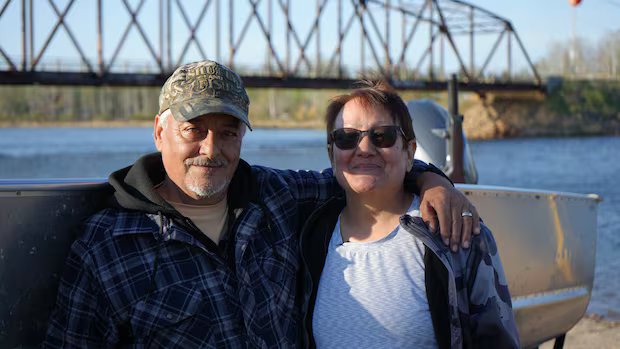
CBC’s road trip series Land of Living Stories explores inspiring stories of community spirit from across Saskatchewan. In our latest visit, CBC-Radio Canada hit the road to Buffalo Narrows. This is one story in a multi-part series from that community.
WARNING: This story contains details of abuse.
When Darlene Petit first moved back to Buffalo Narrows, Sask., she wouldn’t eat or even touch a wild rabbit, though her husband Mervin often went out to set snares. When he would bring her onto his boat, she’d take a book and read while he fished.
But their relationship over the years has reconnected her to a life and culture she almost lost, when she was taken from her family in Buffalo Narrows as part of the Sixties Scoop.
“Mervin was a big, big influence in my life, teaching me my cultural background,” the 62-year-old said, explaining how her husband showed her the joys of catching their own food, from rabbit to wild chickens to moose. Thanks to him, she reconnected with the traditions of her Métis and Indigenous ancestors.
“I started fishing and learning how to catch fish, and now I can outfish anybody,” she said, laughing.
Now the pair can often be seen sitting quietly in their boat, watching the bears and deer in the distance, or setting a net and hauling up fish they share with others in the village.
It’s a fight to keep these cultural traditions alive, as people are losing touch with ways of life that go back hundreds of years, said 61-year-old Mervin. That’s why he’s so keen to help anyone who’s interested learn how to hunt, fish and prepare food.
“I want everybody to feel that, all the young people, all the older people that don’t know this stuff, I want them all to understand this stuff and keep doing it,” he says.
The pair say they don’t need to rely on groceries, but instead eat the wild game and fish they catch themselves. It’s a self-reliance they want to pass on to future generations.
“You’re gonna need this more than ever in the coming years because of all the stuff that’s going on now in the world; it’s so expensive living,” Mervin says.

Darlene and Mervin Petit have been together for 43 years, and have grown closer through sharing their love of living off the land. Now they hope to pass that knowledge on to others in the community.
Scooped from childhood
While Mervin’s memories are deeply rooted in fishing and trapping, Darlene was taken from her family when she was three. She was relocated to Lebret, Sask, 780 kilometres south of Buffalo Narrows, and bounced from foster home to foster home.
It was a traumatizing time.
“I was bathed in hot Javex water and things like that,” she said. “And then when you’re in foster homes, you’re abused by other children that are in the home.”

Fortunately, her mother successfully fought to regain custody of her children, and Darlene was finally reunited with her family when she was 12.
However, meeting Mervin was the catalyst for reconnecting with her roots, as he introduced her to his way of life.

They’ve been together for 43 years now, through thick and thin.
“I went through a period of depression after my father passed away and to get better, Mervin used to take us walking in the bush,” Darlene remembers. They’d walk for hours.
“I don’t suffer a lot from [depression], but that time I did, and that’s how it helped, being out here on the water, on the land.”

Others in Buffalo Narrows call them an inspiration.
“They’re definitely mentors in the community,” said Candice Waite, whose kids and their friends recently joined Mervin and Darlene to learn about filleting and smoking fish.
“When we pulled up there, they were eagerly waiting in their garage, literally fillet knives and hands with just an open heart,” she said. They refused any payment, saying they just wanted to teach others, she recalled.
“I aspire to be Mervin and Darlene when I’m their age.”
The joy the couple finds in sharing their traditions is plain in their smiles as they haul up a net full of fish in just half an hour. It’s a gift Darlene doesn’t take for granted, having been taken from her home as a child and having had to relearn her culture.
And for his part, Mervin doesn’t take her presence in his life for granted.
“She’s my best friend,” he says.
“I just couldn’t imagine living life with somebody else.”
