
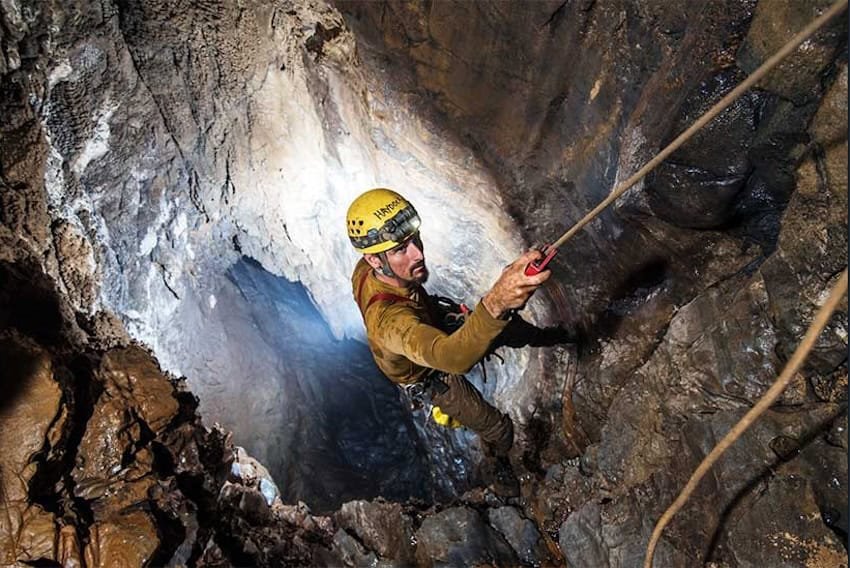
In 1965, a handful of college students in Austin, Texas, asked their geology professor a simple question: Where would you look to find the deepest cave in North America?
Their investigation pinpointed the town of Huautla de Jiménez, Oaxaca.
What was it about this remote spot that attracted their attention?
“It was the local limestone,” says longtime caver and Explorer’s Club member Bill Steele. “It’s around two kilometers thick. Then there is the rainfall: about three meters a year. That’s 118 inches! But there aren’t any surface streams in the area — so where was all that water going?”
In 1966, four Austin cavers drove south to Huautla and ended up rappelling into astoundingly beautiful Sótano de San Agustín (St. Agustine’s Basement).
“That was in 1966,” says Steele, “and here we are now, 60 years later, and we’ve got the deepest system of caves in the Western Hemisphere, 1,560 meters deep. Up until this year, it had been explored and mapped to a length of 101 kilometers. When we process this year’s data, it may surpass 105 kilometers.
The most magnificent cave
“Sistema Huautla has 30 entrances, with immense rooms, stunning crystalline formations, waterfalls and underground rivers. It’s been called — by people who know — the world’s most magnificent cave … and our best hunch is that we’ve only found half of it.”

To promote further exploration of the Huautla Cave System, Proyecto Espeleológico Sistema Huautla (PESH) was founded in 2014 and typically organizes cave studies during April of each year.
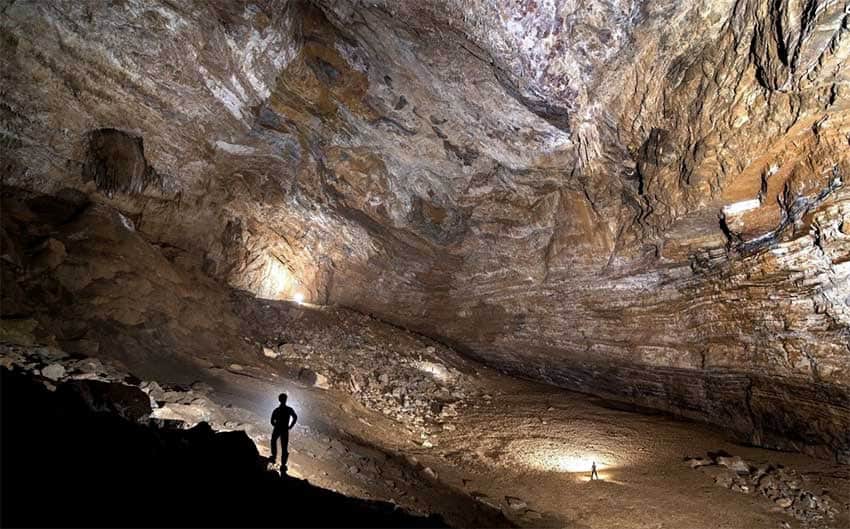
This year, 59 volunteers came to Huautla from Mexico, the U.S., England, Poland, Australia and Costa Rica.
Four teams of the hardiest explorers were sent into four different caves to camp underground for a week, following up on leads discovered in previous years.
One week underground
“They’re completely out of contact with the outside world,” Bill Steele told me. “There’s no radio that works through that much rock, so they tell us when they expect to get out, and if they don’t show up, we go looking for them.”
In addition to the cave explorers and mappers, there are the scientists.
“We follow the philosophy of the people who explore Mammoth Cave, the world’s longest,” says Steele. “This means that while you’ve got the best explorers — and all the right equipment — in the cave, you should take advantage and do all the scientific studies possible.”
The results have included theses on the system’s geology, biology and paleontology as well as an archaeological study related to rain-god rituals held in some of the caves.
“They’re also doing studies of paleoclimatology. It turns out that there are datable traces of minerals in stalagmites, so if you find a stalagmite that’s fallen over in an earthquake long ago, you can bring it out for analysis. A professor in Las Vegas, Nevada, has used these to find much more about the climate of southern Mexico than had even been known before.”
A scorpion named Steve
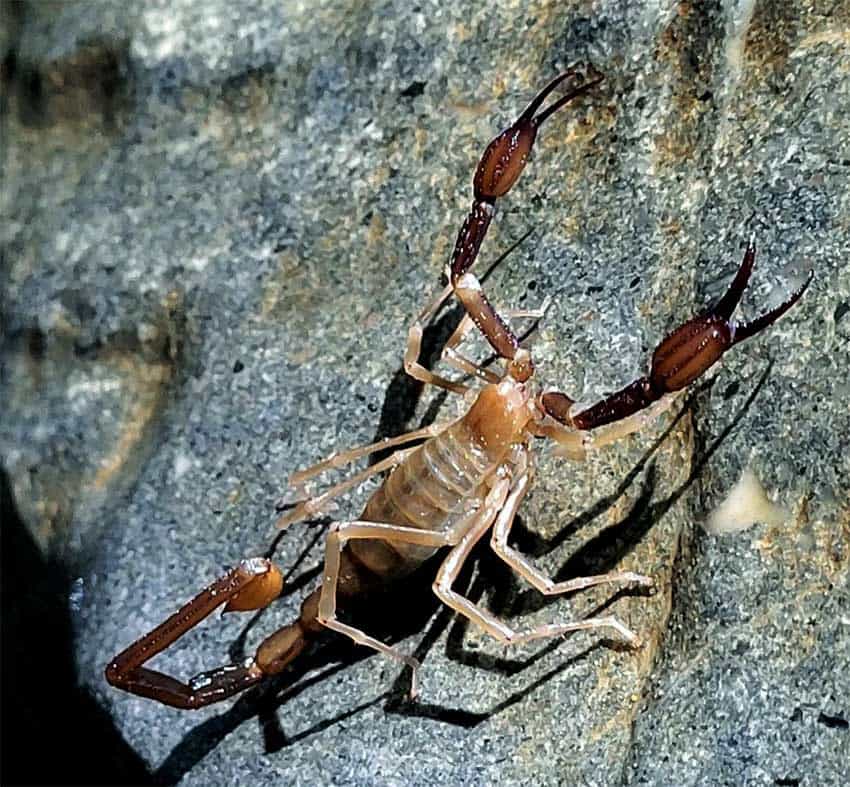
One of Huautla Cave’s many contributions to science is a blind scorpion called Alacran tartarus, which was found around 800 meters below the surface. This was the world’s first known troglobitic scorpion and was described by renowned Mexican biologist Dr. Oscar Francke in 1982.
“Could your people find me a live one and get it all the way to Mexico City?” UNAM professor Edmundo González asked Bill Steele, explaining that a study of the venom of these cave-adapted scorpions might result in the development of a new antivenom.
“By good luck, a couple from Georgia did come across this cave scorpion, deep underground,” Steele told me, “and they brought it to the surface in a half-liter bottle, which they opened every few hours to splash in a little water. Then I put it into a ‘critter box’ whose walls I lined with black paper. All the cavers liked that little scorpion so much, they named it Steve to honor Steve Zeman, the camp cook, whose food everyone adored. Next, the couple transported Scorpion Steve to Mexico City by bus and finally took a taxi to UNAM, where they handed it over to Professor González. So far, it’s alive and healthy and doing fine. This, by the way, is the first time that a cave-adapted scorpion has been kept alive on the surface.”
Collecting experiences
PESH is a non-profit organization, and participants in the project pay their own way. On top of that, the cavers have supported many initiatives benefiting the local communities, including the printing of materials written in the Mazatec language.
Nevertheless, rumors circulate about the motives that would bring so many foreigners out to a remote corner of Oaxaca.
“I was in a pottery shop in the little town of San Andrés,” Steele said, “and the proprietor came over to me and said, ‘¿Sabes que? People say you guys take things out of the caves.’”
For years, Steele had typically replied that this was untrue, that they don’t take things out of the caves.
Taking new knowledge from the caves
This time, he tried a new tactic.
“Yes, that’s true,” Steele told the man. “Actually, we take three things out of the caves.”
The man looked stunned.
“Number one, we take knowledge of what’s down there so that we can share that knowledge with the Mazatec people who don’t have the equipment or the experience to be able to go into them.
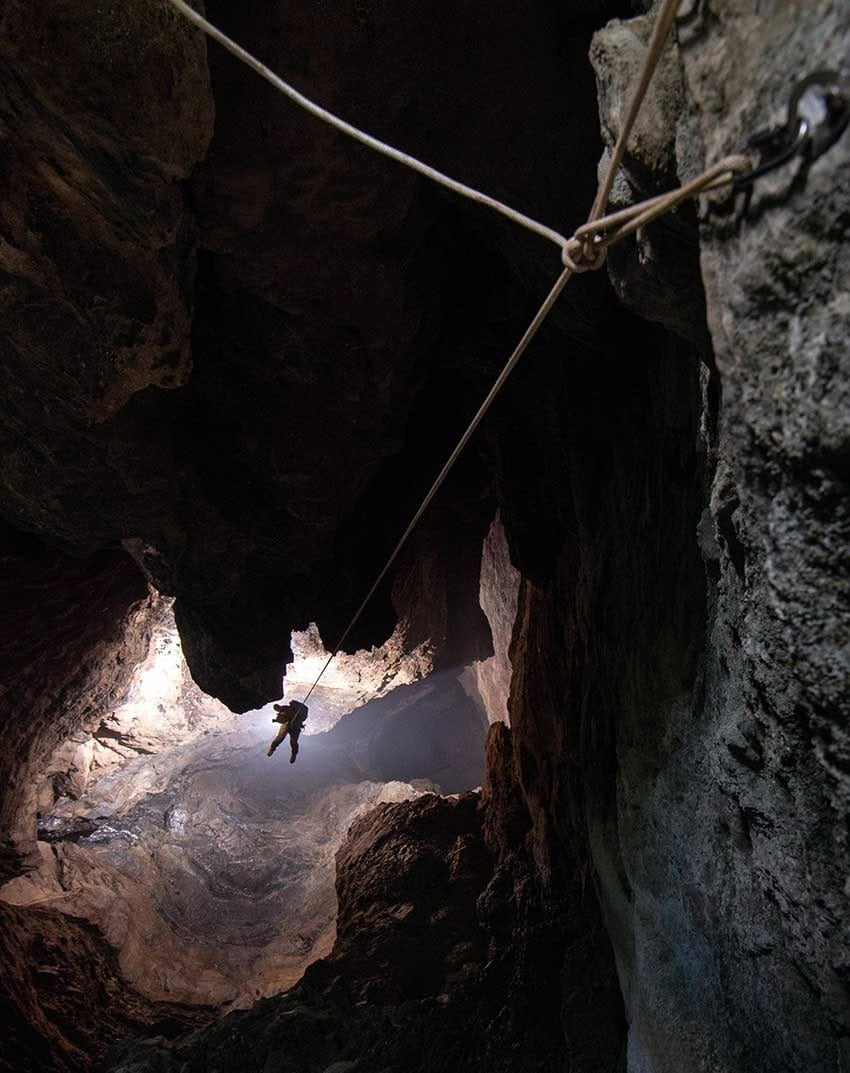
“Number two, photographs of what we see in there, so we can share that beauty with you.
“And then number three: experiences which enrich our lives.
“To my surprise, it was the third one that made the man smile big.
“And on reflection, I understood. These people don’t live in the world community. So it’s their everyday experiences that make up their lives. These are things they appreciate.”
John Pint has lived near Guadalajara, Jalisco, for more than 30 years and is the author of “A Guide to West Mexico’s Guachimontones and Surrounding Area” and co-author of “Outdoors in Western Mexico.” More of his writing can be found on his website.
