
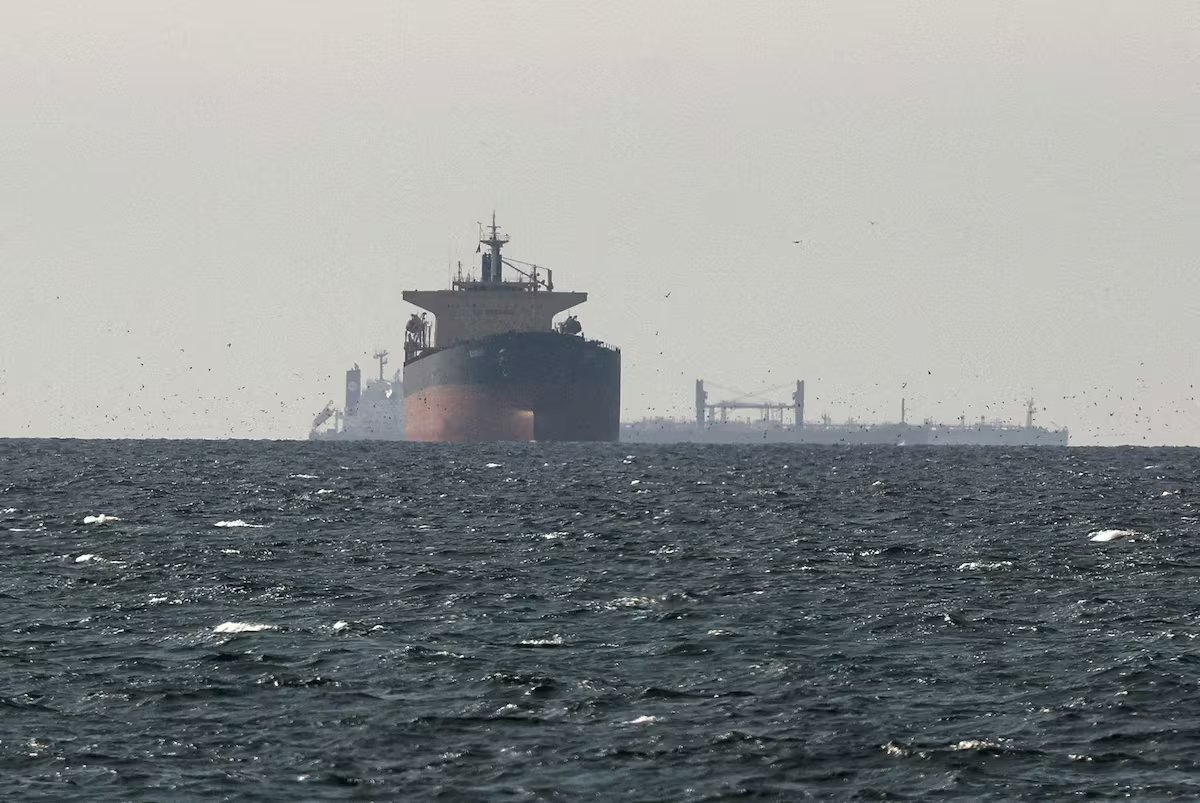
It has been 115 days since the United States and Israel launched their war and Iran, in retaliation, closed the Strait of Hormuz, blocking one of the world’s main maritime routes and leaving more than 20,000 seafarers stranded. More than 16 weeks of uncertainty and direct threats to their safety have turned this into what can already be described as the deadliest conflict for the merchant navy since the late 1980s — and it could now be coming to an end after an agreement reached between the Donald Trump administration and the ayatollahs’ regime.
“Although there is a palpable sense of relief at the prospect of active hostilities ending, it is a deeply sombre, cautious relief, heavily marked by the trauma and losses of the past four months,” says Saman Rezaei, general secretary of the Iranian Merchant Mariners’ Union (IMMS), in an interview with EL PAÍS.
The International Transport Workers’ Federation (ITF), to which IMMS is affiliated, has also welcomed the agreement but stresses that it is “only the beginning” and that “the text on paper must be translated into concrete actions.” In other words, there must be “absolute, binding and verifiable guarantees” that none of the parties will attack civilian transportation workers, who “have paid the cost of the conflict.”
The International Maritime Organization (IMO) has records of 46 confirmed attacks on civilian vessels, which have caused the deaths of at least 14 seafarers. Most were from Iranian fire, although some were by the opposing side, including the freighter Settebello, which the United States Navy fired several missiles at on June 10 after accusing it of trading with the Islamic Republic. Three Indian sailors died. “We want the full truth about what happened and for whoever is responsible to receive the heaviest possible punishment. We are devastated,” Aditya Sharma, the grandfather of one of the victims, said through tears to the Press Trust of India news agency.
However, that list does not include the deaths of 54 Iranian sailors (in addition to 66 more who were injured and seven missing), figures that the Iranian government presented at a recent session of the IMO’s Technical Cooperation Committee and that the IMMS confirms. “These deaths are the result of military actions against our civilian maritime infrastructure. Our seafarers have been attacked in direct bombardments of our ports and merchant vessels, as well as in attacks on coastal communities that have killed 16 fishermen,” Rezaei says.
The IMO statistics also do not record deaths from illness during the blockade. That was the case of the Indian sailor Nishanth Uirthanathan, 35, who was the second officer aboard the Celestial, which was stopped on May 20 by U.S. naval forces as it was heading to the Asian country. The Americans forced the ship to divert to Omani waters and the crew requested medical assistance because Uirthanathan was already unwell. “The shipowner said they would send a helicopter to evacuate him, but it never arrived. Distress calls were ignored,” the Indian union FSUI alleged. His shipmates had to live with the dead body for three days without proper refrigeration.
If the figures presented by Iranian authorities are confirmed, they would total around 70 deaths, which, despite the conflict’s relative brevity, would make it the deadliest interstate war for the merchant navy since the Iran–Iraq war (1980–88), when both countries devoted themselves to sinking each other’s tankers and more than 400 sailors were killed in the process. “Seafarers are civilians, not soldiers. They are trapped, exhausted and frightened, and they need help,” the Iranian union leader says.
“Pray for us”
The Mission to Seafarers is an Anglican charity that has offered support to merchant crews regardless of creed since 1856, with a network that spans 200 ports in about 50 countries worldwide, including those in the Middle East. “At the start [of the war], our colleagues who visited ships told us that seafarers were very frightened because they saw missiles flying by and did not know where they would fall,” John Attenborough, the Mission to Seafarers’ regional chaplain for the Middle East and Southeast Asia, tells this newspaper.
Even now they remain fearful, uncertain whether the peace agreement will hold: “On Thursday one of our chaplains visited several ships in the Gulf and the seafarers asked him whether they could feel safe and whether this peace is real or will be lasting. They were glad to see my colleague — we try to be a friendly face in a foreign place — so they asked him, ‘Can you pray for us, for our protection?’” Attenborough recalls.
“It has been a very hard situation for seafarers because it is a war zone and there have been attacks. The worst thing has been the uncertainty, not knowing when it would end. So we have maintained daily contact with our crews to check on their condition and assess security. We have also expanded satellite internet coverage so they could stay in touch with their families,” says Hanja Richter of the German shipping company Hapag-Lloyd. Four of its ships, carrying around 100 seafarers in total, continue to wait in the Persian Gulf until conditions allow a safe transit through Hormuz.
Hapag-Lloyd vessels, like most from major shipping lines, have anchored near the United Arab Emirates, where they have been able to take on supplies. Not in port, as is customary, but via boats that bring drinking water, food and fuel from the shore and collect waste generated by the seafarers.
Phil Belcher, a spokesman for Intertanko — the trade association representing tank-ship owners, to which roughly 100 vessels still in the Persian Gulf (with about 2,400 crew aboard) are affiliated — acknowledges that it was difficult to relieve crews during the first month, with regional airports under attack and air traffic halted, but says they have since been able to rotate crews. “Seafarers have the right to repatriation and can refuse to remain on those ships. That right has been respected by our members,” Belcher says.
That is not always the case. As in all walks of life, there are classes in seafaring. Those who work for well-established major shipping companies tend to have better pay, working conditions and basic rights. In other cases that is not so. “I thought I had seen it all, but when you see seafarers here earning €75 a day or Iranian shipowners who owe months of wages and say they will only pay at the end of the year, you get angry…,” Mohamed Arrachedi, the ITF coordinator for the Arab world and Iran, says by phone.
The organization has received more than 2,000 requests for help during nearly four months of conflict, especially about shipowners refusing to repatriate crews. “In the morning I turn my phone on and today [last Wednesday] I already had 44 messages,” Arrachedi says. “I have a seafarer from Ukraine who wants to get off the ship because his blood pressure is very high. He is afraid something will happen to him, but they will not let him leave nor pay him the last four months’ wages.”
Another complaint is abandoned ships. The largest companies in the sector have been able to offset the Hormuz crisis with increased traffic on other routes, but for smaller shipping companies leaving vessels immobilised in the Gulf can be a death blow. “Ship abandonment — that is, owners walking away from the vessel and the crew, leaving them without pay, without provisions and with no way to be repatriated — is a persistent issue in this area, and the recent conflict has dramatically worsened it,” Rezaei says.
According to IMO data, at least 17 vessels have been reported abandoned in the Gulf so far this year. There is the added danger that, for lack of maintenance, these vessels may suffer damage or even sink.
“There are also many crooks who use the conflict as an excuse and abandon seafarers,” Arrachedi complains, citing the case of a Filipino crew on a vessel abandoned by both owner and operator, who have not been paid for five months and are not allowed to leave the ship: “Seafarers tell me they will kill themselves if they are not helped to return home.”
“They are human beings with the same emotions as any of us,” Chaplain Attenborough concludes. “They are living in danger, in a state of great uncertainty, and have been away from their families and loved ones for months. So they feel trapped.”
Sign up for our weekly newsletter to get more English-language news coverage from EL PAÍS USA Edition
