
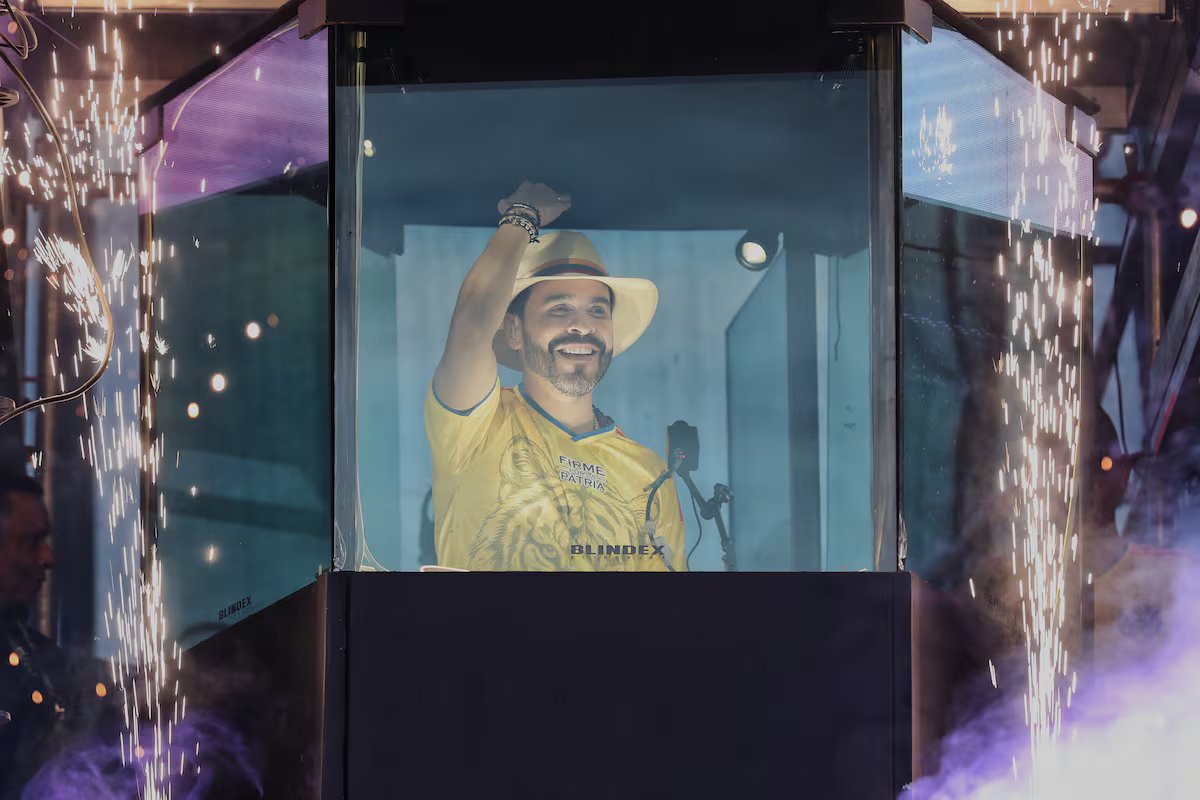
Abelardo de la Espriella won Colombia’s presidency on Sunday by a very narrow margin over the leftist candidate Iván Cepeda, an outcome that will make it difficult for him to fulfil the grandiose promises he made during the presidential campaign. Almost all of his headline-grabbing proposals copy measures by other far-right leaders in the region, who now feel they have gained ground in Casa de Nariño, the seat of Colombian government.
Those who know the president-elect say he is more pragmatic than ideological, that he will pursue only the promises that are feasible and popular, while discarding those that become politically complicated. It is not yet clear whether De la Espriella will moderate some of his most radical ideas to avoid a greater clash with the half of the country that did not vote for him, as he did in the final stretch of the campaign, or whether he will continue to uphold them to keep his popularity or please his base.
From Argentina’s president, Javier Milei, De la Espriella borrowed a symbol and a policy. The symbol is a big cat: the Buenos Aires native campaigned with the image of a lion, while the Colombian candidate chose a tiger. “We are going to make a wonderful duo: a tiger and a lion,” De la Espriella told Milei in a video call. From Milei he also borrowed a policy: he has promised to cut the state bureaucracy by 40 percent, which would mean eliminating the contracts of about 700,000 people. It is a proposal that is almost impossible to implement without enacting legislative reform, which would be lengthy and politically costly for lawmakers who often demand positions within that same bureaucracy. It is easier for the president-elect to close embassies created by the Petro government, for example, or to try to merge ministries, as former conservative president Álvaro Uribe did. But the 40 percent target will be neither easy nor popular.
From Nayib Bukele he borrowed the tough-on-crime rhetoric. De la Espriella adopted the Salvadoran leader’s plan to build 10 mega-prisons and, as former Colombian president Uribe did in 2002, has promised that the military will benefit from a larger budget and more equipment to fight armed groups. He has pledged to solve the security crisis in the country’s south in 90 days, a claim he later nuanced by pledging to capture or kill 10 armed group leaders in the first three months.
The promise resonated with Colombian voters who are sharply critical of the “total peace” policy advanced by left-wing president Gustavo Petro, who sat down to negotiate with various armed groups who used the time to reinforce themselves and did not hand over their weapons. This is likely the promise that the president-elect will focus on the most, with two major difficulties: it is not easy to capture 10 leaders, and above all he faces a huge and growing fiscal deficit that will limit military spending and social investments.
Also, like Milei in Argentina — who changed institutional rules to redefine protected glaciers — De la Espriella has said he wants to closely review how the boundaries of national parks and other natural landscapes are determined. The president-elect is close to businesspeople linked to the hydrocarbons industry and has already said he wants not only to return to a more aggressive mining-and-energy exploitation policy — which Petro had halted under the banner of the environment — but also to explore the possibility of carrying out “as much fracking as possible.” The promise has alarmed environmental activists, who have in the past mobilized thousands of protesters for environmental causes in a country proud of being one of the most biodiverse in the world. If he does not temper his ambition, De la Espriella will almost certainly clash with the social movement that did not vote for him.
Like Donald Trump, De la Espriella is dismissive of international organizations and has said he is not interested in Colombia maintaining its embassy at the United Nations. “The U.N. is a political directory of the left,” he has said. It is a promise that would face several legal challenges, especially because of Colombia’s international commitments, which are reflected in Colombian jurisprudence. He does expect a more fluid relationship with the United States — after Petro went through serious crises last year — and with the Republican Party, of which he has been a donor as a U.S. citizen, a relationship he hopes will translate into more U.S. military support for Colombia.
But he shares much more with Trump. De la Espriella also marketed himself as a successful, ostentatious billionaire businessman who wants to run the state like a company, using patriotic emotion to enter politics: if Trump spoke of making America great again, the Colombian talks about not being ashamed of the homeland. The U.S. president also cut back on government with help from Elon Musk, and launched a legal campaign against what he called “the swamp”: the Democratic Party, which he now persecutes through the Justice Department. During his campaign, De la Espriella downplayed the support he received from those he calls “the usual people,” and now faces the challenge of forming a cabinet with new faces without those appointments appearing to replicate the old formulas of the past.
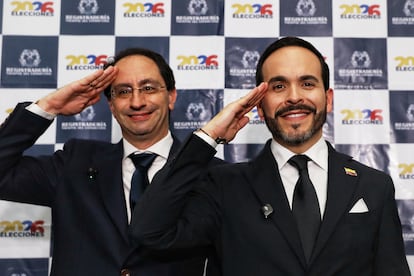
In a manner similar to Trump’s rise against the Democrats, De la Espriella came to power partly propelled by Colombians angry with Gustavo Petro’s government, to whom he promised justice. On the campaign trail he spoke of gutting the left and extraditing the current president. In his victory speech, however, he toned down that rhetoric of revenge and spoke of unity with those who did not vote for him. Were he to try to carry out such revenge, as an experienced criminal lawyer he knows there is an independent judicial system in which political vengeance has little place.
From Jair Bolsonaro, De la Espriella borrowed an aesthetic idea, in part militarizing his rhetoric, which helped him gain many supporters among retired officers. He also adopted the tactic of using the national soccer team’s yellow shirt while campaigning: he asked his followers to wear it at political events. With soccer fever running high ahead of the World Cup, every soccer fan in the street became a political placard. He now faces the challenge of retaining the backing of those retired officers who want a firm hand, while confronting the difficulty of the fiscal deficit and pressure from the opposition to respect human rights, if air strikes and glyphosate fumigations were to return to rural areas.
De la Espriella also carries the pro-life banner: he is now a devout Catholic and campaigned with evangelical churches that now expect their candidate to push a referendum that would eliminate the current right to abortion in Colombia, which is decriminalized up to 24 weeks of pregnancy. The candidate said he will respect the Constitutional Court’s decisions, but he has also emphasized that he is as pro-life as his supporters. A similar dynamic exists on adoption by same-sex couples: he respects that the Court allows it, but says he is concerned about “gender ideology.” He will now have all the Christian churches that supported him expecting that rhetoric to translate into action, while he will have only a slim margin in which to make legislative changes on those issues.
But the figure De la Espriella most evokes at home is Álvaro Uribe, who governed Colombia from 2002 to 2010 and was the unquestioned leader of the right until this latest election. The veteran politician took office propelled by a much larger majority and in his first months cut bureaucracy by merging ministries and closing embassies, and above all replaced military doctrine with a tougher line that during his eight-year administration brought security to many but also drew criticism for repeated and dramatic human rights violations. Uribe came to power with a tiny party, Primero Colombia, as an outsider: although he had been a member of the Liberal Party, he broke from it and campaigned with an anti-politician message.
“I did not come to do politics as usual; I came to change politics forever,” says Abelardo de la Espriella, who was endorsed by a small ultraconservative party called Salvación Nacional. The man who claims to represent “the nevers” against “the usual ones” will now occupy Colombia’s most important seat with an agenda similar to all the region’s like-minded leaders, but with a larger opposition than he expected.
Sign up for our weekly newsletter to get more English-language news coverage from EL PAÍS USA Edition
