
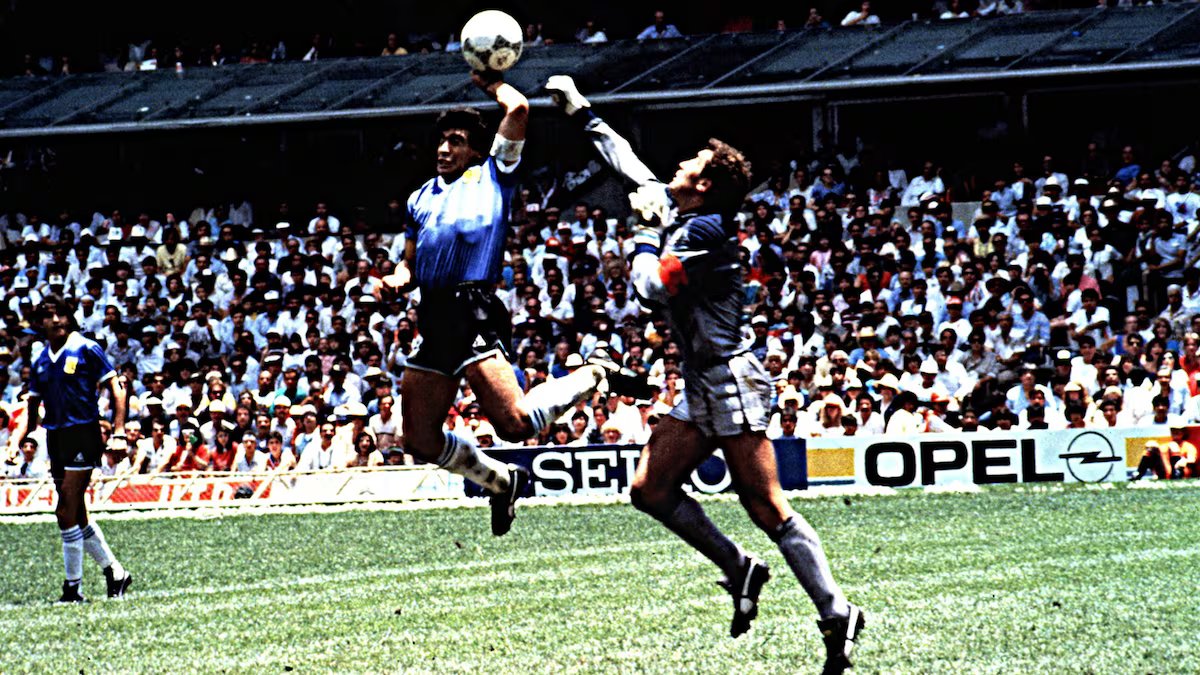
If one had to rescue a handful of matches from a shipwreck, Argentina 2–1 England in the quarterfinals of the 1986 World Cup in Mexico, played on June 22 — 40 years ago this Monday — should be among them. With the wounds of the Falklands War still fresh, Diego Maradona produced both the most exalted of goals and the most illegitimate: the so-called “Hand of God” goal.
And, in the wake of the deification of Argentina’s No. 10, one of the greatest pieces of sports journalism was also born: the image that proved that the first goal of that now-legendary match had been scored with his hand.
“I’ve got the photo, I’ve got the photo!” exclaimed its author, Alejandro Ojeda Carbajal, a photojournalist for El Heraldo de México, as he made his way back from the Azteca Stadium to the newsroom, where he would develop his film — still unaware that the image would be published in newspapers across hundreds of countries and would eventually end up as a poster on walls in Buenos Aires, Kathmandu, and Addis Ababa.
That Sunday ended with a question that television and other technologies of the time had been unable to settle: whether the opening goal had been scored with Maradona’s hand or his head. It was an era of photo development, of laboratories spitting out negatives still wet with chemicals.
“My father died in 1999, he was 65. The Hand of God photo was always a topic of conversation between us,” recalls Juan Carlos Ojeda, one of Alejandro’s sons. “He told me that he was driving back to the newspaper, hugging his camera and saying, ‘I’ve got the photo, I’ve got the photo.’ He still had to wait for the film to be developed, but his intuition told him he had it.”
Ojeda had a long career — he covered the World Cups in Mexico 1970, West Germany 1974, Argentina 1982, Mexico 1986, and Italy 1990 as a contributor — but he never made a living from photography. Apart from the World Cups, he only worked with El Heraldo on weekends.
“His regular job was grooming dogs. One of his regular clients was El Heraldo’s editor, Gabriel Alarcón. One day, he told him that he had set up a darkroom at our house to develop the photos he took of us, his children. Don Gabriel invited him to join the coverage of the 1968 Mexico Olympics, and that’s how it all began. They paid him very little. It was all very instinctive — he never studied photography,” recalls Juan Carlos.
A well-known Mexican journalist, Francisco Javier González — author of the book El 86 and a commentator for Mexico’s Televisa’s coverage of the 2026 World Cup — was then a reporter in El Heraldo’s sports section. Forty years later, he remembers a tense atmosphere in the newspaper’s offices.
“When I returned from the Azteca [stadium], the head of photography, Aureliano López — now deceased — was asking about Alejandro’s material,“ says González. ”Everyone wanted to know if he had the Hand of God image. But the rolls were missing. Some colleagues even believe the slides turned up in the trash. That someone, by mistake in the heat of the moment, had thrown them away.”
Another member of that newsroom, Adolfo Peñaloza, then El Heraldo’s sports photographer, also recalls the frantic search. “Someone told me they had seen Ojeda at a tavern near the paper. Matches were played at noon in Mexico, and journalists who went to the stadium, when they returned, wanted to have lunch,” he recalls.
Peñaloza continues: “I went to the bar, and Ojeda was playing dominoes and drinking a beer. I said to him, ‘They’re looking for your photos!’ ‘But I already handed in the rolls,’ he told me. ‘No, they’re not here,’ I insisted. In the end, he had left them in a bag. We returned to the paper and started developing them. Aureliano, my boss, who had a strong temperament, was furious. He asked, ‘Do you have the Hand of God photo?’ We had had two photographers at the match, and the first one had not captured it. Ojeda calmed him: ‘Of course, my man, I’ve got it.’”
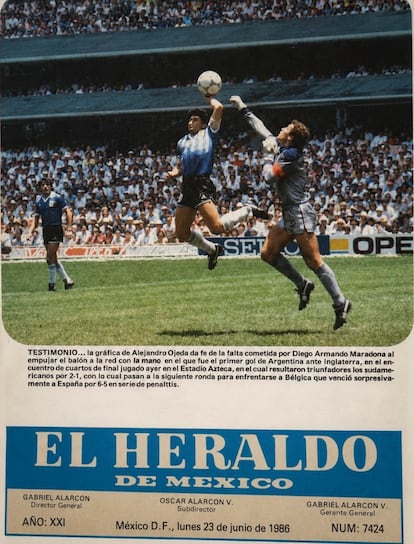
Then the developing process began. Peñaloza continues: “We had a light table to view the slides. When Ojeda saw the hand stuck to the ball like a magnet, he said, ‘There it is, there it is, look at it.’ Aureliano pushed him aside to check for himself: when he saw it, he turned red from shouting, ‘We’ve got it, we’ve got it,’ and called the editor, Alarcón, who announced: ‘Front page — run the whole photo on the front page.’”
And indeed, the next day, Monday, June 23, 1986, the perfect image covered the entire front page of El Heraldo de México under the headline “EVIDENCE.”
It was a world scoop. No Mexican — or global — newspaper had a comparable image. An Argentine photographer, Eduardo Longoni, had taken another extraordinary shot for NA, a news agency in his country, although with the ball still about 15 centimeters from hitting Maradona’s hand. An Italian freelance photojournalist, Giuliano Bevilacqua, also captured a similar image to Ojeda’s, though from the English goal’s side. However, since he had traveled that same day to Puebla to cover Spain vs. Belgium — played after Argentina vs. England — he did not realize until the next day that he, too, had that photograph, with the ball pressed against Maradona’s fist.
The day after the match, Monday, June 23, with Ojeda’s photo on El Heraldo’s front page, the impact was immediate. “Only then did we become aware of its reach. Many English newspapers came to the newsroom to buy the photo, but the owners of El Heraldo did not want to profit from it; they only asked that the newspaper and Alejandro Ojeda be credited,” González says.
“I remember a line of English photographers wanting to buy the photo,” says Peñaloza. “We all thought it would be good business for the paper, but its owner, Gabriel Alarcón, told them: ‘The original doesn’t leave here; I can give you a copy, but only if you include the credits.’”
Many years later, a mystery would emerge around this photograph: sometimes the credit is given to Ojeda himself, and at other times to an English photographer, Robert “Bob” Thomas, who does not grant interviews. Did Thomas buy the rights from El Heraldo or from Ojeda? It remains unclear. Even the photographer’s son does not know.
“The next day, the BBC in London contacted my father to buy the slide,” says Juan Carlos Ojeda. “They offered him $10,000, but he said no. I was 23 and I begged him, ‘Sell it, Dad,’ but he told me it wouldn’t be honest, that the photo belonged to the paper. Back then, there were no copyright rules, or we didn’t know them. Later, whether the newspaper profited or not, I don’t know, but for the family it was always a source of pride.” Amid the crisis facing print media, El Heraldo has in recent years reinvented itself as a digital news outlet.
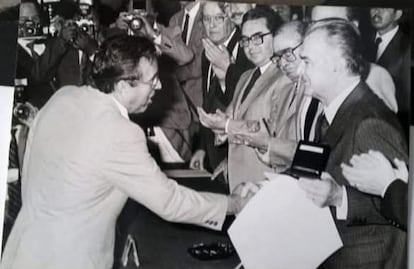
The following year, that image earned Ojeda Mexico’s National Journalism Prize, awarded by then-president Miguel de la Madrid (1982–1988). How a photojournalist who practiced photography more as a hobby than a profession had managed to capture that image was another of the miracles of June 22, 1986.
“Alejandro had a conventional camera, not an automatic one, which were only beginning to be used,” Peñaloza notes.
“That is, after he took a photo, he had to advance the shutter. Now you press a button and 50 shots come out in a row, but that didn’t happen then,” González adds.
Ojeda himself, before his death, helped enlarge his own legend: “When I saw Maradona jump, I pressed my camera shutter twice — that was all.”
Sign up for our weekly newsletter to get more English-language news coverage from EL PAÍS USA Edition
