
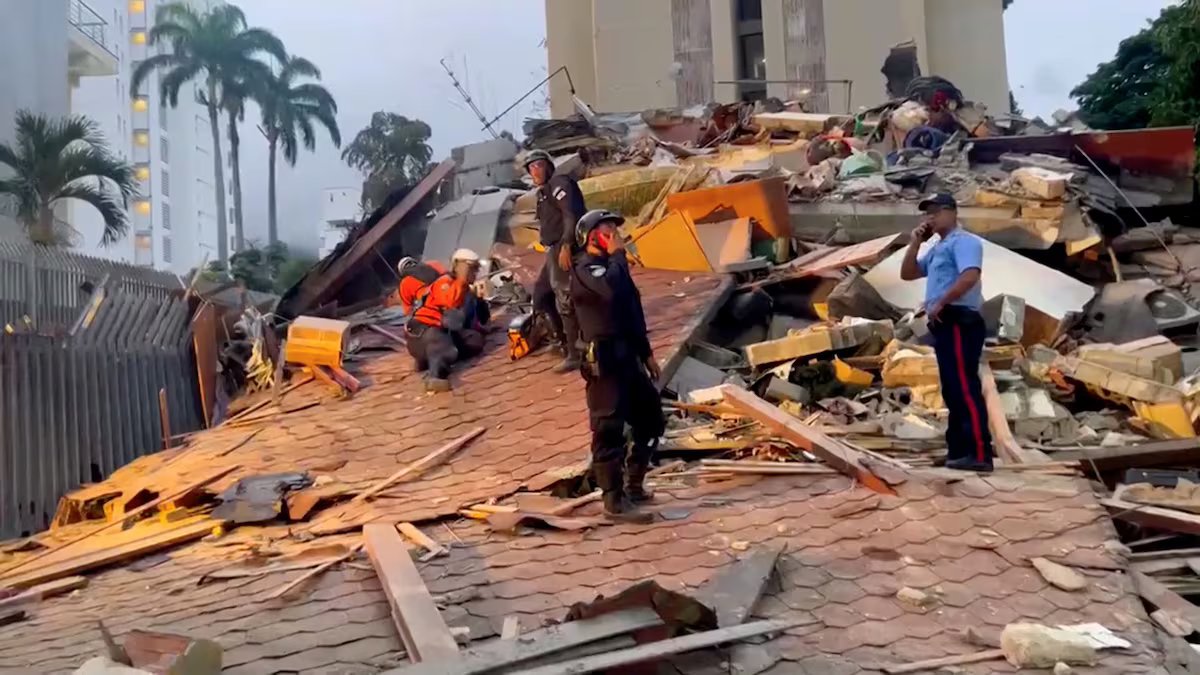
Two powerful earthquakes of magnitude 7.2 and 7.5, separated by just 39 seconds, struck several regions of Venezuela on Wednesday afternoon, according to the United States Geological Survey. The epicenter was located northwest of the municipality of Montalbán, in the state of Carabobo in central Venezuela. The tremor also reached the capital, Caracas, some 300 kilometers east from the epicenter. The U.S. National Tsunami Warning Center said the two quakes formed a “seismic doublet” — a phenomenon in which two large earthquakes occur within seconds of each other in the same area.
“A seismic event has occurred that all indications suggest exceeded magnitude 7,” Interior Minister Diosdado Cabello announced shortly after the quake. “It was felt most strongly in Trujillo, Yaracuy, Carabobo, Aragua, Miranda, Caracas and La Guaira.” Cabello confirmed that buildings had collapsed in Caracas and that several areas of the capital faced “alarming” situations, including Palos Grandes —a known seismic zone— and Altamira, where at least one building collapsed entirely. In Caracas, the roof of Maiquetía airport caved in and all flights have been cancelled. The minister urged residents not to stay indoors due to the risk of aftershocks. The number of injured remains unknown, and it is unclear whether there are any fatalities. Venezuela’s acting president, Delcy Rodríguez, has announced that she will hold a press conference “shortly” after 9 p.m., local time, to provide an update on the situation.
Residents rushed to evacuate as the earthquake shook the buildings. Videos that have emerged of the earthquake in Caracas show several collapsed structures, as well as others that were severely damaged. “We were on the street and had to hold on to cars,” Michael Alicastro said, describing the tremor. He helped rescue five people and a pet from a 14-story building that had collapsed. That residential complex has two towers, but only one collapsed.
Rescue workers, mostly police officers, lack equipment. They are asking for ropes and flashlights. Family members of residents from the collapsed building are shouting out names beside the rubble. “Antonio is alive!” shouted a desperate woman who managed to get in touch with someone inside the building. Meanwhile, other neighbors have gone inside to help see if they can find more people. The Venezuelan government announced in a statement that, as a preventive measure, it has authorized the shutting off of the direct gas supply to “some buildings because certain structures are damaged and the necessary assessments must be carried out.”
The U.S. Geological Survey, which monitors and documents earthquakes worldwide, estimates that the powerful quake will result in a high death toll. The agency anticipates extensive property damage in the areas of Puerto Cabello, San Felipe, and Ocumare de la Costa—three of the regions where the tremor, which occurred at a depth of 13.2 kilometers, was felt most strongly. Meanwhile, the U.S. Tsunami Warning System issued a tsunami warning for Puerto Rico and the U.S. Virgin Islands following the earthquake but later canceled it.
Javier, 53, who lives in La Candelaria, in downtown Caracas, is staying informed through what he hears from acquaintances, sees on the streets, and on some social media platforms: “When you turn on the TV, no channel is reporting what’s happening. There’s no official information; we don’t know how many people are affected or how they’re organizing to help. You don’t see any police or firefighters on the streets.” The walls of their homes are cracked and the windows are broken. When he and his wife went out onto the street —a few minutes after the earthquake— they saw a column of dust rising several meters from where they were standing, which they assume was caused by the collapse of a building.
“I was driving down the highway and it felt as if I’d run over someone,” says Favio, a driver from Caracas. “Then everyone started coming out of the buildings; several walls cracked and things fell down,” says another witness from the capital.
Caracas suffered a strong earthquake—the strongest to date—in 1967, which left 236 dead and about 2,000 injured. It had a magnitude of 6.7 on the Richter scale.
María José del Pino, a veterinarian, felt the earthquake at her home in Chivacoa, in the northern part of the country. “I felt the earthquake while I was having a snack with my children, and I heard a loud noise; I thought it was a truck parking outside, and I found that strange. But soon everything started shaking: people were running through the streets in fear, and some were screaming. We’re still out on the street; we don’t want to go back inside our homes for fear they might collapse, because the structures of many houses in Venezuela are fragile,” she said. “We don’t have cell service, just Wi-Fi. And we don’t know what happened to our families in Caracas, because we can’t reach everyone. An uncle of mine, who was in downtown Chivacoa, told me he could see the utility poles and power lines swaying.”
So far, several Venezuelan political figures have reacted to the news. “My prayers are with every Venezuelan household during these hours of anguish,” wrote María Corina Machado, who called for unity and solidarity in the face of the catastrophe. Edmundo González denounced on social media “the information blackout” that is preventing people from obtaining information about the extent of the two earthquakes: “Venezuelans abroad cannot know if their families are safe. Those inside the country do not understand the magnitude of what happened. Uncertainty adds another layer of anguish, and it’s not just a network outage: it’s the systematic and prolonged information blockade that Venezuelans are experiencing.” Juan Guaidó, the Venezuelan opposition leader in exile, also reacted: “I sincerely hope that those who need help will receive it soon and that the coming hours will bring certainty for everyone.” On the international stage, Nayib Bukele, the president of El Salvador, has expressed his concern for the Venezuelan people: “We send them all our solidarity and our prayers.”
