
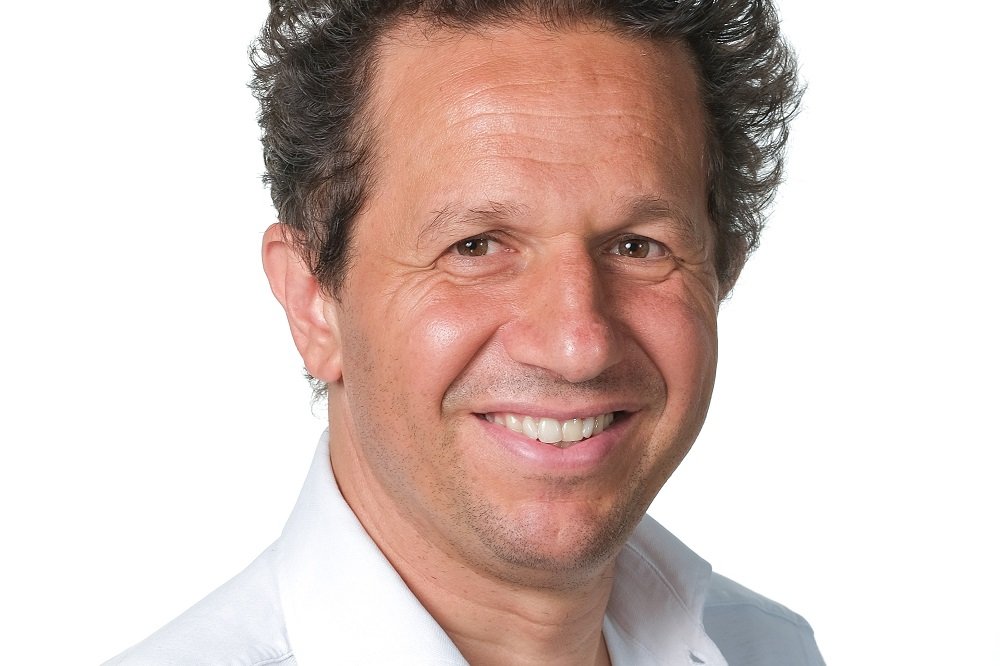
– A leading figure in the international animation industry, the French producer gives his candid views on the economic climate, streaming platforms, independence, AI and co-productions
An interview at the 45th Annecy International Animation Film Festival with Aton Soumache, a producer whose career has been marked by ambitious ventures and successes (including Renaissance, The Little Prince, Little Vampire, Ladybug & Cat Noir Awakening and Little Nicholas – Happy as Can Be).
Cineuropa: You founded your first animation company 30 years ago. How has the sector developed in Europe since then?
Aton Soumache: The industry has become exceptionally professionalised thanks to government support, schools and so on. It has grown to quite an incredible scale in France, which has had a knock-on effect across the whole of Europe. When I started out, we had some talent who travelled a little, but Japan and the United States dominated the world of animation. Thirty years on, European animation has become more accessible and diverse, with a high standard of quality that allows us to make highly ambitious films that were previously impossible. And it’s even winning Oscars! On my own small scale, I’m delighted to have played a part in pushing the boundaries of what’s possible with, amongst others, Renaissance, The Little Prince – with its €60 million budget, which was a huge international success – and the Miraculous: Tales of Ladybug & Cat Noir series, which went on to compete with and beat the American productions on their own turf. When you look at the animated films recently showcased at Cannes and the richness of the Annecy Festival there are only positives, even though we’re going through a temporary crisis.
What is your assessment of the current challenges?
These past 30 years have been built on independence but our model is under threat and we must fight to defend it, just as professional associations, such as The European Producers Club, have been doing. After all, the audiovisual and film industry in Europe comprises a huge number of companies, jobs and skills, and generates a turnover that exceeds that of the automotive sector, for example. Forty or fifty years ago, the animation sector was largely in the hands of the major studios – a barrier that independent producers managed to break down somewhat by developing a market. But today, we are witnessing a sectoral re-concentration that has taken place through technology and the rise of streaming platforms. It is as if we had allowed the creation, in our own countries, of channels controlled by foreign groups which have ten times the resources, ten times the power, and which exploit their position of strength. This is extremely damaging because, even if, for instance, it is French people who manage the editorial content of these platforms in France, the key decisions are ultimately taken outside Europe. The current crisis stems from this bubble that has turned producers into service providers. When you’re overpaid, at some point you start compromising on editorial standards, on choices, on everything; you develop bad habits and your companies take on more staff than they need. That’s what happened in the animation industry: many companies expanded very rapidly, because suddenly there was a flood of orders and everyone thought it was extraordinary. But at the first sign of trouble, at the first minor cost-cutting decisions by the American groups, an entire industry that had been running on high octane suddenly stumbled a bit.
Independence means diversity, different points of view, the power of creativity driven solely by personal initiative and relationships of trust between producers and talent. With the SMAD decree (Editor’s Note: investment obligations for streaming platforms), we made progress, but we are now taking a step backwards; this is clearly evident in public and political debates. We are even hearing calls to privatise public service broadcasters, whereas I believe we should be doing the opposite. Because if costs fall due to AI, what will be the crux of the matter? It is broadcasting and distribution. We must protect broadcasting tools as much as possible, make them as independent as possible and impose diversity quotas on them so that independent artists and producers can have open access. Without this, we are heading for major problems. Because if the rules are scrapped and platforms can potentially produce content at a lower cost, it will be an editorial disaster dictated by algorithms geared towards the lowest common denominator.
With the cable-and-satellite model on the decline and the ‘free-to-air’ model under some threat from streaming platforms, all traditional broadcasters are struggling to make the digital transition and are still unable to find a viable business model amid falling advertising revenue, whilst all-powerful players such as YouTube and TikTok do not redistribute the wealth they absorb and do not contribute to the funding of creative content. It is therefore vital that European producers show genuine solidarity and that there is a realisation of the extremely virtuous nature of the French redistributive model and the decisive role of cultural soft power for Europe. In a world rife with disinformation, opening the public’s minds through intelligent and independent works is vital. But it is also a question of political will.
How do you view the impact of AI on the animation industry?
I have a fairly positive view of the matter. Not regarding AI from a global or civilisational perspective – I won’t venture into that – but in terms of the creation and impact of a tool. Firstly, the history of cinema and television has been built on innovation and technological research. Today, we’re witnessing a spectacular technological revolution, much like when electricity was first discovered. My profession is CGI – computer-generated imagery – and AI is essentially the same thing. In animation, hundreds of millions of children have already been captivated by computer-generated characters. The real question is emotion. Is it a good film? A good story? What is the quality like? The way it’s crafted, that’s a debate for the technicians.
Today, the animation industry is struggling with resources and costs: everything is too expensive. If this tool enables us to shorten production times slightly and reduce costs, our industry will become more profitable. Some might argue that many jobs will disappear, but more projects will be able to go ahead, which will create a knock-on effect for other professionals. There will be a rebalancing of roles, just as there was when After Effects, Final Cut or Avid first appeared. What won’t change is the concept of storytelling: the quality of a story is written, storyboarded, edited, watched, discussed and tested against the market, with producers, broadcasters, actors and the talent working behind the scenes. In animation, there are some very tedious tasks that less and less people want to do and which may well disappear. But I’m obviously not talking about making a rubbish film on a budget of 50 euros in three weeks that nobody will want to watch. For the time being, there are still a lot of fantasies surrounding AI. One of the most unsettling is the idea of having humans who aren’t actually human but are rendered in CGI. But ultimately, as far as I’m concerned, it’s nothing more than an ultra-realistic 3D character that can be animated by anyone, so it doesn’t bother me from a technical point of view. That said, from an artistic point of view, if the film is good, it’s good. However, I don’t think it will replace actors, even though there will no doubt be various experiments, such as ‘digital make-up’ amongst others. It’s impossible to predict the future, but if we take the analogy of music, once copyright issues have been resolved, perhaps a generation of talent will emerge with “sampled” films. After all, who would have believed back then that a DJ who samples everyone else’s music would become a global star? Nevertheless, geniuses are always rare, and a flood of content won’t change that. I’ve been reading screenplays for 30 years; many are poorly written, and that hasn’t really changed since the emergence of AI, which is merely a sparring partner for the writer. When there’s no human behind it – at least for now – I haven’t seen any meaningful expression. That said, if it can make the production of 3D animated films – which is very labour-intensive, very expensive and very complex – a little easier, then I say all the better. If production costs become less of a factor, producers will become more like publishers: professionals capable of delivering, supporting, providing editorial guidance and bringing together talent. But for that to happen, independence is paramount.
What about European co-productions?
Given the level of talent and professionalism in Europe today, it is a pleasure to co-produce, whereas previously it was merely an obligation due to the complexity of financing an animated film. However, the co-production system could still be improved, particularly with regard to European funding schemes such as Media and Eurimages. More generally, simpler pathways could be established and greater incentives provided. European national film councils (such as the CNC) are trying to implement solutions and forge partnerships, but producers must also come together and form alliances, as The Creatives have done, for example. In Europe, if we stand united, we can be incredibly powerful, as the European audiovisual market is very strong – artistically, economically and in terms of job opportunities. On the other hand, if we operate solely at a national level, we may be somewhat vulnerable. We must recognise our collective cultural influence, as there is a challenge that goes beyond us: protecting culture and Europe in all its diversity.
What projects are you currently working on?
Mathieu Kassovitz’s The Big War, an animal-centred satire set during the Second World War, is due to go into production in the coming months. Early next year, filming will begin on Joann Sfar’s adaptation of Louis-Ferdinand Céline’s Journey to the End of the Night (based on a screenplay by Thomas Bidegain), which I am producing with Alain Attal (Les Productions du Trésor). And I’m working with Sylvain Chomet again; he’s set to complete The Triplets trilogy, following The Old Lady and the Pigeons and Belleville Rendez-vous, by revisiting a screenplay he wrote 20 years ago.
In collaboration with

(Translated from French)
