
– The second part of Antonin Baudry’s two-part series devoted to the figure of the General – as epic as ever – follows De Gaulle in his quest for freedom and for sovereignty for France
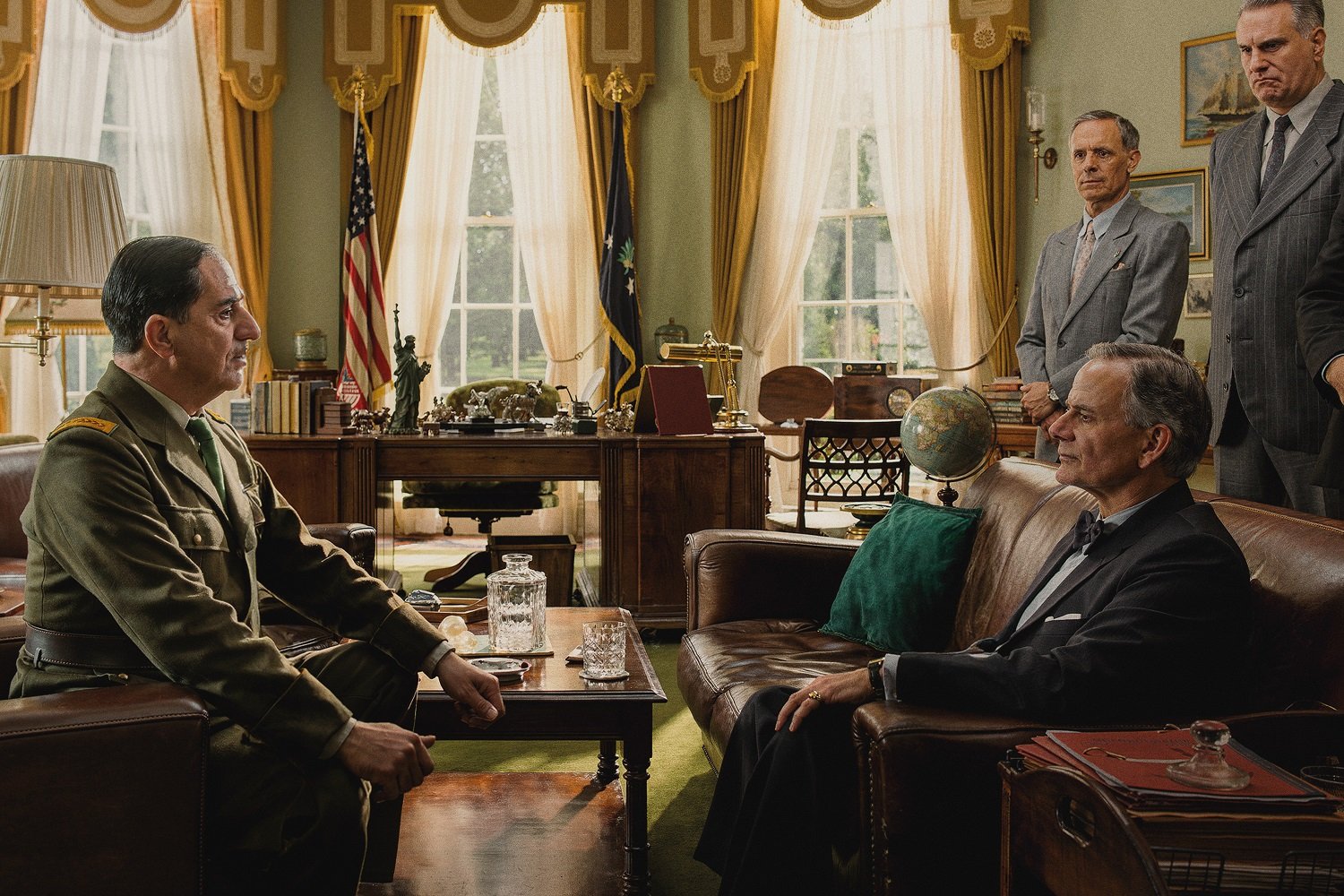
Simon Abkarian and Campbell Scott in De Gaulle: Liberté
Following on from De Gaulle: Résistance, which had its world premiere out of competition at the last Cannes Film Festival, De Gaulle: Liberté brings this defining chapter in the General’s life – and in France’s destiny – to a close. Moving beyond the events of the first instalment, this second film follows a series of parallel struggles, all aimed at establishing Free France – against the German enemy, of course, but also against the American allies. In this second instalment – which will be released in France by Pathé this Friday, 26 June, and in Belgium on 3 July by The Searchers – we find the hero, as imagined by director Antonin Baudry, in the throes of turmoil in January 1943, as preparations are underway for the Casablanca Conference, which could well seal the fate of a France placed under Anglo-Saxon control.
But De Gaulle (Simon Abkarian) believes in a free and sovereign France, and he is prepared, to realise this somewhat fanciful hope, to confront on Moroccan soil both General Giraud (Thierry Lhermitte), a dignitary put forward by the United States who has no qualms about collaborating with the collaborators, as well as President Roosevelt (Campbell Scott), who has a firm vision of a Europe with redrawn borders, where France would be severely diminished in favour of a ‘New Wallonia’ that would serve as a buffer state, administered by the USA. The screenplay weaves three storylines together. First, of course, that of the General: an uncompromising hero and a shrewd political animal who upends diplomacy to safeguard his country’s interests. Next is that of Jean Moulin (Félix Kysyl), the great organiser of the domestic Resistance and France’s youngest prefect, whose determination overcomes the ideological differences between the various Resistance leaders, before his struggle is taken up by his loyal comrades. Finally, there is the story of General Leclerc (Niels Schneider), who leads his battalion – composed overwhelmingly of African soldiers – to victory in the Libyan desert against the German panzers, despite being vastly outnumbered.
Whilst the first instalment set out to portray its intrepid yet clumsy hero – a cross between Don Quixote and Captain Free France – this second instalment, which is far more gritty, focuses on the struggles, featuring a succession of epic scenes: battles fought in France by the domestic Resistance, fuelled by the boundless energy and courage of the young, but also in Africa, highlighting in passing the role of African contingents in the country’s impending liberation. Despite its considerable running time, and the ending that everyone already knows, the tension never lets up, occasionally defused by Churchill’s (Simon Russell Beale) British phlegm, or De Gaulle’s unexpected jest at the expense of Giraud or Roosevelt. This decidedly ambitious French-style blockbuster tells a different story of the Second World War, distancing itself from the Allied victory narrative to emphasise that the fight for Free France was also waged against Roosevelt and America, as evidenced by this scene of the liberation of Paris, which highlights General Leclerc’s troops rather than the GIs of the Epinal-style images.
As with De Gaulle: Résistance, De Gaulle: Liberté was produced by Pathé Films, TF1 Films Production, Logical Pictures – Logical Content Ventures, Ness Films, Auvergne-Rhône-Alpes Cinéma, Laurent Dassault Rond Point, Stags Participation II and Belgian company Beside Productions. Pathé Films also handles international sales.
(Translated from French)
