
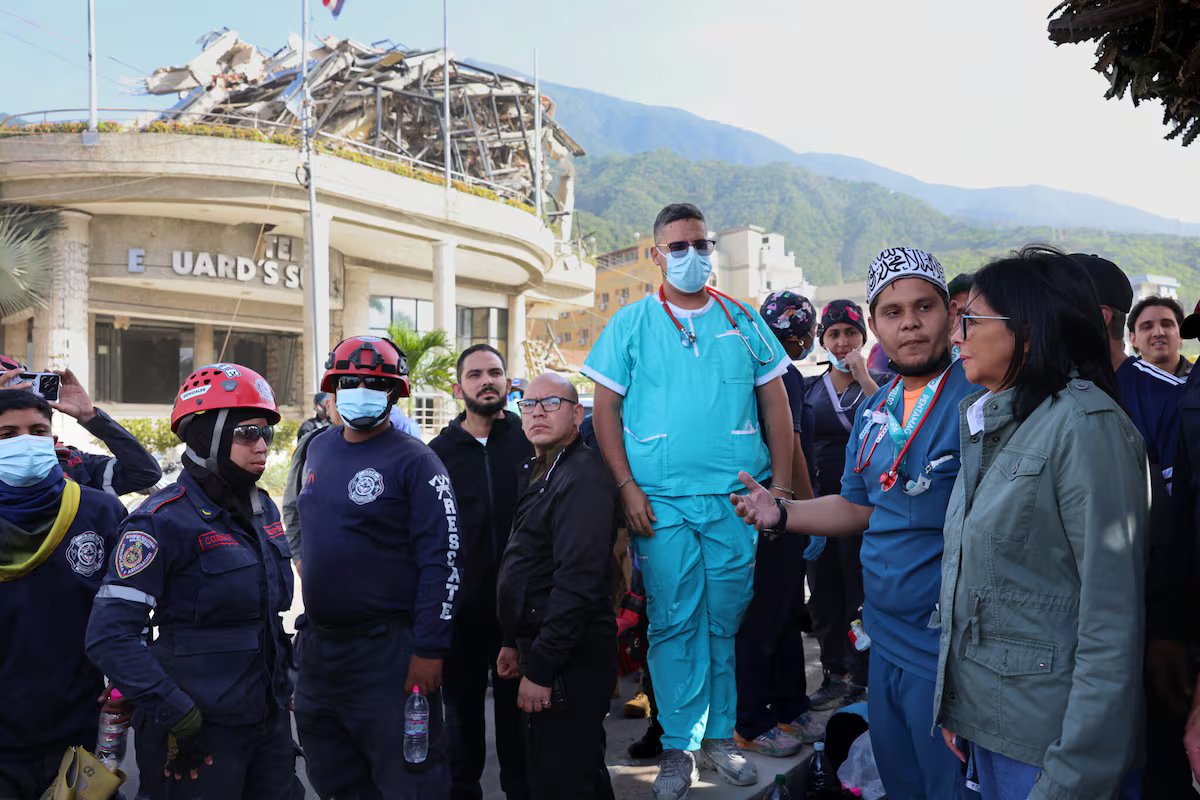
When Caracas stopped shaking, people poured into the streets — to find an internet signal, to track down those who weren’t answering their phones, to check which buildings were still standing. The Venezuelan capital and, above all, the nearby city of La Guaira had become ground zero for two earthquakes that have plunged Venezuela into a new tragedy.
The challenge now is to rescue the injured and account for the dead, to rehouse those left homeless, equip hospitals, provide psychological support to victims, and rebuild. The problem is that the disaster has struck a Venezuela with fragile basic services, limited resources, and a governance capacity that has been under strain from the very first moment. The handling of the crisis has put acting President Delcy Rodríguez under intense scrutiny — and she is not the only one in the spotlight.
It was 6:04 p.m. on Wednesday, a public holiday marking the Battle of Carabobo, with many people at home. A magnitude‑7.2 earthquake hit the north of the country and, 39 seconds later, was followed by another, even more powerful shock. The U.S. Geological Survey recorded it as the strongest earthquake in Venezuela in more than a century. Its rapid assessment system issued a red alert — the highest level — and projected a potential death toll ranging from 10,000 to 100,000. The estimate is based on the intensity of the shaking and the vulnerability of buildings, but the true scale of the tragedy remains uncertain. So far, at least 235 people have died, while more than 4,300 are injured.
La Guaira is the great blind spot in the figures yet to come. In this coastal state, just 30 kilometers (12.4 miles) from Caracas, dozens of buildings have collapsed and information trickling out remains scarce. Official sources say at least 100 structures have been destroyed.
The government has mobilized, but there is little clarity about how it has done so or with what resources. Rodríguez is known— even among her critics — for her efficiency and work capacity, but after 27 years of the Venezuelan regime there is lingering mistrust about how the state apparatus will manage the crisis. For the ruling elite, this represents both a risk and an opportunity.
“If the response is swift, transparent and effective, the interim government could regain operational legitimacy,” warns political scientist Benigno Alarcón. “If it is opaque, militarized, exclusionary or corrupt, the social cost will rise, international pressure will intensify, and the likelihood of internal fractures will increase.”
Delcy Rodríguez, like thousands of Venezuelans, has barely slept. Her account on X is more active than ever, though it has focused more on expressing gratitude for international aid than on providing a steady stream of practical information.
Offers of personnel and supplies have come in from Qatar to Mexico — and above all from the United States, her unlikely ally following the capture of Nicolás Maduro on January 3 by U.S. troops. Rodríguez represents the same Maduro regime that crippled the economy and hollowed out state institutions, yet Donald Trump has spent the past six months praising her leadership. She is his chosen figure for the kind of managed transition Washington has designed. Rodríguez is at the helm of a complex and unpredictable political maneuver, but after stepping into her former boss’s role, the earthquake has now placed her before what could become her biggest political test.
Since taking over as acting president, Rodríguez has governed around a narrative: that of a country recovering, reopening and stabilizing. It is a storyline also encouraged by Washington, but at the same time, one that underpins her political survival. The disaster now puts that narrative to the test in a context where she will be judged on efficiency, coordination, transparency and resources — and not just on announcements.
For Alarcón, the quake has turned state capacity into the central test of Venezuela’s current transition. The process, he argues, is no longer measured only by the electoral timetable or political prisoners, but by whether the state can carry out rescues, provide information, maintain services and accept outside assistance. Within 72 hours, he estimates, it will become clear whether the government is responding effectively.
For now, aid is on its way, and rescue teams from around the world are heading to Caracas and La Guaira, whose main airport remains closed due to severe damage. Information is coming through in dribs and drabs — irregularly, without the consistent presence of civil protection officials, and largely through appearances by Delcy Rodríguez and her brother Jorge Rodríguez, the head of the National Assembly.
But the challenge Venezuela faces after this earthquake is not just one for the Rodríguez family. On Thursday, in one of the houses that remained standing and undamaged, a prominent figure in Venezuelan society voiced a hope. “I hope the tragedy achieves what politics has not. I hope Rodríguez and [opposition leader] María Corina Machado would shake hands,” they said by phone on condition of anonymity.
“This is a moment when the greatness and leadership both claim to have should emerge,” they continued. “The country has suffered too much from the government’s mismanagement, from that of the opposition and from U.S. opportunism. Now nature also strikes us. I hope it helps reach real agreements to recover the country.”
If the two leaders were able to come to terms, the figure argued, homegrown solutions could begin to emerge — and Caracas, not Washington, would dictate the terms of its future, not the other way around.
The opposition, Alarcón adds, must avoid two mistakes: appearing detached from the public’s suffering and allowing the emergency to sideline the democratic agenda. The optimal approach, he argues, is to combine national solidarity with institutional oversight — support for technical international aid, public scrutiny of the damage, protection for political prisoners, guarantees of access to information, and electoral safeguards.
“After the quake, that agenda does not disappear; its sequence changes. Aid can become a bridge — or an excuse to indefinitely postpone democratic milestones,” he warns.
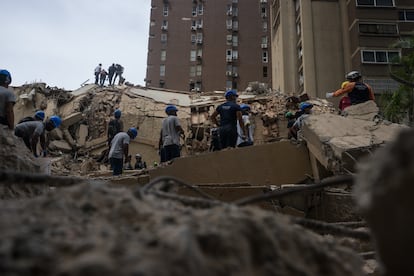
For now, the United States has taken a leading role in providing aid to the country under its supervision. Secretary of State Marco Rubio said he had spoken with Rodríguez and on Thursday announced the deployment of search-and-rescue teams from Virginia and Los Angeles. “Washington faces a reputational dilemma: it must move quickly to provide help without conferring political legitimacy,” says Alarcón, who insists the transition promised by the White House should not be forgotten.
El Salvador has sent 300 rescue workers, while Mexico, Brazil, the Dominican Republic and more than a dozen other governments have offered assistance. The United Nations declared itself “fully mobilized.” The image of U.S. teams and governments led by the far right searching for bodies under the rubble would have been unthinkable less than a year ago. Yet in any disaster, the challenge is not accepting aid but coordinating it.
Meanwhile, the diaspora has begun gathering water and medicines — two basic goods that are already running short. In family group chats scattered across half a continent, people were cross-checking the names of the missing. A firefighter in Caracas was searching for his sister and nephew in the rubble of a building in La Guaira. Neighbors are clearing debris with their bare hands. What Venezuela needs in the coming days is a response capacity that has been eroding for years.
At least the oil sector appears to have escaped major damage: a worker at the El Palito refinery told Reuters there were no signs of damage, and the Morón petrochemical complex, near the epicenter of the quake, resumed operations after a precautionary shutdown.
Sign up for our weekly newsletter to get more English-language news coverage from EL PAÍS USA Edition
