
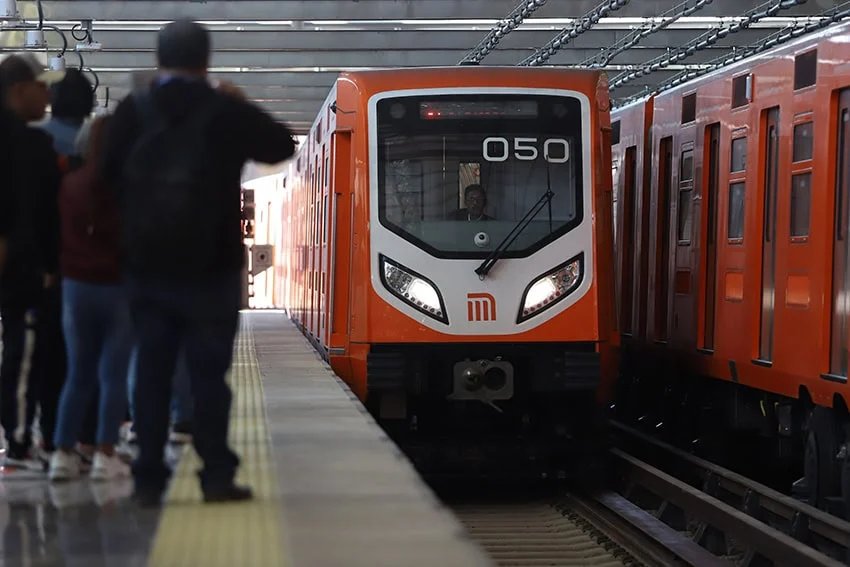
Editor’s note: This feature brings together previous Mexico News Daily reporting on Mexico City’s Metro culture, commerce and mobility — now updated to include information on how to use the subway system and on the latest renovations made for the 2026 FIFA World Cup. It is conceived as a single, long-read guide for visitors and residents who want to rely on the Metro to get around as Mexico City welcomes the world.
Now that the 2026 FIFA World Cup has started, thousands of visitors are trying out Mexico City’s Metro subway system for the first time and discovering that it’s not only a convenient way to get from Mexico City Stadium to their hotel, it’s also a rolling museum, a bustling marketplace and the backbone of a vast mobility network across the city that includes buses, light-rail trains, bicycle rentals — electric and manual bikes — and even airborne cable cars.
Every day, more than 3 million passengers descend into the Metro’s subterranean city of 12 lines and 195 stations, paying just 5 pesos a ride. The Metro has a fully digital fare system that uses the Integrated Mobility Card (often referred to as the MI), a rider card that’s the only way to use all of the city’s forms of public transportation. The card can easily be bought and recharged with cash or plastic at Metro station ticket booths, as well as at the automatic vending machines for Metrobús, Cablebús, and the CDMX Tren Ligero (the light rail system).
CDMX authorities are betting that the recently updated and modernized Metro — with new trains, revamped stations and better connections to buses, cable cars and suburban rail — will be one of the capital’s strongest calling cards during the World Cup.
Mexico City’s network of Metro stations has long been one of the world’s most unusual art spaces, where pre‑Columbian relics, contemporary murals and scientific exhibits coexist with rush‑hour crowds. Line 3’s Hidalgo station boasts works from over 300 artists from 50 countries, making it one of the world’s largest public art galleries, according to the city government.
One stop away, at the Bellas Artes station on Line 2, commuters routinely rush past a reproduction of a Maya stele from the Izapa archeological site in Chiapas, a replica of a Mesoamerican Chac Mool statue and a reproduction of Chiapas’ Bonampak archaeological site murals, turning a subway transfer into a crash course in Mesoamerican history. For a more modern art experience, visit the station’s Galería Metro, which features trippy Pedro Friedeberg murals and light displays.
Farther along on Line 2 — as well as on Line 1 — the Pino Suárez station, which hides a surprising treasure: a historic circular pyramid dedicated to Ehécatl, the wind aspect of Quetzalcóatl, discovered during Metro construction in the 1960s and now billed as Mexico’s “busiest” archaeological site, with tens of millions of people streaming past each year.

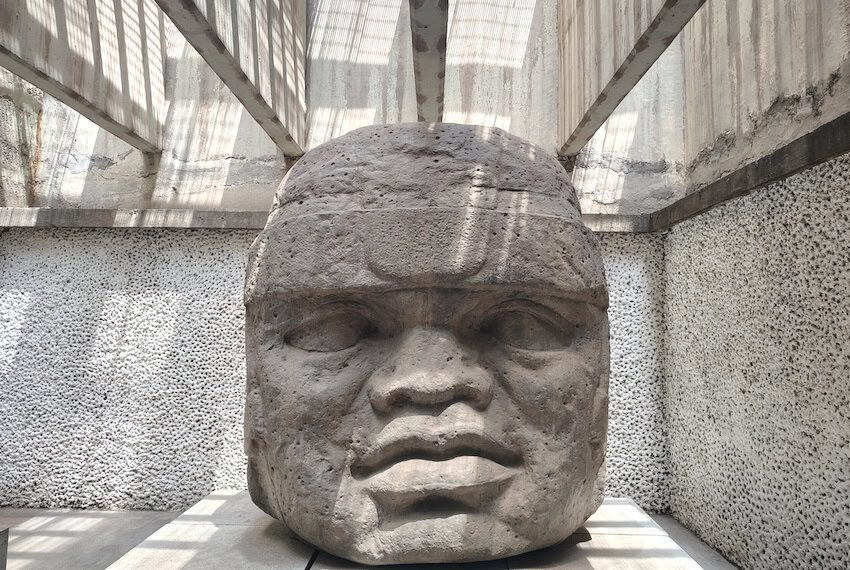
At the Talismán station on Line 4, a genuine mammoth skeleton unearthed here in 1978 greets passengers under a glass dome, while colossal replicas of Olmec heads loom over platforms at Tezozómoc on Line 6.
Mexico City’s Metro network also celebrates science and pop culture: At the La Raza station, the Tunnel of Science stretches between Lines 3 and 5, with astronomical exhibits and a glowing celestial sphere that offers perhaps the clearest “night sky” that most chilangos will ever see in their notoriously hazy city. At the Auditorio station on Line 7, a London Underground‑themed station opens up to “Un Viaje por el Rock and Roll,” (A Trip Through Rock and Roll”), a mural teeming with images of iconic musicians, including Mick Jagger, Patti Smith and Jimi Hendrix.
Not just a museum, the Metro is also one big market — one that stretches from platforms to concourses and spills out onto surrounding streets. Beyond the restaurants and stores that occupy Metro stations, there are also around 2,000 designated commercial spaces within the system where vendors ply their trade, offering just about anything a commuter could possibly want to pick up on their way home — fruits and vegetables, skincare products and costume jewelry, headphones, books — the list goes on and on.
There are also, of course, vendors selling a myriad on-the-go snacks: This includes not just the typical candy, chips and soda but also churros, fresh sliced fruit, fresh-squeezed juices, pan dulces, and much, much more.
Inside the train cars, you’ll sometimes encounter informal sellers known as vagoneros — who have become less visible after a series of city crackdowns, yet they still slip through. These are generally folks doing an unauthorized side hustle, selling small items often bought in bulk to offer for resale at cut-rate prices: We’re talking traditional Mexican candies, packs of ballpoint pens or pencils, children’s coloring books, small gadgets — you name it. The iconic bocineros, who once blasted their pirated CDs for sale from backpack speakers as they walked through train cars, have mostly disappeared, thanks to the advent of streaming and smart phones.

If you’re a book lover, you can’t miss the Pasaje Zócalo-Pino Suárez, a long underground passage that connects the Zócalo/Tenochtitlan and the Pino Suárez stations on Line 2. It’s one giant book walk, featuring over 40 bookstores representing around 500 publishing houses, one after the other along a kilometer-long pedestrian walkway.
This underground path devoted to the love of literature was once the site of the city’s annual Metropolitan Book Fair, which stopped being staged here in 1992, prompting the Pasaje’s creation in 1997 by the National Chamber of the Mexican Publishing Industry. You’ll find books on every topic here, from philosophy to pop culture.
You can get there by stopping at either station, or walk in from the historic center by entering either at the Pino Suárez station entrance at the intersection of Pino Suárez Avenue and República El Salvador Street, or at the Zócalo/Tenochtitlan station, using the entrance that’s by the Supreme Court building and Josefa Ortiz de Domínguez street.
In the run‑up to the World Cup, the Metro underwent significant revamping: Line 1 saw new tracks, the installation of advanced telecommunication systems and 29 new trains, designed with better accessibility. Line 2, with a direct route to one of the World Cup host venues, Mexico City Stadium (Estadio Azteca), was also a major focus for renovations, with 15 stations on the line updated to provide better lighting, new floors, wider transit passageways and textured floor surfaces designed to help people with visual impairments navigate safely.
All the renovations to Lines 1 and 2 for the World Cup have also inspired the city to revamp Line 3, earmarking 5 billion pesos (US $270 million), but not until after the Cup, to avoid paralyzing north‑south flows through the nation’s capital during the tournament.
The tournament will test how this complex transportation ecosystem handles an influx of first‑time users. If successful, the Metro will not only move fans efficiently but also offer them an unexpected crash course in Mexican history, art and everyday life. The legacy, city leaders have argued, will be a more modern, better‑connected transit system that continues to serve the Mexico City’s residents long after the last World Cup banner comes down.
For, behind the art and the commerce, the Métro remains above all a workhorse: a 226‑kilometer system of 12 lines that has run every day since 1969 and moves a metropolitan region of over 20 million people. For lower‑income residents who cannot afford cars, the Métro is a lifeline, connecting peripheral neighborhoods to formal job markets in the city’s interior.
The Métro runs until midnight seven days a week. On Monday through Friday, services start at 5 a.m., on Saturdays at 6 a.m. and on Sundays and holidays at 7 a.m.
With the interactive map in the image below, you can quickly find any route you need—just zoom and navigate within the map. If you want a more static map showing the entire subway system at a glance, plus links to finding info on the rest of the city’s transportation public network, download this map.
And, finally, as in any other major metropolis, there are some commonsense things to know about using Mexico City’s Metro that will help you have the best experience possible:
- It’s notoriously crowded during peak hours. Be prepared for a lack of seating during these times, and perhaps to be packed in with your fellow passengers like a bunch of sardines. Be clear on exactly how many stops there are until yours — because it may be crowded enough that you can’t see the station names going by — and plan to be situated near a subway car door by the next-to-last stop on your route, or you may struggle to make it off the train in time before the doors close.
- Pay attention to your surroundings. Pickpockets do ride the subways, especially during the chaos of peak hours, so be aware of what’s going on around you, especially when you’re in a particularly crowded train or station. Also, you’ll notice many locals with their backpack worn in front rather than on their back so that they can see it at all times. It’s an idea worth adopting if you are carrying anything that you’d be upset to lose.
- Women and girls may want to ride in the female car. Every Métro train has at least one female-only car, usually located at the front, where only women and children under 12 — of all genders — are allowed. You can spot them in most stations by the signage bearing the phrase mujeres y niños, located at or near the boarding platform. They’re often cordoned off by barriers and a security officer who’s there to keep men and teenage boys from trying to board — which some males are tempted to do during rush hour. Enforcement is not always perfect, but many women say they feel safer there than being trapped in a super-packed car where they can’t see who’s doing what.
- If you need assistance, find a service module. These are located at the following stations, which are all on Line 1, 2 or 3: Observatorio, Insurgentes, Hidalgo, Zócalo/Tenochtitlan, Ermita, Juárez, Balderas and Centro Médico. You can also try the “México Contigo” kiosk at the Glorieta de los Insurgentes Métrobus station.
Mexico News Daily
