
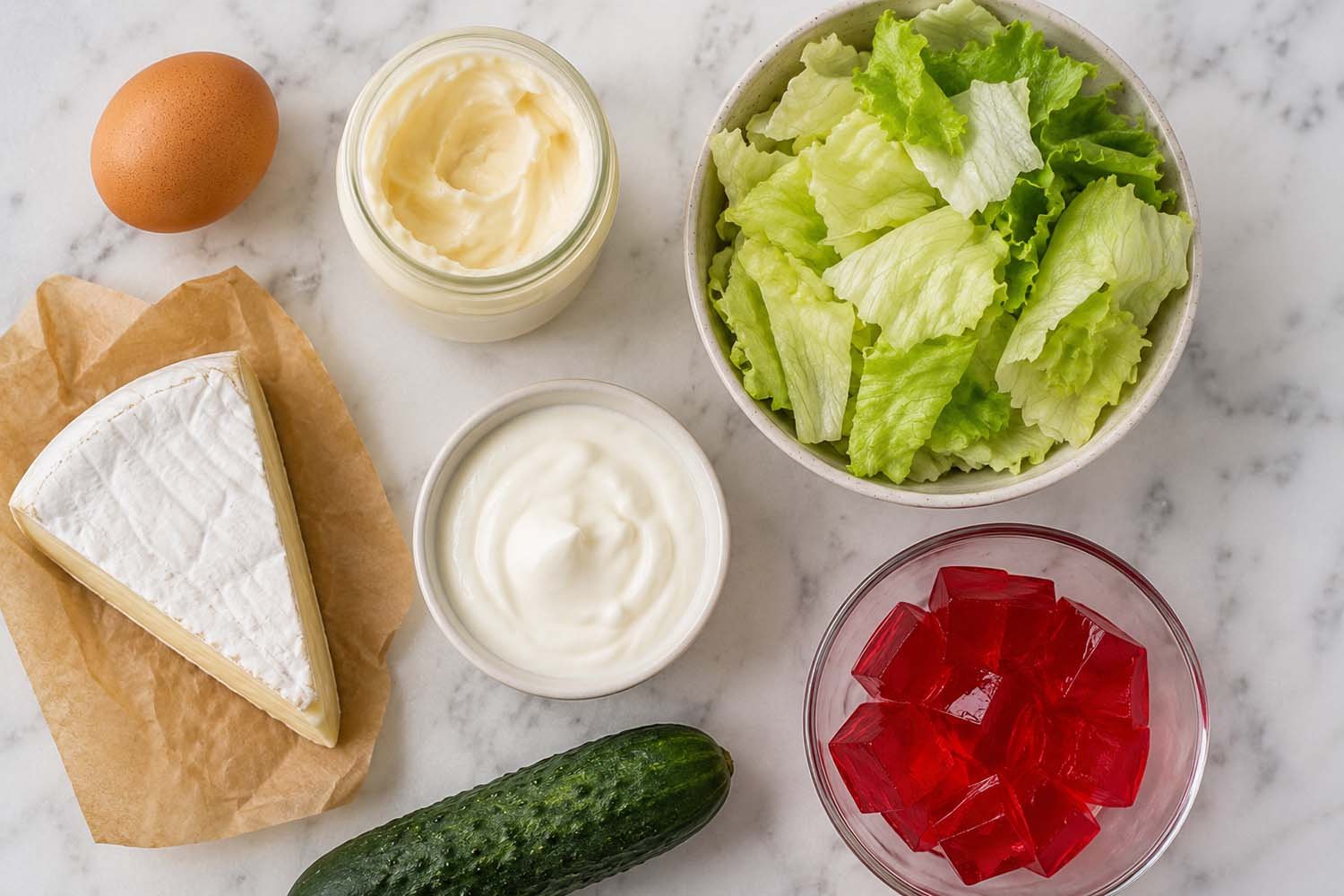
Most of us treat the freezer as an insurance policy. Something about to turn? Freeze it. Bought too much? Freeze it. But the freezer is not a neutral holding tank. It is a harsh chemical and physical environment that permanently destroys certain foods at the molecular level, or at minimum renders them unrecognizable compared to what went in. The damage is not always visible, but when you pull that container out and thaw it, you will know.
What foods should you never freeze?
The short answer: Eggs in the shell, mayonnaise, gelatin desserts, raw cucumbers, raw lettuce, soft cheeses (for fresh use), sour cream, yogurt, fried foods, cooked pasta on its own, boiled potatoes, and cream-based sauces should never go in the freezer. Most are ruined by the large ice crystals that form during home freezing, which puncture cell walls and destroy emulsions. For several soft cheeses and cultured dairy, there is a narrow cooking exception, but fresh use is off the table once they have been frozen.
For a complete reference on how to store these foods properly, see our Food Storage Guide.
| 🥚 Eggs in the shell | 🫙 Gelatin desserts |
| 🥣 Mayonnaise | 🥗 Raw lettuce and salad greens |
| 🧀 Soft cheese (for fresh eating) | 🥒 Raw cucumbers and celery |
| 🥛 Sour cream and yogurt | 🍝 Cooked pasta (on its own) |
| 🍖 Fried foods | 🥔 Boiled or baked potatoes |
| 🍦 Cream-based sauces | 🍰 Custard and cream pie fillings |
| 🥚 Hard-boiled eggs | 🫐 High-water raw fruits (watermelon, citrus) |
🔑 Key Takeaways
- The USDA Food Safety and Inspection Service confirms that eggs in the shell must never be frozen. The expanding liquid can crack the shell and the yolk turns thick and syrupy, limiting its usefulness even after thawing.
- Mayonnaise is an oil-in-water emulsion stabilized by egg lecithin. Home-freezer temperatures permanently break that emulsion. After thawing, it separates into a curdled, watery mess that cannot be restored.
- Ice crystals that form during home freezing are large and slow-growing compared to commercial flash-freezing. Those large crystals physically rupture plant cell walls, turning high-water vegetables like cucumbers, celery, and lettuce into soft, watery pulp after thawing.
- Gelatin networks are destroyed by ice crystal formation. Unlike most foods, a frozen and thawed gelatin dessert will not re-set. It stays liquid permanently.
- Many items on this list have a narrow cooking exception: soft cheeses, sour cream, and yogurt can all go into baked or cooked dishes after freezing, where texture change is less noticeable. None of them are suitable for fresh eating after thawing.
Why Home Freezing Damages Certain Foods Permanently
The freezer is a powerful preservation tool, but home freezing and commercial flash-freezing are not the same process. When you place food in a standard home freezer, water inside the food freezes slowly, forming large, jagged ice crystals. In commercial operations using individually quick-frozen (IQF) technology, food is exposed to extremely low temperatures almost instantly, producing small crystals that cause far less structural damage.
🔬 The Science of Ice Crystal Damage
When water inside food freezes slowly, as it does in a home freezer, it forms large extracellular ice crystals that expand and physically rupture surrounding cell walls. Peer-reviewed food science literature, including a widely cited 2018 review on freezing damage to cellular foods, confirms that the quality of frozen and thawed cellular foods is directly tied to the integrity of those cells after freezing. The USDA Food Safety and Inspection Service explains this directly: slow freezing creates large, disruptive ice crystals that damage cells and dissolve emulsions on thawing. For protein networks like gelatin, ice crystal damage to the three-dimensional structure prevents the gel from ever resetting.
20 Foods You Should Never Freeze
1. Eggs in the Shell
Never freeze an egg in its shell. The USDA Food Safety and Inspection Service is unequivocal: shell eggs should not be frozen. When the liquid inside freezes, it expands, placing pressure on the shell until it cracks. A cracked shell is an entry point for bacteria. Even if the shell does not visibly crack, the yolk undergoes irreversible changes, becoming thick and syrupy, so it will not flow or blend well with the white or with other ingredients. Freezing does not improve anything about an in-shell egg, and it creates both a quality and a potential safety problem.
Crack eggs first, beat lightly, and freeze in an airtight container. Frozen beaten eggs work well for scrambles and baking after thawing. Freeze yolks and whites separately if needed. Add a small pinch of salt or sugar to yolks before freezing to reduce gumminess on thawing. For full egg storage guidance, see do eggs go bad and do eggs need to be refrigerated.
Store instead: Fresh eggs in the refrigerator last 3 to 5 weeks past the pack date. Do not leave eggs at room temperature for more than 2 hours.
2. Mayonnaise
Mayonnaise is an oil-in-water emulsion stabilized by egg lecithin. That emulsion depends on a precise molecular arrangement that home-freezer temperatures destroy. The USDA Food Safety and Inspection Service explicitly names mayonnaise as a food that does not freeze well, noting that emulsions separate and appear curdled after freezing and thawing. The ice crystals that form during freezing physically disrupt the emulsion bonds, causing the oil and water to separate permanently. What comes out of the freezer is a broken, watery, curdled liquid that looks nothing like the condiment that went in. This applies to both commercial and homemade mayo, though homemade varieties fare worse because they lack the additional stabilizers present in commercial versions.
Store instead: Opened commercial mayonnaise in the refrigerator lasts 2 months. For full guidance, see does mayo go bad and does mayo need to be refrigerated. Our easy healthy coleslaw and burger recipes both use mayo and are best made fresh.
3. Raw Cucumbers
Cucumbers are approximately 95 percent water by weight. That water is contained within rigid plant cell walls that give the cucumber its crunch and structure. When you freeze a cucumber, the water inside every one of those cells expands and ruptures the cell wall. When it thaws, the water rushes out of the now-destroyed cells, leaving a limp, translucent, waterlogged mass. There is no textural recovery. A frozen and thawed raw cucumber cannot be used as a fresh cucumber in any application.
Store instead: Raw cucumbers keep best at around 50 to 55 degrees Fahrenheit, slightly warmer than most refrigerators. Stored in the crisper drawer wrapped loosely, they last 1 to 2 weeks. For full guidance, see how to store cucumbers.
4. Raw Lettuce and Salad Greens
Lettuce and most leafy salad greens are among the foods most consistently listed by food scientists as unsuitable for freezing. Like cucumbers, they have very high water content and very low dissolved solid content, which means they freeze close to 32 degrees Fahrenheit and form large, damaging ice crystals almost immediately. The cell walls rupture, and the thawed lettuce collapses into a wilted, translucent, watery mess. There is no way to restore the crisp texture that makes raw lettuce worth eating. The USDA Food Safety and Inspection Service lists lettuce among its examples of foods that simply do not freeze well.
Blanched spinach, kale, and chard freeze well. Blanching (boiling briefly, then shocking in ice water) deactivates the enzymes that cause deterioration during freezer storage and partially breaks down cell structure before ice crystals can. Blanched greens thaw appropriately soft for cooked applications like soups, quiches, and pasta. For a great way to use fresh spinach before it turns, our crustless veggie quiche works perfectly and can be made ahead.
Store instead: Unwashed lettuce in the refrigerator in a paper-towel-lined container lasts 7 to 10 days. For full guidance, see how to store lettuce and how to store arugula.
5. Raw Celery and Radishes
Raw celery and radishes both fail in the freezer for the same reason as cucumbers and lettuce: their very high water content freezes into large ice crystals that rupture the rigid cell walls responsible for their snap and crunch. Thawed raw celery becomes limp and quickly develops an oxidized color and off-flavor. Thawed radishes become soggy and waterlogged. Neither is edible in raw form after freezing.
✅ The Exception: Celery for Cooking
If you want to preserve celery for use in soups, stews, or stocks only, you can slice, blanch for 2 to 3 minutes, cool in ice water, drain well, and freeze. The texture will still be soft, but the flavor carries into cooked applications. Do not expect it to be usable raw after this process. Radishes cannot be meaningfully salvaged for cooking use after freezing and are best composted rather than frozen.
6. Hard-Boiled Eggs
Hard-boiling changes the protein structure of the egg white, and freezing damages it further. The American Egg Board is explicit on this: hard-boiled whole eggs and whites become tough and watery when frozen. Cooked egg whites do not survive the freeze-thaw cycle in edible condition, turning rubbery and spongy. The yolk alone tolerates freezing somewhat better and can be frozen separately for later use in recipes. The whole hard-boiled egg as a unit is not a freezer candidate.
Store instead: Hard-boiled eggs in the refrigerator, in their shells, last up to 1 week. Peeled hard-boiled eggs stored in cold water (changed daily) also last about 1 week. For full guidance, see do eggs go bad. If you need a dish that uses several hard-boiled eggs at once, our Greek meze board and crustless veggie quiche are both good options.
7. Soft and Semi-Soft Cheese (for Fresh Eating)
Soft cheeses (brie, camembert, fresh mozzarella) and high-moisture varieties like ricotta and cottage cheese have delicate protein structures that break down when frozen. After thawing, they become grainy, crumbly, and watery, with a texture unrecognizable compared to fresh. Cream cheese becomes gritty and loses its smooth spreadability. Fresh mozzarella loses its tender, milky bite entirely. None of these should be frozen if you intend to eat them fresh.
The National Center for Home Food Preservation (NCHFP) at the University of Georgia notes that cream cheese can be frozen for later use in cooking, dips, or as a frosting on frozen sandwich loaves. Cottage cheese and ricotta can also be frozen for up to 1 month for use in baked applications. North Dakota State University Extension confirms that the texture change makes them suitable for cooked dishes, even when they are no longer pleasant to eat fresh. The rule: freeze only if you plan to cook or bake with them afterward. For full guidance, see does cream cheese go bad, does ricotta go bad, and does mozzarella cheese go bad.
Hard, low-moisture cheeses like cheddar, parmesan, and aged gouda can be frozen for up to 3 months, tightly wrapped. They will become slightly more crumbly after thawing but are perfectly usable for cooking, melting, and grating. For full guidance, see does cheddar cheese go bad and does parmesan cheese go bad.
8. Sour Cream and Yogurt
Both sour cream and yogurt are cultured dairy products with smooth, homogeneous textures that depend on a stable protein matrix. Freezing breaks that matrix. After thawing, sour cream separates and cannot be blended back together. Yogurt becomes grainy and watery, losing the thick, creamy consistency that defines its appeal. The NCHFP confirms that all cultured and soured dairy products lose their smooth texture when frozen, becoming grainy and sometimes separating liquid. They can still be used for cooking, but eating them fresh after freezing is not recommended.
Store instead: In the refrigerator, sealed. Sour cream lasts 1 to 3 weeks after opening. For full guidance, see does sour cream go bad and does sour cream need to be refrigerated. For yogurt, see does yogurt go bad.
9. Gelatin Desserts
Gelatin is a network of protein chains that traps water in a flexible three-dimensional structure. That structure depends entirely on specific molecular bonding between protein chains. When gelatin freezes, ice crystals grow within the gel matrix and physically disrupt those molecular bonds. The protein network cannot reform after thawing. What was a firm, wobbly dessert becomes a thin, watery liquid that will not re-set, regardless of how long you refrigerate it afterward. The damage is complete and permanent.
Store instead: Gelatin desserts keep well in the refrigerator for 7 to 10 days, loosely covered. This is the appropriate storage method. If you made too much, eat it from the fridge rather than attempting to extend its life in the freezer.
10. Fried Foods
Fried chicken, fried fish, tempura, onion rings, donuts, and anything else that gets its appeal from a crisp, crackling exterior is permanently compromised by home freezing. The moisture that migrates during freezing and thawing saturates the breading or batter from the inside out. When thawed, the coating is soggy and cannot crisp back up in a standard oven. The contrast between crust and interior, which is the entire point of fried food, is gone.
✅ The Exception: Commercially Frozen Fried Foods
Commercially produced frozen fried foods (frozen french fries, frozen fish sticks, frozen onion rings) are engineered with specific coatings and blast-frozen at temperatures home freezers cannot match. They are not the same as taking homemade fried food and placing it in your home freezer. The commercial process produces far smaller, less damaging ice crystals that preserve texture in ways a standard home freezer cannot replicate.
11. Boiled or Baked Potatoes (Whole or Cubed)
Cooked potato flesh is mostly water and starch. Freezing whole or cubed cooked potatoes causes the water inside to form ice crystals that rupture the starch cells. After thawing, the texture is grainy, waterlogged, and mealy, and the potato cannot hold its shape. This applies to boiled potato chunks, baked potatoes, cubed potatoes for salads, and any other preparation where the potato appears as a distinct, textured piece.
Mashed potatoes made with plenty of butter and cream freeze reasonably well because the starch cells have already been broken down before freezing. The USDA FoodKeeper lists cooked mashed potatoes as suitable for freezing for up to 2 to 3 months. Reheat gently with added cream or broth to restore consistency. Lean mashed potatoes made with just milk can become slightly gluey after thawing; richer preparations fare better. For full potato guidance, see do potatoes go bad and do potatoes need to be refrigerated. Our clam corn chowder is a good example of a potato-forward soup that freezes well when made without cream in the base.
12. Cooked Pasta (on Its Own)
Pasta cooked to al dente absorbs additional water in the freezer and thaws overcooked. The starch structure of the noodle continues to absorb moisture during freezing and thawing, resulting in a soft, mushy texture that has lost its structure. Pasta that was pleasantly al dente going into the freezer comes out closer to well-past-done. This is especially pronounced with delicate shapes like angel hair, spaghetti, and rigatoni.
Pasta baked into a casserole (lasagna, baked ziti, pasta bake) freezes quite well because the surrounding sauce, cheese, and other ingredients protect the noodles from the worst of the moisture absorption. Freeze the whole dish together rather than freezing pasta on its own. Broth-based dishes that contain pasta, like our tortilla soup and red lentil soup, also freeze well with minimal quality loss.
13. Cream-Based Sauces and Soups
Cream, half-and-half, and milk are emulsions. Freezing breaks the fat-and-water bond in dairy emulsions, causing cream sauces to separate into greasy and watery layers after thawing. Bechamel, cream of mushroom, alfredo, and similar white sauces will look curdled and broken after freezing. Reheating does not fix this. The emulsion is gone. The USDA Food Safety and Inspection Service explicitly names cream sauce among foods that do not freeze well.
⚠️ What to Do Instead
Freeze the soup or sauce base without the cream, then add fresh cream when reheating. Broth-based soups, tomato-based soups, and bean-based soups all freeze without this problem. Add the dairy component fresh after reheating from frozen. This is the standard approach in professional kitchens for exactly this reason.
For full guidance on dairy storage, see does heavy cream go bad, does half and half go bad, and does milk go bad.
14. Custard and Cream Pie Fillings
Custard is a cooked mixture of eggs and dairy that sets into a smooth, silky gel through protein coagulation. Freezing disrupts both the egg protein network and the dairy emulsion, resulting in a filling that weeps liquid, becomes grainy, and cannot return to its original creamy consistency. The same applies to pastry cream, creme patissiere, lemon curd, and any pie filling thickened primarily with egg yolks. Cheesecakes with dense cream cheese bases also suffer, becoming grainy and wet after thawing.
Fruit pies, including apple, cherry, blueberry, and peach, freeze well before baking (assemble and freeze unbaked) or after baking and cooling. The fruit filling does not have the emulsion problem. Fruit pies with cream, custard, or meringue toppings are different: those components must always be added fresh after thawing and reheating. Our creme brulee and French macarons are both custard-based recipes best made and served without freezing.
15. Meringue
Meringue is a foam of egg white proteins and sugar that depends on precise air incorporation and protein bonding. Freezing collapses that foam. The egg white protein structure cannot survive the thaw, causing the meringue to weep liquid (a process called syneresis), flatten, and turn rubbery. Soft meringue that tops pies is particularly vulnerable. Baked meringue shells, used for pavlova and individual desserts, fare slightly better because the protein has been set by heat, but they still become sticky and soggy after thawing.
16. Raw Watermelon and High-Water Fruits
Watermelon is over 90 percent water. Freezing it whole or in chunks destroys every cell in the flesh, producing a thawed product that is completely structureless: a pile of faintly colored liquid and limp fiber. The same applies to whole raw strawberries intended for fresh eating, raw melon chunks, raw grapes, and raw citrus segments. The water inside each cell expands, ruptures the cell wall, and drains out upon thawing.
If you plan to blend the fruit into a smoothie or puree it for a sauce, freezing is perfectly appropriate. The cell destruction does not matter when the fruit is being blended. Frozen banana chunks, frozen watermelon cubes, and frozen strawberries are excellent smoothie ingredients. Our mixed berry smoothie and banana cream protein shake are both built around frozen fruit. Overripe bananas headed for the freezer also make the base for our classic banana bread.
17. Raw Whole Tomatoes (for Fresh Use)
Freezing a whole raw tomato destroys the flesh’s cell structure, producing a thawed tomato that is soft, watery, and completely unusable as a fresh tomato in salads or any slicing application. The skin slips off easily, the interior collapses, and the juice runs freely.
Freezing whole raw tomatoes for cooking is an excellent strategy for dealing with a summer surplus. The cell destruction is irrelevant when you are pureeing or slow-cooking anyway. Freeze whole, then thaw briefly and the skins slip off before cooking. This is also why our strawberry jalapeno salsa should always be made fresh: freezing the raw tomato component destroys its texture. See do tomatoes go bad and the upcoming can you freeze tomatoes for full guidance.
18. Icings and Frostings Made with Egg Whites
Frostings made with a high ratio of fat (pure buttercream) freeze reasonably well and are commonly used in advance cake prep. But frostings and icings made with egg whites, including 7-minute frosting, royal icing, and Italian meringue buttercream, do not freeze well. The foam structure of the egg white component collapses in the freezer, and the icing weeps liquid and loses its gloss and body after thawing. Granulated sugar-heavy frostings can also turn grainy when frozen and thawed.
Store instead: Most finished frosted cakes keep for 2 to 4 days at room temperature, or 5 to 7 days refrigerated. Freeze the unfrosted cake layers if you need to make them ahead, then frost fresh on the day you plan to serve. For specific frosting guidance, see does frosting go bad and does frosting need to be refrigerated.
19. Whole Raw Onions
Whole raw onions should not be frozen. Freezing destroys the crisp, firm cell structure that makes them useful as a vegetable in their own right. Thawed whole onions are mushy and watery, and they lose much of the pungency that comes from intact cell walls releasing sulfur compounds when cut.
Chopped raw onions can be frozen for use in cooked applications such as soups, stews, and stir fries, where the softened texture is appropriate. The NCHFP provides guidance for freezing chopped onions specifically for cooking use. Freeze them in a single layer on a sheet pan first, then transfer to a bag. Their flavor holds well when cooked from frozen. See do onions go bad and the upcoming can you freeze onions for full guidance.
20. Deli Meats Intended for Cold Sandwich Use
Deli meats like turkey, ham, roast beef, and salami can be frozen safely from a food safety standpoint, but they come out of the freezer with a noticeably different texture: slightly mushy, wet, and less firm. This does not matter in a cooked application such as a frittata, a pasta, or a soup. It matters a great deal if you planned to use them cold on a sandwich, where the distinct texture and bite of deli-style meat is the point.
Foods That Freeze Better Than You Think
This post focuses on what to keep out of the freezer, but it is worth naming the common surprises in the other direction: foods many people assume cannot be frozen that actually freeze well.
| Food | How to Freeze It | How Long |
|---|---|---|
| Butter | Freeze in original wrapper, then place in a zip bag | Up to 9 months |
| Hard cheese (cheddar, parmesan) | Shred or cut into blocks, wrap tightly | Up to 3 months |
| Bananas (peeled) | Peel and freeze in a bag; use for baking or smoothies | Up to 3 months |
| Avocado | Mash with lemon juice and freeze flat in a bag | Up to 3 months |
| Garlic | Peel and freeze whole cloves or minced | Up to 12 months |
| Fresh herbs (basil, parsley, chives) | Blend with olive oil and freeze in ice cube trays | Up to 3 months |
| Cooked beans and lentils | Cool, freeze in airtight containers with a little liquid | Up to 3 months |
| Bread and baked goods | Slice first, freeze flat, toast directly from frozen | Up to 3 months |
| Mashed potatoes (with butter and cream) | Cool fully, freeze in airtight portions, reheat with added cream | Up to 2 to 3 months |
Frequently Asked Questions
Eggs in the shell should never be frozen, according to the USDA Food Safety and Inspection Service. When the liquid inside freezes, it expands and can crack the shell, creating an entry point for bacteria. Even if the shell stays intact, the yolk becomes thick and syrupy and will not flow or blend well after thawing. Crack eggs out of the shell, beat lightly, and store in an airtight container to freeze them safely. See do eggs go bad for full storage guidance.
Mayonnaise is an oil-in-water emulsion. Freezing permanently breaks that emulsion. After thawing, it separates into a curdled, watery, broken mixture that cannot be stirred back together. The USDA Food Safety and Inspection Service specifically lists mayonnaise as a food that does not freeze well. Refrigerate it instead; opened commercial mayo lasts about 2 months in the fridge. See does mayo go bad for full shelf life guidance.
Not if you want to eat them as cucumbers. Cucumbers are roughly 95 percent water, and freezing ruptures every cell in the flesh. After thawing, they are completely limp, waterlogged, and translucent. They cannot be used in any fresh application. If you want to preserve cucumbers, quick-pickling is a far better option. See how to store cucumbers for full guidance.
Can you freeze celery?
Not raw celery intended for fresh use. Raw celery becomes limp and develops an oxidized color and off-flavor after freezing. However, if you slice and blanch it first, the result can be used in cooked applications like soups, stews, and stocks. Do not expect it to retain any crunch or be usable raw after this process.
Why does gelatin not re-set after freezing?
Gelatin is a three-dimensional protein network that holds water in a flexible gel structure. When frozen, ice crystals form within that network and disrupt the molecular bonds holding the structure together. Those bonds cannot reform after thawing. The gelatin stays liquid permanently because the structural framework it needs to gel has been destroyed. There is no fix: refrigerating a thawed gelatin dessert will not make it firm up again.
Yes, but only for cooking applications. The National Center for Home Food Preservation confirms that cream cheese can be frozen for later use in cooking, dips, or as a frosting on certain dishes. Freezing makes it grainy and crumbly after thawing, so it is no longer suitable for spreading on a bagel or eating fresh. For baked dips, cheesecakes, casseroles, and cooked sauces, thawed cream cheese works fine. See does cream cheese go bad for full guidance.
Technically yes, but the texture is permanently changed. Both products rely on a smooth protein matrix that freezing destroys. After thawing, sour cream separates and cannot be blended back together. Yogurt becomes grainy and watery. Both can be used in cooked or baked applications after thawing. For eating fresh, buy only what you will use before the expiration date. See does sour cream go bad and does yogurt go bad.
Why does fried food go soggy after freezing?
Fried foods get their crunch from a dry, rapidly dehydrated outer crust. During freezing and thawing, moisture migrates from the interior of the food outward through the crust, saturating it from the inside. Home oven reheating cannot drive off that moisture fast enough to restore crunch. Commercially frozen fried foods use engineered coatings and blast-freezer temperatures that home kitchens cannot replicate.
Can you freeze cooked pasta?
On its own, cooked pasta does not freeze well. The noodles absorb moisture during freezing and thaw overcooked, with a mushy, swollen texture. Pasta baked into a casserole like lasagna freezes better because the surrounding ingredients provide protection. If you want to meal prep pasta dishes, freeze the sauce separately and cook fresh pasta when you are ready to eat.
Cream-based sauces do not freeze well. The dairy emulsion breaks during freezing, causing the sauce to separate and look curdled after thawing. The USDA explicitly lists cream sauce as a food that does not freeze well. The right approach is to freeze the base without the cream, then stir in fresh cream when reheating. Broth, tomato, and bean-based soups freeze without this problem. See does heavy cream go bad for storage guidance.
Soft cheeses should not be frozen for fresh eating. Freezing makes them grainy, crumbly, and watery after thawing. Cottage cheese and ricotta can be frozen for up to 1 month according to NDSU Extension, but only for use in cooked or baked applications afterward. Hard, aged cheeses like cheddar and parmesan tolerate freezing much better. See does ricotta go bad and does cottage cheese go bad for individual guidance.
Hard-boiled whole eggs should not be frozen. The American Egg Board is explicit: hard-boiled whole eggs and whites become tough and watery when frozen. Cooked yolks tolerate freezing somewhat better and can be frozen separately. If you have leftover hard-boiled eggs, refrigerate them in their shells for up to 1 week, or peeled in cold water for up to 1 week. See do eggs go bad for full guidance.
Can you refreeze food that has already been thawed?
Generally, no. Each freeze-thaw cycle allows additional large ice crystals to form, causing further cell damage and quality loss. If food was thawed in the refrigerator, it is technically safe to refreeze (with quality loss), but if it was thawed at room temperature or left out, refreezing creates a food safety risk. The USDA recommends cooking thawed food before refreezing it if you have any doubt about how it was thawed.
How long can frozen foods safely be stored?
Frozen food stored continuously at 0 degrees Fahrenheit is safe to eat indefinitely, according to the USDA. Freezing stops microbial growth entirely. Quality declines over time even in a properly maintained freezer. Most proteins are best within 4 to 12 months. Fruits and vegetables are best within 8 to 12 months. Cooked dishes are best within 2 to 3 months. Label everything with the date before you freeze it. Safety is not the concern after extended freezer storage; texture and flavor are.
Yes. Butter is one of the best candidates for freezer storage. Its high fat content and very low water content mean ice crystal damage is minimal. Freeze it in the original wrapper, then place inside a zip bag to prevent odor absorption. Frozen butter lasts up to 9 months with no meaningful quality loss. See does butter go bad and does butter need to be refrigerated for full guidance.
Yes, but only in mashed or pureed form. Whole or halved avocados do not freeze well: the cell structure is damaged and thawed avocado flesh becomes brown, mushy, and loses its buttery texture. For guacamole, dips, or smoothies, freezing mashed avocado with a little lemon juice works very well. See our full guide: can you freeze avocados.
You can freeze cottage cheese, but it changes significantly. The curds break down and the texture becomes grainy and watery after thawing. NDSU Extension notes it can be frozen for about 1 month, and while it will not be pleasant to eat fresh, it works in cooked dishes like lasagna, stuffed shells, and baked casseroles. See does cottage cheese go bad for full storage guidance.
Further Reading
Better Living may earn commissions through affiliate links and may occasionally feature sponsored or partner content. If you make a purchase through our links, we may receive a small commission at no cost to you.
