
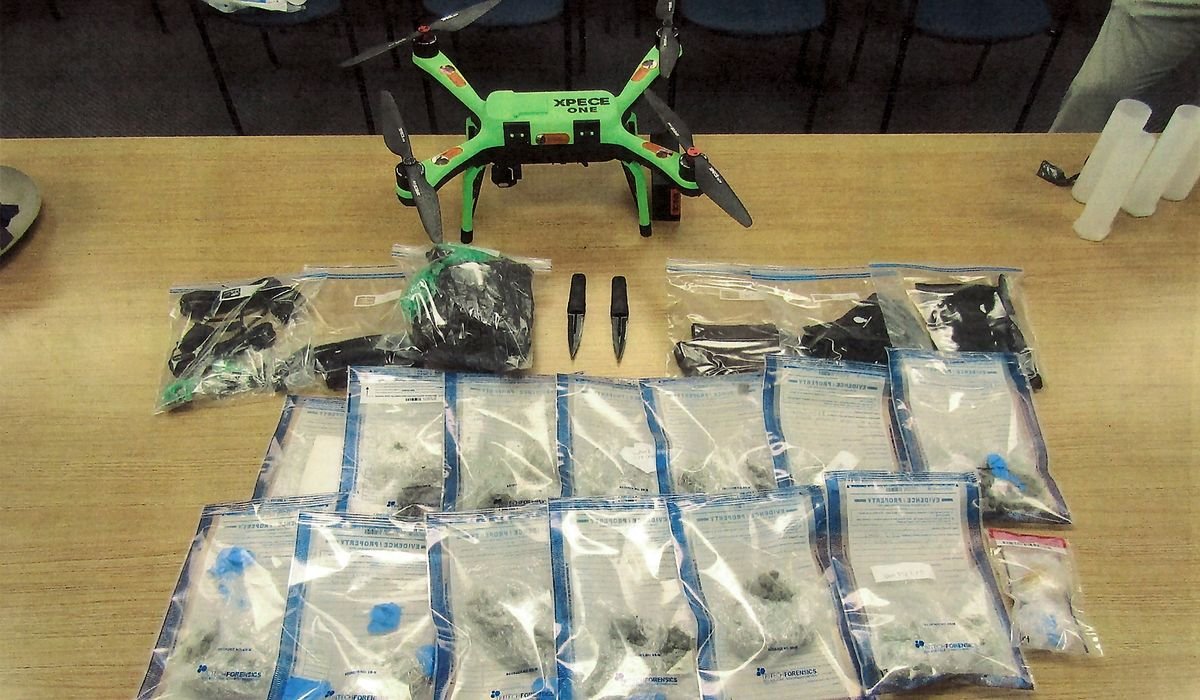
For America at large, the idea of delivering packages by drone is relatively new and exciting. For prison officials, however, it has long been a reality — and a dangerous one at that.
Smugglers have kept some prisons supplied with a steady stream of drugs, cell phones and, in some instances, escape tools such as saw blades.
Federal authorities struck back last week, busting what they said was the most sophisticated prison drone operation on record, charging a dozen people with smuggling into at least 10 federal prisons.
Drone smuggling at prisons, particularly in Georgia, has become so bad that the FBI’s special agent in charge of its Atlanta office said that on some evenings, prisons “looked like a small airport.”
“We are talking about supplies of drugs, cellphones, cigarettes, even blades that could be used as escape tools and weapons,” said Special Agent Marlo Graham, as she helped announce the new charges last week. “These items are going into the hands of murderers, violent gang members, con men and others.”
Prosecutors said Ira Chris Jackson, who also went by the nickname Action Jackson, kept a fleet of drones and worked out of a former daycare that the operation nicknamed “The Lab.”
Kenna Middleton and Jeff and Tysean Richardson were fingered as the drone pilots. Chrystal Dunn was identified as a lookout. Leviticus Blash was accused of traveling to prisons to orchestrate the drops. Xavier Maxwell is alleged to have managed the packaging of the contraband.
Lametheus Douglas, Robert Lee Whisby Jr., Aaron Hubbard and James Phillips, all inmates of various federal prisons, are charged with scheduling the drops at their prisons.
They used cell phones to call in the times and locations, prosecutors said.
The Lab was in Macon, Georgia, but the outfit’s reach extended from prisons in Louisiana to those in Virginia.
In one instance on Oct. 29, 2023, authorities say two drones buzzed the Federal Correctional Institution in Atlanta, roughly 20 minutes apart. Prison guards later found two black trash bags stuffed with cigarettes, cell phones and what the indictment called a “green leafy substance.”
Two months later, just after Christmas, a drone flew over Federal Correctional Institution Jesup, also in Georgia, and authorities say they found a bag with cell phones, cigarettes, lighters and saw blades.
Other times, authorities detected drones but never managed to find contraband from the drops. At still other times, the outfit managed to make drops undetected, according to authorities who pieced that together by comparing the operation’s logs and messages to the prisons’ own records.
Authorities revealed that the incursions they did spot were thanks to a “drone detection system” employed at prisons, which can not only detect intrusions but also record the drone’s make, model, ID number and information about the aircraft’s launch location and flight path.
Authorities traced five of the drones that infiltrated prison airspace back to the vicinity of The Lab, helping authorities connect the incursions to the operation.
All the drones used were manufactured by DJI, a Chinese firm.
The U.S., citing national security concerns about DJI and China, has imposed restrictions on importing new DJI drones, but millions of DJI aircraft already in the U.S. remain legal.
Prosecutors identified 38 separate incursions, but acknowledged there could have been others.
“This is the largest charge on an organization doing this activity in the history of the United States,” said Will Keyes, the U.S. attorney prosecuting the case.
Overall, the U.S. Bureau of Prisons recorded 479 drone incursions in 2024, up from just 23 in 2018. As of 2024, roughly half of federal prisons had drone detection systems.
State prisons face similar challenges, though national law gives U.S. officials specific authority to combat drones invading federal facilities.
DroneXL, a website that covers drone news, said the striking feature of the Georgia case is that the drones used were off-the-shelf.
“No exotic technology, no military-grade aircraft, just consumer drones flown well enough to beat the walls more often than not over nearly three years,” the site said.
The site said the scope of arrests shows the feds are taking the issue seriously, but also said prisons need authority to knock drones out of the sky.
That debate is happening in a number of spaces, including at the border and around major public events.
Among the 17 charges lodged against the Georgia group are smuggling into a prison, drug dealing, operating an unregistered drone, conspiracy to tamper with evidence, wrongful use of a communication device and illegal possession of a gun.
Prosecutors have sought to have the drones forfeited as proceeds of the smuggling operation. They’ve also asked a judge to forfeit a number of guns associated with the defendants.
While the drugs and blades are a problem for the prisons, the cell phones may be the biggest danger to the public.
In another scam, this one also run out of Georgia, drones dropped cell phones into a prison and inmates then used them to make scam calls impersonating local police, spoofing real police phone numbers, and demanding payments to avoid arrest.
Other members of the scam who weren’t behind bars would pick up the cash.
