
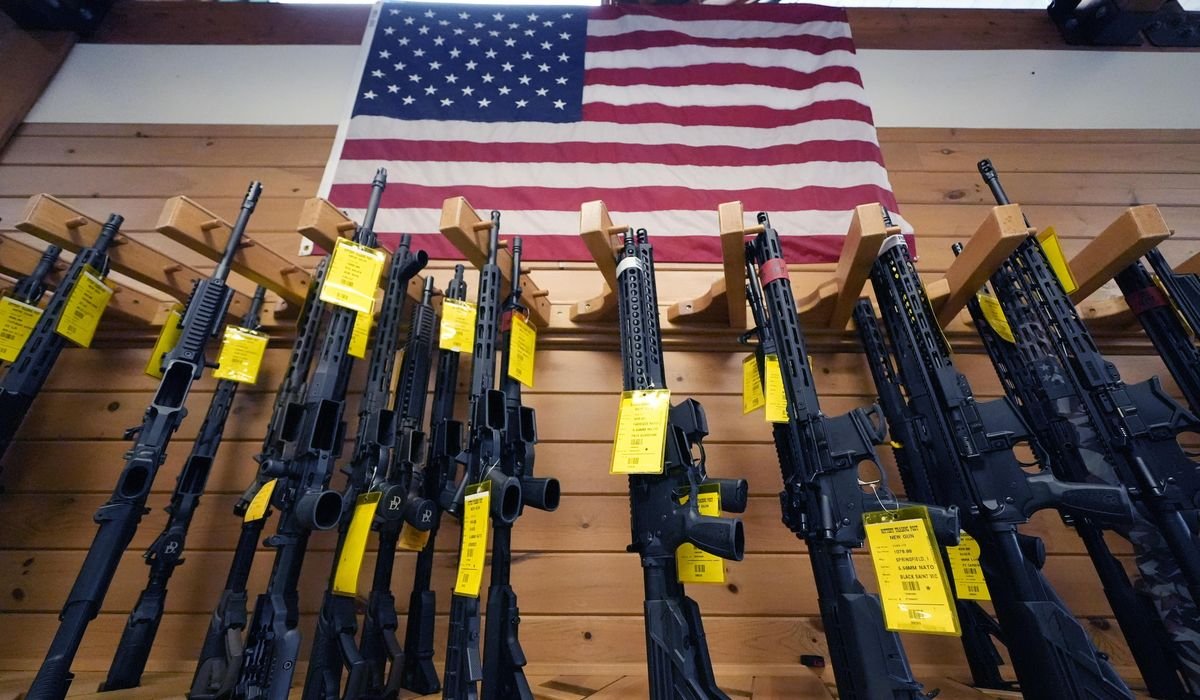
The Supreme Court said Tuesday it will hear cases challenging states’ bans on semiautomatic “assault weapons” such as the popular AR-15.
The justices agreed to take cases challenging bans in Illinois and Connecticut, though the eventual ruling would likely affect laws in a number of other Democrat-led states as well.
AR-15s and similar guns are the most popular style of rifle sold in America, making them a prominent target for gun control advocates — and a key test of the Second Amendment’s guarantee of a right to bear arms for self-defense.
The justices announced they would hear the cases the same day they released their final opinions for cases argued in their 2025-26 term. The gun cases will be heard in their next term, which starts in October.
A year ago, the justices rejected a similar case challenging Maryland’s ban on the AR-15.
At that time, Justice Brett M. Kavanaugh, a Trump appointee, said the court would have to reckon with the issue soon.
“Although the court today denies certiorari, a denial of certiorari does not mean that the court agrees with a lower-court decision or that the issue is not worthy of review,” he said in a statement. “Additional petitions for certiorari will likely be before this court shortly and, in my view, this court should and presumably will address the AR–15 issue soon, in the next term or two.”
Certiorari is a legal term for an appeal at the Supreme Court level.
Tens of millions of AR-15s are in circulation, and they’re legal in most states, which makes the states that do purport to ban them outliers.
AR-15s are semiautomatic rifles, which means each trigger pull fires a round. They are distinct from automatic rifles, or machine guns, where the weapon fires for as long as the trigger is pulled and there is ammunition to feed it.
Restrictions on automatic weapons have long been recognized, but semiautomatic weapons are a trickier matter.
Under the Supreme Court’s latest rulings, for gun restrictions to survive constitutional scrutiny, they must be the sort of laws that would have been countenanced by the founders.
Justice Clarence Thomas, who wrote the 2022 opinion laying out that test, said last year that it’s tough to square AR-15 bans with that standard.
He said AR-15s are quintessential “arms” as envisioned by the Second Amendment, and there’s no sense that the founders would have believed a ban on the most popular rifle in America was constitutional.
